Nauruans Tell U.N.
p. 29 · Read in the full issue
"We Want Independence"
The Nauru Council in April asked a UN Visiting Mission for independence for the island. It said the Nauruans were con vinced they would be happier with independence than ‘‘some people of the bigger nations who seem to be finding it difficult to achieve peace in their time”.
THE Council said Nauruans had had advisory powers for 37 years and now wanted a Legislative Council “with all possible speed”, to be followed, at the end of two years, with a review aimed at establishing independence.
It asked that meanwhile the UN organisation should advise on the whole problem of rehabilitating the island, and that it should send to the island experts to work in con junction with Australia on the problems of independence.
The UN Mission, led by Mr.
Andre Naudy, of France, was the same Mission that has been visiting New Guinea (see p. 21). It visited Nauru by air.
The Council supplied the Mission with a lengthy document outlining its views on resettlement, a Legisla tive Council, independence, re habilitation of worked out phosphate lands, and ownership of the phos phate deposits.
On the resettlement question it presented the entire history of negotiations, and complained that the phosphate industry owners (UK, NZ and Australia) “did not much care” about anything except the exploita tion of supplies for the benefit of their own agriculture.
Government Propaganda
On the breakdown of resettlement proposals, the Council said, “No doubt the Australian Government will say it is entirely our fault, and no doubt with their clever public relations no doubt people will believe them.”
The Nauruans said that “despite Government propaganda”, the main cause of the Nauruan problem was the destruction of the island by exploitation of the phosphate in dustry.
On the Legislative Council, the Nauruan submissions said there were 11 Trust territories when the Trusteeship Council started work and now there were only three, in cluding Nauru. The other eight had “now taken their places with the independent nations of the world” and the other two had attained legislative status.
“Only little Nauru is still being considered unsuitable and unfit yet for such level of government,” the Council added.
The Nauruans suggested a Legisla tive Council with the Administrator as chairman and a Nauruan majority, but with resettlement and phosphate matters to lie outside the Council’s jurisdiction.
The Council said the idea of independence for Nauru was not too “ridiculous, irrelevant or ambitious”.
It could be achieved with the UN’s help, with Australia’s, and “with assistance from nations willing to
afford us a friendly hand, preferably those countries near us, if they are so willing”.
The Nauru Council told the UN Mission that after 50 years half Nauru’s phosphate wealth had been carried away, with only slightly more than £AS 00,000 received in return. Had the Nauruans been “more kindly treated”, and given a more substantial return for their only national asset, the problems of the future would not be so frighten ing.
The Nauruans said they wanted complete ownership of the asset, so that “we might be enabled to obtain the best possible terms for our needs”.
They asked that meanwhile there be a slowing down of the rate of extraction (the BPC has proposed increasing the extraction rate to 2.5 million tons a year) or maintenance of it at its present rate of 1.6 million tons. This would have to be ac companied by a big increase in royalty payments to the Nauruans.
The Nauruans’ final submission was that Nauru must be fully rehabilitated with new soil shipped in, and the Council added: “We fully admit the fact that life will not be as good and as Western as it would have been had our proposal to resettle on a suitable island close to Australia not been rejected by that Government. We are prepared to suffer some in convenience to preserve our national identity.
“We are encouraged in this by the fact that neighbouring islands and peoples are managing to preserve theirs under other governments. The United Kingdom and the United States, who look after these peoples, have no designs to create situations for those peoples in which they will eventually be found unable to pre serve their national and racial identities,”
New Man In Vila
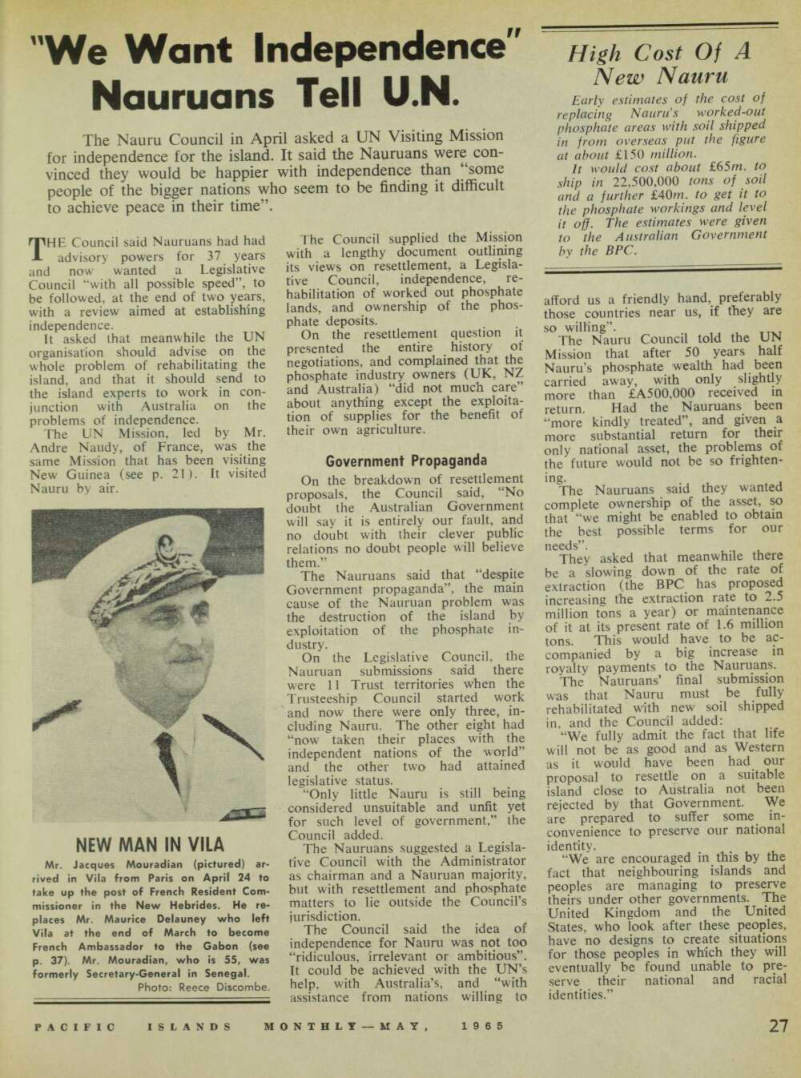
Mr. Jacques Mouradian (pictured) ar rived in Vila from Paris on April 24 to take up the post of French Resident Com missioner in the New Hebrides. He re places Mr. Maurice Delauney who left Vila at the end of March to become French Ambassador to the Gabon (see p. 37). Mr. Mouradian, who is 55, was
formerly Secretary-General in Senegal.
Photo: Reece Discombe.