Shooting Squabble
p. 18 · Read in the full issue
American Samoans
Not Amused At Pig
Long before Europeans en
tered the Pacific 450 years ago, the Polynesians were keepers of
pigs. Apart from dogs, pigs were
the only domestic animals they
had. Generally speaking, they
still are.
PIGS, therefore, are much more important to the Polynesians than any animal is to a European or an American.
So when, early this year, two Americans roamed across American Samoa’s main island of Tutuila shooting the villagers’ pigs with high powered rifles, the villagers took a decidely dim view of the affair.
The two Americans were Govern ment officials—one, James Sinks, being the Chief Sanitation Officer; the other, Dan Eastman, being Public Safety Commissioner.
Sinks and Eastman shot the villagers’ pigs after pleading with them to put the pigs in pens.
“Nobody wants to shoot pigs,”
Sinks told the Press in late February, “but you have to look at it the other way, too. You have to prevent diseases. There were at least 2,000 cases of scabies in the last few years.”
The villagers protested to the Government, but the Government did nothing and the shootings went on.
About 200 pigs had been shot before news of the massacred pigs reached Washington—and, in par
ticular, the ears of Mr. George A.
Wray, an attorney, who won the respect of Samoans in Pago Pago last year for defending a man who allegedly threatened to shoot Gov ernor H. Rex Lee.
Mr. Wray, who had also been hired to go to Pago in March to act as counsel to majority members of the territory’s legislature, sent word to Pago that, in his opinion, the pig shooting was unlawful, unless it had been legally determined that the animals had been allowed to run loose.
At the same time, Messrs. Sinks and Eastman were warned that moves would be made for their arrest if they continued shooting pigs.
Mr. Eastman resigned from his job soon after this, but Mr. Sinks stayed on.
It was not long before American Samoa’s Senate demanded his resignation, too.
With the help of Attorney Wray, who was now in Pago, the Senate prepared a long, legalistic resolution calling on Governor Lee to ask Mr.
Sinks to resign at once, otherwise the Senate’s confidence in the Ad ministration would be at stake.
The Senate also resolved to use the full extent of its powers to pro vide “reparation in money” for those villagers who had been “un lawfully deprived of their property by acts of their Government”.
Later, majority members in the House of Representatives introduced an amendment to an Administration bill to increase customs duties on luxury items so that the first $6,000 collected by the Government could be set aside as a special reparations fund for the affected villagers.
Amendment Disappears
The amendment was translated and stencilled, but when members next asked to see it, they were told it had disappeared.
However, a few days later —much to their amazement —Speaker Ma’o introduced a bill which appeared to be the same as their amendment— except that it proposed that money for pig reparations should be raised by an amusement tax rather than by customs duties.
Specifically, Speaker Ma’o wanted an additional five-cent tax on all theatre tickets until the money was raised.
In subsequent discussions, mem bers rejected the idea of an amuse ment tax because, they said, the children of the territory—in going to the movies—should not have to pay for the government’s folly over the pigs.
As for their own proposal to in crease customs duties to pay for the pigs, this finally lapsed through lack of time to consider it.
So the owners of the 200 pigs killed by Messrs. Sinks and Eastman are still awaiting reparations; Mr.
Sinks is still Chief Sanitation Officer; and the Senate, presumably, has lost confidence in the Administration.
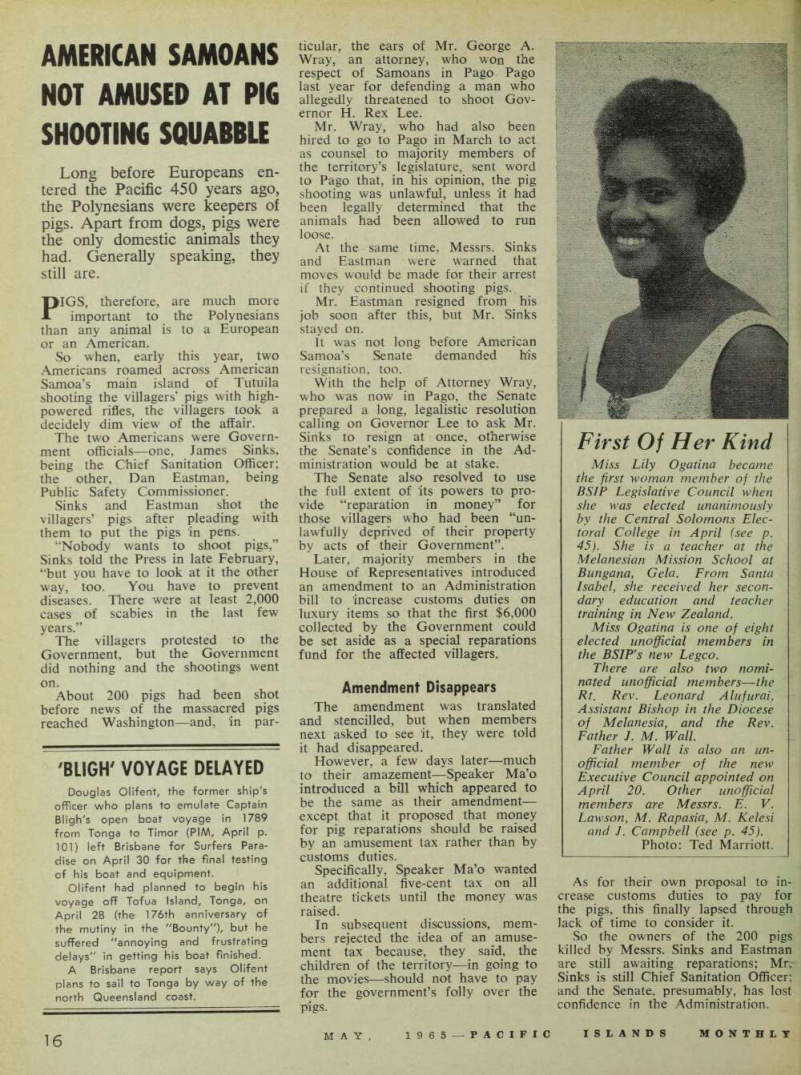
First Of Her Kind
Miss Lily Ogatina became the first woman member of the BSIP Legislative Council when she was elected unanimously by the Central Solomons Elec toral College in April (see p. 45). She is a teacher at the Melanesian Mission School at Bungana, Gela. From Santa Isabel, she received her secon dary education and teacher training in New Zealand.
Miss Ogatina is one of eight elected unofficial members in the BSIP’s new Legco.
There are also two nomi nated unofficial members—the Rt. Rev. Leonard Alufurai, Assistant Bishop in the Diocese of Melanesia, and the Rev.
Father J. M. Wall.
Father Wall is also an un official member of the new Executive Council appointed on April 20. Other unofficial members are Messrs. E. V.
Lawson, M. Rapasia, M. Kelesi and J. Campbell (see p. 45).
Photo: Ted Marriott.