Showdown
pp. 15-17 · Read in the full issue
Soon On
Nauru’S
Future
By Stuart Inder.
A new phase—a phase close to being a showdown— has been reached in the growing problem of the diminishing phosphate island of Nauru. A series of talks, expected to con tinue in June, should result in a course to be followed by the 2,700 islanders who live on Nauru, which is administered by Australia under a UN trusteeship.
THE series began in Canberra in April when members of the UK, NZ and Australian Governments met in an effort to get their ideas straight on future political and economic moves on Nauru. The trusteeship is shared by the three countries which between them market Nauru s phosphate through the British Phosphate Commissioners.
Following this April meeting a UN Mission headed by Mr. Andre Naudy, of France, visited Nauru, and the Mission will present a report to the UN at the end of May, which will be discussed by the Trusteeship Council in June.
Following this UN discussion there will be a full meeting in Canberra between the Australian Government and the Nauruans, led by Head Chief Hammer Deßoburt.
This will be the showdown meeting. The agenda includes a discussion on the future political status of Nauru, including the possibility of independence; phosphate royalties; and the ownership of the rich deposits.
The Nauruans will be supported at this vital meeting by a Sydney firm of economic advisers, who have prepared a detailed case for a greater Nauruan share of the phosphate wealth.
The whole operations of the BPC monopoly will be under strong attack, and the Nauruans appear determined to achieve their demands.
Unless something is worked out in
June the whole Nauruan question will develop quickly into an inter national rumpus, with strong pressure being brought to bear by the Asian bloc, and with the UN Committee on Colonialism becoming involved, Alread the Nauruans have asked the UN thro h the visiting Mission in April> for UN i nterve ntion to (a) examine the whole problem of re habilitating the island and to (b) send to the island “competent experts” to work on problems con nected with “the wish of the Nauruan people to achieve independence”, ...
B,tter A,,e g atlons Thus, what started out 15 years ago as an unhurried search by the Australian Government for a new home for the Nauruans has now de yeloped into a Nauruan demand for '"dependence, and bitter allegations
colonialism and. exploitation .
ee re P° rt on UN visit p. 27.) The Australian Government’s view is that it does not intend to be panicked into any hasty decisions be cause of this new change of pace, At the same time Australia is going to have to be very careful in deed if it is to avoid allegations that its only real concern is to protect the interests of the BPC. Already there are indications that Australia persists in taking a much harder line than either the UK or NZ and that at their April meeting the three Powers
were not by any means in full agree ment about what should be done to meet the Nauruan demands.
It’s all a far cry from those early stages of the search for a new home, when the Australian Government thought the problem of dealing with 2,700 Nauruans wasn’t very difficult!
Time has shown clearly that the Nauruan views are dictated by much stronger feelings of nationalism than most people gave the Nauruans credit for.
This insistence on maintaining their identity resulted in their rejection of the £ll million resettlement scheme on Curtis Island, a stone’s throw from the Queensland coast, with their own commercial fishing industry. The flaws were that the scheme did not give them sovereign rights, and they would have had to become Australian citizens (at present they are Aus tralian Protected Persons).
After their final rejection of the scheme last August the Nauruans said they had decided to remain on Nauru, and they asked that a Legislative Council be established in 1965 and that they be given independence by 1967. They also asked for increased phosphate royalties and for transfer of the industry to them.
The Government remained hopeful that the Nauruans would change their minds, but on April 1 this year, in Federal Parliament, the Australian Minister for Territories, Mr. C. E.
Barnes, announced that since the
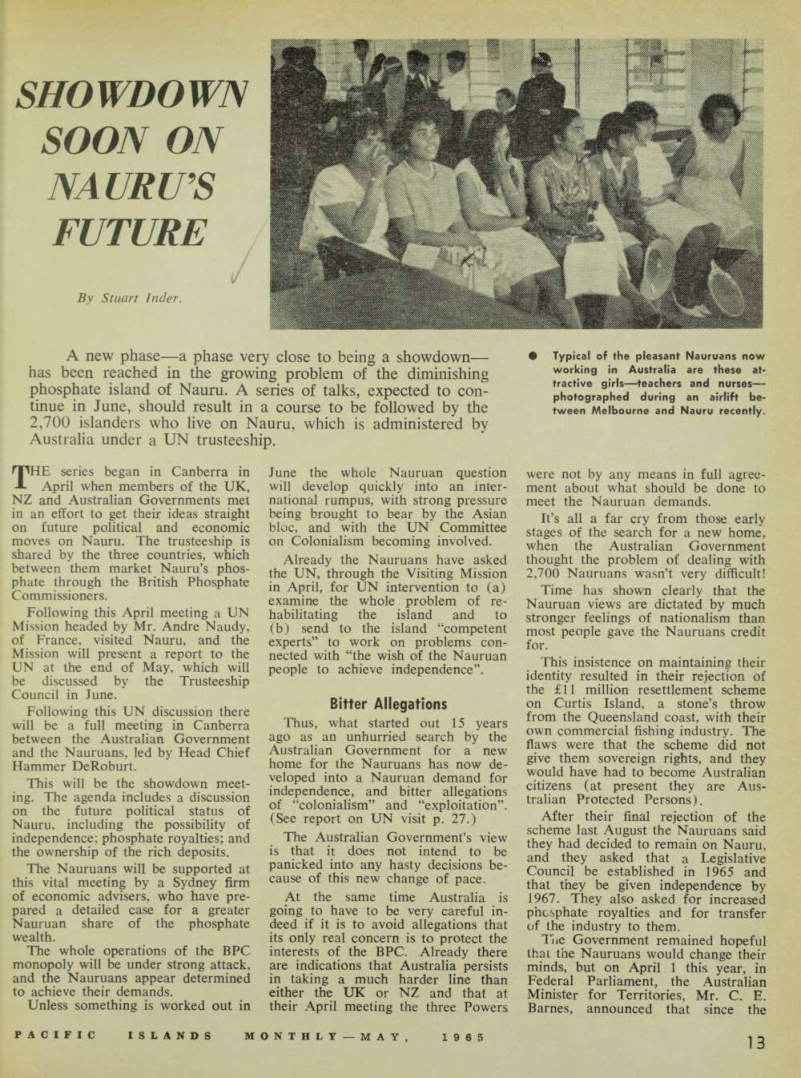
• Typical of the pleasant Nauruans now working in Australia are these at tractive girls—teachers and nurses— photographed during an airlift be tween Melbourne and Nauru recently.
Nauruans were maintaining their attitude the Curtis Island scheme would be dropped.
He said the Government had no other specific resettlement proposals before it, but added that he thought resettlement was best, in view of the “inevitable growth in Nauru’s popu lation, the high standard of living enjoyed by the Nauruan people, the small size of Nauru and the limita tions of its natural resources other than phosphate”.
This, too, was the view of the 1962 UN Mission to Nauru led by Sir Hugh Foot, although what the Naudy Mission thinks remains to be seen.
Single Community
The Foot report said, “It must be finally accepted that the Nauruan community cannot continue on Nauru when the phosphate deposits are exhausted”. But the Mission doubted whether an island home offered the best solution, as the Nauruans were neither farmers nor fishermen, and it was more than doubtful “whether they could happily survive even on an island of tropical fertility”.
The Foot Mission therefore pro posed that Australia establish the Nauruans in a single community in Australia, within easy reach of some main centre. This in fact is what Australia attempted to do with the Curtis Island scheme—now rejected by the Nauruans for reasons ap parently not foreseen by the Foot Mission.
An important consideration, to the Nauruan mind, which is operating now and which wasn’t so vital in 1962 when the Foot Mission made its survey, is the question of time.
The Nauruans in 1962 certainly felt that there had been too much delay by Australia in attempting to solve their problems, but today they have almost convinced themselves that the delay is deliberate and that Australia is attempting to hold up a solution in its own interests.
The Nauruans know very well— it was one of the main points made in April to the Naudy Mission—that phosphate is their only card to bar gain with. With that gone they lose their present position of strength, and therefore they have no intention of letting the situation drift on while the BPC continues to remove phosphate at the rate of more than 1,600,000 tons a year.
Which is one of the main reasons why the Nauru Council wants to make the Canberra meeting in June something of a showdown.