Mr. Patel And Friends Say:
pp. 13-14 · Read in the full issue
" We Don't Wanna Play !"
From a Suva Correspondent Mr. A. D. Patel, Indian political leader and stormy petrel of Fiji politics, in Suva in April touched off an explosion whose reverberations have rocked the foundations of racial harmony in the British Colony.
HE told about 600 supporters gathered in the Century Theatre that, in effect, there was no hope for Fiji until they got rid of the Euro peans.
He followed up this bombshell some days later by announcing that he would not discuss his views on Fiji’s political future with his fellow members of the Legislative Council until he got to the London consti tutional conference on Fiji, which is set down for July. What he had to say he would say at the conference.
The reaction to these events have been such that the London confer ence may well have little hope of suc cess. There has been a split between Patel’s Indian forces on the one hand and the Fijians, Europeans and anti- Patel Indian forces on the other. And this makes it very difficult for unanimity to be achieved at the con ference.
Translations Challenged
Ambalai Dahyabhai Patel is the member for Social Services in the Fiji Government (a sort of shadow Cabinet Minister) and president of the Indian Federation Party, which has support in the canefields. His views can hardly be overlooked.
It is possible he meant his words on the Europeans to be heard by his friends only and was surprised at their wide circulation. Certainly he has at tempted to challenge the published translations, although in vain, be cause the reports were clear enough.
They were published first in his own mouthpiece, Jagriti.
According to the translation of the speech, Mr, Patel said that “until Fiji is in the hands of only the two major races, Fijians and Indians, the situa tion in the Colony will remain as it is”. He added: “Under the present circumstances, these two races will have to break whatever barriers there are between them and draw closer together. This is not an easy thing to achieve as there is another race trying to sep arate the two for its own ends.”
His words were hardly conducive
to encouraging the European mem bers of the Legislative Council to work with him in the search, with the Fijians, to find a formula to be taken to London for Fiji’s future peace. But worse was to come.
Up to this time there seemed to be a bright hope that the 18 unofficial members of the Legislative Council (six Indians, six Fijians, six Euro peans), all of whom are going to London, would beforehand reach general unanimity on what should be sought from the Colonial Office. The Fijians had achieved a notable suc cess by having the question of land divorced from the London proceedings (see p. 57) and the European mem bers had finally come out with a lengthy, restrained statement on where they stood. (Basically, they want as much of the status quo as is needed to protect the Fijian and European rights against extremist demands of the ever-growing Indian community—see panel, next page.) All unofficial Legco members were due to have another meeting in Suva on April 26 to discuss constitutional matters. This was the day of the arrival from London of Mrs. Eirene White, Parliamentary Under-Secretary of State for the Colonies, who came to Fiji for a week to learn the views of unrepresented groups on consti tutional matters.
Annual Meeting
But on April 25 the Federation Party held its annual meeting at Lautoka, after which it was unex pectedly announced that the four un official Indian members of the Legis lative Council who are in the Federa tion group—Messrs, Patel, S. M.
Koya, J. Madhavan and C. A. Shah —should not hold any discussions on constitutional matters with other members of the Legislative Council, but should present their views in London. The meeting re-elected Mr.
Patel as president, and elected the others to various positions.
One of the resolutions passed at the conference said it was “inconceivable” that any good purpose would be
served by holding any further dis cussions in Fiji.
The meeting resolved, among other things, that “certain vested interests and organisations in Fiji, in particular The Fiji Times, the Government Public Relations Office and the Fiji Broadcasting Commission, have in the past deliberately published distorted news concerning the proposed consti tutional changes for Fiji, concerning inter-racial harmony in Fiji and con cerning the political rights and views of the Indians in Fiji.”
Other resolutions in the same vein attacked those groups for having “deliberately created animosity and an atmosphere of mistrust.” The PRO was accused of having “intentionally and deliberately” distorted Mr, Patel’s Century Theatre address.
The meeting said it had the fullest confidence in Messrs. Patel, Shah, Madhavan and Koya to present the
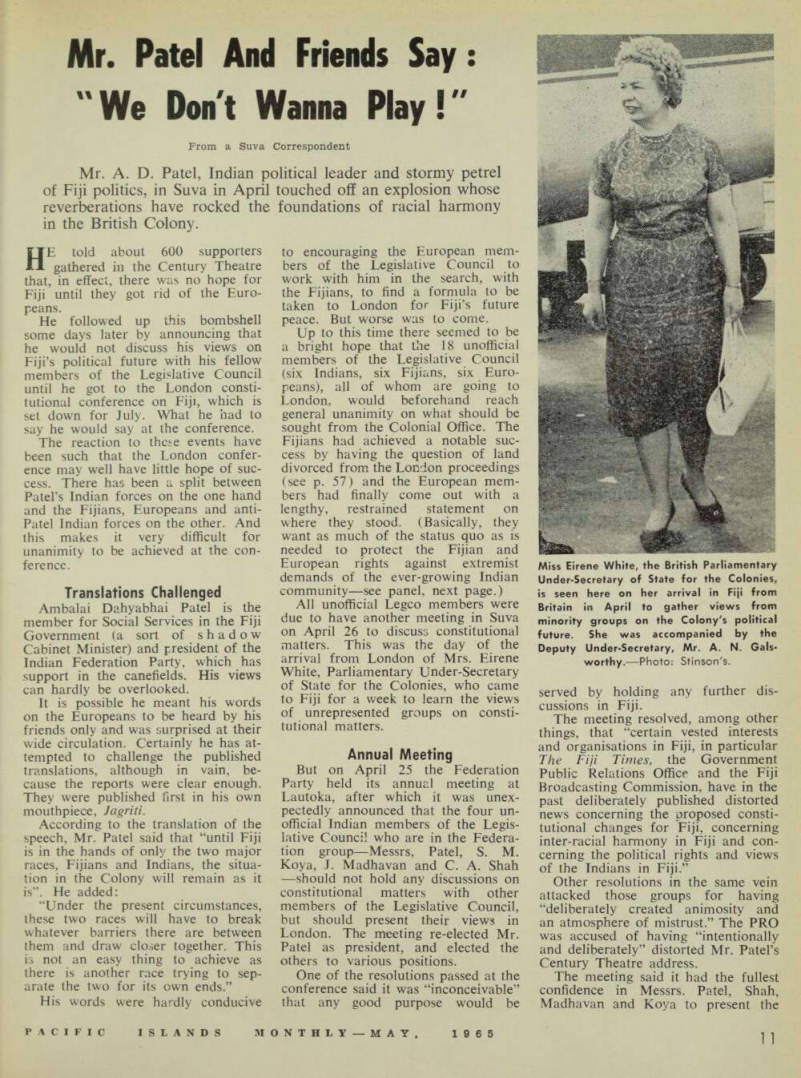
Miss Eirene White, the British Parliamentary Under-Secretary of State for the Colonies, is seen here on her arrival in Fiji from Britain in April to gather views from minority groups on the Colony's political future. She was accompanied by the Deputy Under-Secretary, Mr. A. N. Gals
worthy.—Photo: Stinson's.
Indian community’s case in London and empowered them “to make all such representations and submissions which they may think fit and proper in their absolute discretion”.
In other words, they were issued with a blank cheque to speak for “all” the Indians of Fiji. The next day Mr.
Patel began writing on the cheque.
He turned up at the meeting of the unofficial members of the Legislative Council, together with his three sup porters, and read a statement advocat ing introduction of a common roll.
He said a common roll would “encourage citizens to form political parties along national lines,” but a communal roll stood for divided loyalties.
The four members then confirmed that they had been “directed” by tJie annual meeting of the Federation Party not to hold any further dis cussions in Fiji, and they left.
The remaining Legco members, now irate, decided that further meet ings should be held in future by the six Fijians, the six Europeans and the two Indian members who are not Federation supporters—Messrs. A. I.
N. Deoki and C. P. Singh.
They would attempt to prepare a considered policy for London.
There is an uneasy feeling in Suva that malign influences. are at work, and that trouble has been deliberately created, based on racial grounds, while Mrs. White is in Fiji so that political advantage can be reaped from the publicity.
There is also a feeling that too many high officials have been bend ing over backwards to let Mr. Patel have the reins, on the assumption that he is just a poor, misunderstood fellow who can’t get a fair go.
There are those who believe that from the very first Mr. Patel has had no intentions of reaching agreement with the British Government and with other Fiji representatives on the Colony’s constitution.
He knows, of course, that neither the Fijians nor the Europeans would agree to a common roll, because this would give political control to the Indians, who are half the population.
There are those who believe that Mr. Patel will never be satisfied with any plan which does not give com plete independence to Fiji, with him self heading the independent Govern ment as the South Pacific lagan.
How many Indians will go along with Mr. Patel in the sentiments ex pressed on the stage at the Century Theatre? The Indian community is hopelessly divided, and whatever Mr.
Patel and his propagandists may claim, the majority of Indians in Fiji do not support the Federation Party.
The Indian Association of Fiji, the farmers’ associations of the Kisan Maha Sangh and the Kisan Sangh, which embrace the greatest number of farmers, are all uncompromisingly opposed to Mr. Patel and his party.
The Muslims also are now campaign ing for separate representation.
Mr. Patel, born at Mahij, India, 60 years ago, was interned in Fiji under the defence regulations between 1942 and 1944. Many Indians have not forgiven him—let alone the Fijians— for his leadership of the disastrous strike in the canefields in 1960, out of the welter and skullduggery of which the Federation Party was born.
But what will London know of this?
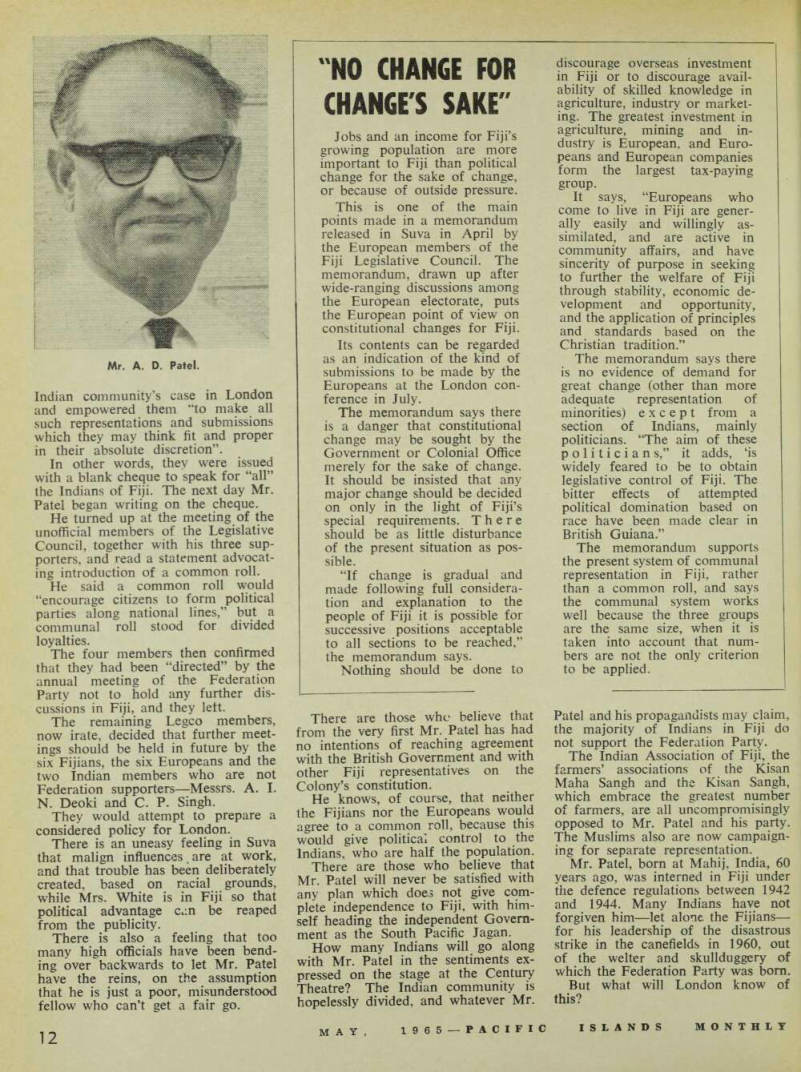
Mr. A. D. Patel.