Pacific Commerce and Produce
pp. 133-137 · Read in the full issue
Australian Trade
Drive To SIN Pacific
Begins In May
More than 80 companies are expected to book display space in the Australian trade ship Slet holm, which will leave Sydney for the Western Pacific on May 4. The Sletholm will attempt to improve Australian trade figures in Papua-New Guinea, the British Solomons, New Hebrides, New Caledonia, and Fiji.
SINCE the announcement of the ship’s visit there has been com ment in Western Samoa and Tonga suggesting that the vessel should also visit those territories, but the fact is that Australian performance on that side of the Pacific is better than in the Western Pacific, where there has been a steady increase in the purchase of goods from Japan and Asia. This is why the May drive intends to concentrate on the West.
Australia’s income from the Western Pacific has shown a steady increase in recent years but this is merely a reflection of the market growth, and Australia obtains about only 36 per cent, of the business available in the Western Pacific.
Ports of call for the Sletholm will be Port Moresby, May 11-15; Lae, May 18-20; Madang, May 21-23; Rabaul, May 25-27; Honiara, May 30-June 1; Vila, June 4-5; Lautoka, June 7-8; Suva, June 8-11; and Noumea, June 14-17.
Company representatives will not sail with the Sletholm but will fly ahead of the ship and meet it in each port. Within New Guinea the businessmen will be travelling by DC3, but from Honiara, through the New Hebrides, Fiji and New Caledonia, they will travel in a chartered DC4.
The exhibition has been sponsored and organised by Australian Export Promotions in conjunction with the Australian Department of Trade.
AEP is a non-profit company, formed by the Associated Chambers of Manufactures of Australia and the Associated Chambers of Commerce of Australia, to undertake export promotion ventures for Australian products overseas. The Sletholm has been chartered from the Karlander NG Line.
Some Hints For
"Sletholm" Visitors
A PORT MORESBY correspondent reports that many Territory businessmen are ready to give Aus tralian exporters visiting P-NG with the Sletholm first hand information about at least one of the reasons why the Australian share of the New Guinea market has been dropping.
They say it is because of insufficient care by Australian businessmen in providing quotes.
One Territory importer says: “Frequently you send to Australia inquiring about goods and your letter doesn’t get answered. You chase them up a second time and finally you get back a pretty vague acknowledgement giving you half the information you want. And the quote is usually FOB anyhow. I have known Australian exporters to be rude in replying to orders—adopting a take-it-or-leave-it attitude.
“While this sort of thing is going on in Australia, the Japanese and
Hong Kong Chinese exporters are right on the ball. Send an inquiry to them and back comes an im mediate letter confirming your in quiry, giving full details of the goods, with shipment dates, and frequently even naming a vessel.
They quote CIF and if they have to quote FOB they give shipping measurements so that freight can be calculated.
“With this kind of service it is simply a matter of wiring your ac ceptance in a couple of words and your business is done.
“It’s time that many Australian manufacturers woke up to the fact that competition is hard in New Guinea these days and that the company that gives the service gets the order.”
P-NG traders also point out that many Australian manufacturers treat New Guinea as a domestic market instead of formulating a special export price. Most other countries, on the other hand, set a special price for New Guinea—and especially so if they are attempting to break in.
New Guinea importers suspect that some of Australia’s big firms do formulate special prices for Fiji and some of the eastern Pacific territories, but do not give New Guinea the advantage of them.
The agency situation is also an occasional bone of contention in the Territory. Smaller trading firms say the big Territory stores hold too many agencies for Australian goods.
They claim that manufacturers would frequently sell more goods if the agency were given to a smaller organisation ready to concentrate on pushing a particular line. They say that if the line is a good one the big stores would have to stock it anyway.
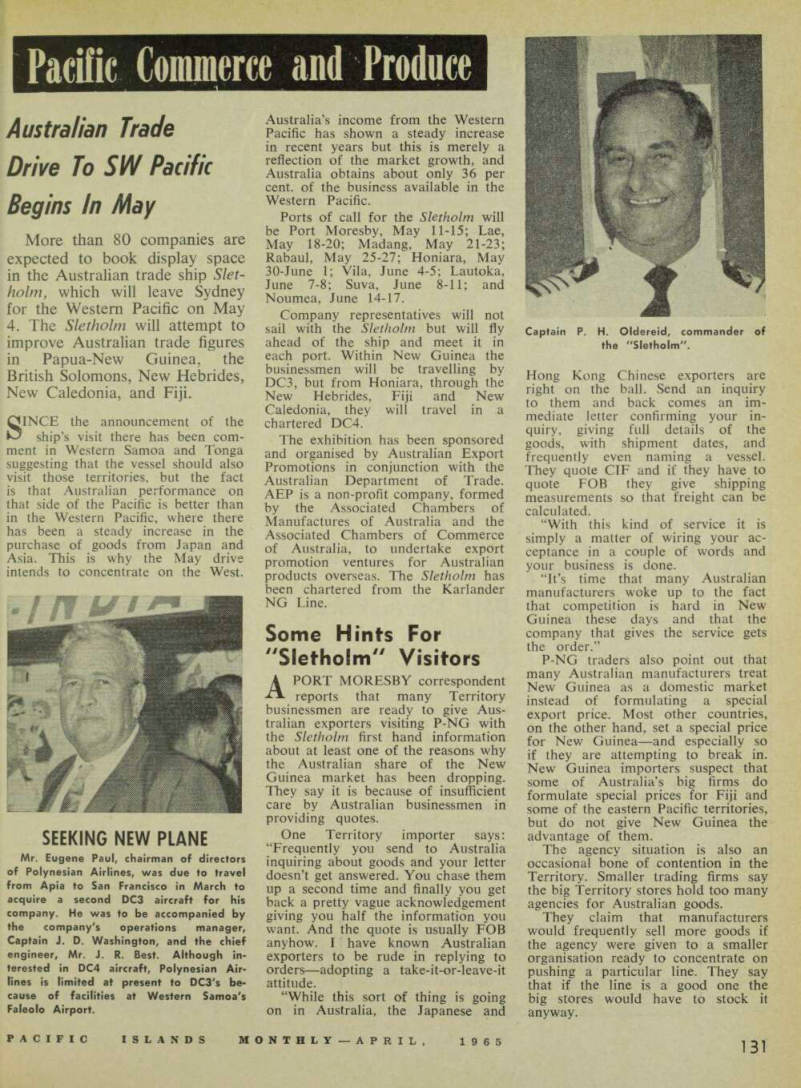
Seeking New Plane
Mr. Eugene Paul, chairman of directors of Polynesian Airlines, was due to travel from Apia to San Francisco in March to acquire a second DCS aircraft for his company. He was to be accompanied by the company's operations manager, Captain J. D. Washington, and the chief engineer, Mr. J. R. Best. Although in terested in DC4 aircraft, Polynesian Air lines is limited at present to DC3's be cause of facilities at Western Samoa's Faleolo Airport.
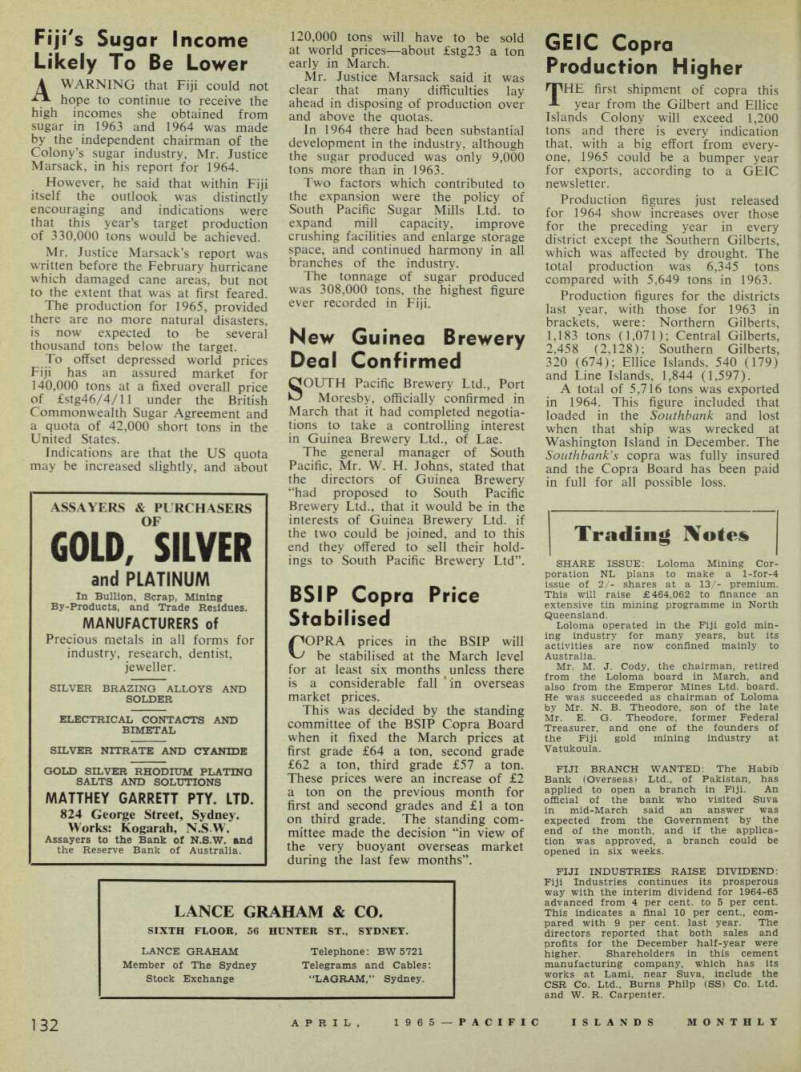
Captain P. H. Oldereid, commander of the "Sletholm".
Fiji's Sugar Income
Likely To Be Lower
A WARNING that Fiji could not hope to continue to receive the high incomes she obtained from sugar in 1963 and 1964 was made by the independent chairman of the Colony’s sugar industry, Mr. Justice Marsack, in his report for 1964.
However, he said that within Fiji itself the outlook was distinctly encouraging and indications were that this year’s target production of 330,000 tons would be achieved.
Mr. Justice Marsack’s report was written before the February hurricane which damaged cane areas, but not to the extent that was at first feared.
The production for 1965, provided there are no more natural disasters, is now expected to be several thousand tons below the target.
To offset depressed world prices Fiji has an assured market for 140,000 tons at a fixed overall price of £stg46/4/l 1 under the British Commonwealth Sugar Agreement and a quota of 42,000 short tons in the United States.
Indications are that the US quota may be increased slightly, and about
120,000 tons will have to be sold at world prices—about £stg23 a ton early in March.
Mr. Justice Marsack said it was clear that many difficulties lay ahead in disposing of production over and above the quotas.
In 1964 there had been substantial development in the industry, although the sugar produced was only 9,000 tons more than in 1963.
Two factors which contributed to the expansion were the policy of South Pacific Sugar Mills Ltd. to expand mill capacity, improve crushing facilities and enlarge storage space, and continued harmony in all branches of the industry.
The tonnage of sugar produced was 308,000 tons, the highest figure ever recorded in Fiji.
New Guinea Brewery
Deal Confirmed
SOUTH Pacific Brewery Ltd., Port Moresby, officially confirmed in March that it had completed negotia tions to take a controlling interest in Guinea Brewery Ltd., of Lae.
The general manager of South Pacific, Mr. W. H. Johns, stated that the directors of Guinea Brewery “had proposed to South Pacific Brewery Ltd., that it would be in the interests of Guinea Brewery Ltd. if the two could be joined, and to this end they offered to sell their hold ings to South Pacific Brewery Ltd”.
BSIP Copra Price
Stabilised
COPRA prices in the BSIP will be stabilised at the March level for at least six months unless there is a considerable fall ‘in overseas market prices.
This was decided by the standing committee of the BSIP Copra Board when it fixed the March prices at first grade £64 a ton, second grade £62 a ton, third grade £57 a ton.
These prices were an increase of £2 a ton on the previous month for first and second grades and £1 a ton on third grade. The standing com mittee made the decision “in view of the very buoyant overseas market during the last few months”.
GEIC Copra
Production Higher
THE first shipment of copra this year from the Gilbert and Ellice Islands Colony will exceed 1,200 tons and there is every indication that, with a big effort from every one, 1965 could be a bumper year for exports, according to a GEIC newsletter.
Production figures just released for 1964 show increases over those for the preceding year in every district except the Southern Gilberts, which was affected by drought. The total production was 6,345 tons compared with 5,649 tons in 1963.
Production figures for the districts last year, with those for 1963 in brackets, were: Northern Gilberts, 1,183 tons (1,071); Central Gilberts, 2,458 (2,128); Southern Gilberts, 320 (674); Ellice Islands, 540 (179) and Line Islands, 1,844 (1,597).
A total of 5,716 tons was exported in 1964, This figure included that loaded in the Southbank and lost when that ship was wrecked at Washington Island in December. The Southbank's copra was fully insured and the Copra Board has been paid in full for all possible loss.
New Fiji Newspaper
Company
A COMPANY registered at Suva in March plans to carry on business as newspaper proprietors and publishers, etc. The company is the Pacific Daily Ltd.
The nominal capital is £lO,OOO in £1 shares.
The shareholders are all from North-West Viti Levu, and are: H. M. Lodhyia, accountant, Nadi; Chinnaiya, cultivator, Nadi; Shan karbhai, merchant; Sarju Prasad, merchant, Cuvu; H. K. Patel, merchant, Sigatoka; H. Khan, culti vator; C. A. Patel, merchant, Lautoka; Kallappa, cultivator, Lovu, Lautoka; K. S. Jaswal, merchant, Tavua; M. T. Khan, solicitor, Tavua; R. D. Patel, solicitor, Ba; Dr. M. S.
Amin, medical practitioner, Ba; R. C. Patel, merchant, Ba; P. Patel, director, Ba; K. Naidu, cultivator, Sigatoka; Narayan, cultivator, Nadi.
The witness of the signatures was Swami Rudrananda, monk, of Nadi.
BSIP Rice Trials
Encouraging
THE Commonwealth Development Corporation has completed its second season of wet rice trials in the BSIP at Ilu, Guadalcanal. The yields obtained were most en couraging.
Approximately 83,000 lb of paddy, or between 30 and 40 tons, were harvested from 26 acres, which is an average yield per acre of 3,200 lb.
Six acres were partially abandoned owing to wet weather in January.
The CDC representative in the Solomons, Mr. R. H. W. Johnson, said recently that control of insect pests had proved to be the most serious problem in the rice trials so far, and further research was needed to find out the best method of control.
The CDC sold its first five tons of soya beans last month on the Australian market.
Trials of wet and dry rice and soya beans will be continued this year.
Inquiry Into P-NG
Coffee Industry
THE Australian Tariff Board will open a public inquiry on April 22 into possible protection for the Papua-New Guinea coffee industry.
Under the terms of reference the board will be required to bear in mind: The Commonwealth’s re
sponsibility for P-NG; and the effect ot imports of coffee on sales in Australia of coffee produced in P-NG.
If the board finds for assistance through Customs tariff, it will be required to suggest the rate of duty.
The board will comprise Messrs.
G. F. Gill (sitting member) and E J L Tucker (member).
Evidence will be given on oath.
Hearings will be held in Dalton House, Sydney, on April 22 and June 10, and at Port Moresby and Goroka in the week beginning on
M ? y i O, ,
In Goroka on March 16 the chairman of the P-NG Coffee Marketing Board, Mr. A. L. Hurrell, said the inquiry was of vital interest to the coffee industry. A share of the Austrahan market had to be retained by P-NG because of the limit on non- Australian imports imposed by the International Coffee Agreement and the fact that current and future crops will exceed this limit.
He said the 1962 Tariff Finding provided an incentive, which had proved effective, for 30 per cent, of the Australian requirement to be purchased from P-NG.
The P-NG Board was making detailed studies of ways to improve marketing and had directed its new executive officer, Mr. N. Bluett (who
assumed duties in February) to take all steps necessary Mr. Hurrell added that Mr.
Bluett’s arrival coincided with the Board’s need to prepare a well docu mented case to present to the Tariff Board inquiry.
StOck-BreedlM PlotlS
i ji UL J
’** Ing «Mgw Rigdmdgs
fpHE Condominium Agricultural Department in the New Hebrides recently imported six beef short-horn heifers, one Illawarra bull, and two Illawarra heifers. The short-horns are to form the basis of a beef cattle herd which will breed stock for sale At first heifers, and later—as the herd increases—young bulls will be sold to improve other herds of cattle in the New Hebrides. The Illawarra cattle are being reared for the dual purpose of giving both beef and milk, To establish a pure-bred flock of sheep the Agricultural Department has imported six Corriedale sheep— five ewe lambs and one ram lamb, Initially, only the surplus rams wili be sold, but when the flock has grown ewes will also be offered for sale.
About half a dozen flocks of sheep are kept on plantations in the New Hebrides; the two largest are on Efate.
Big Jap. Interest
In Timber Co.
THE New Guinea Lumber Develop ment Co, Ltd., of Rabaul (a joint Australian-Japanese venture) has acquired a 55 per cent, interest in Thompson and Wright Ltd,, an Australian company which has been exporting timber from the Cape Hoskins area of New Britain since 1960.
New Guinea Lumber Development is a subsidiary of the Southern Trade and Industry Co. Ltd., of Tokyo, which, in turn, is a subsidiary of the Japan Line, established in April last year through the con solidation of Nitto Shosen and the Daido Line.
Thompson and Wright is a partly owned subsidiary of Clarke Bros.
Holdings.
Mr. Max Wright, the company’s managing director, told PIM in March that the company hoped soon to be exporting three million super feet of logs a month from the Cape Hoskins area. All of the timber would go to Japan.
“We will have a staff of about 15 Europeans and 150 New Guineans getting the timber away,” he said.
“Three Japan Line ships, the Shinkai Maru, Shinei Maru and Austral Maru will carry the timber to Japan. Two of the three will call at Cape Hoskins each month.
“Meanwhile, our sawmill will be expanded to increase our production of sawn timber for the local trade.
Machinery for the mill is due from Japan in late March,”
Fishing Plan
For Papua
A BRISBANE businessman hopes to set up a £250,000 fishing industry in Papua-New Guinea employing Japanese labour and capital, accord ing to AAP-Reuter.
The businessman, Mr. Angelo A.
Efstathis, has been surveying the fish ing potential of Territory waters for the past few weeks.
If he gets approval from the Aus tralian Government Mr. Efstathis plans to bring three 60-ft Japanese fishing trawlers to work in Papua’s Gulf District.
The boats would be manned entirely by Japanese crews, who would live on board while in Territory waters.
Mr. Efstathis says 45 per cent, of the capital invested in the venture would be Japanese.
He hopes to build wharves in Port Moresby and freezing and processing sheds for the catch, and later a cannery.
New Hopes For
VoilikorO S Kauri
THE BSIP’s Chief Forestry Officer, Mr. K. W. Trenaman, who visited Vanikoro from February 23 to March 2 said in Honiara in mid- March that he hoped it might be possible to arrange for the exploitation of the small amount of kauri timber remaining on Vanikoro before the kauri and other forests on Santa C™ 2 were worked.
Vanikoro s kauri has been unworked since last August when the Kauri Timber Company of Melahmu e 4o e ve e a l OPerat ' OnS aDout 4U years.
During his visit to Vanikoro, Mr. koro and neighbouring Tevai about arrangements that would be necessary between them and the Government, and a basis of agreement was reached verbally.
Mr. Trenaman said he hoped that the arrangements might be taken a stage further in May or June, at about the same time that a timber survey was made at Vanikoro by the British Solomons Forestry Company Limited.
work on the regeneration of the kauri pines in areas where the original timber had been exploited was mak ing excellent progress. This consisted basically of poisoning weed trees and pulling out some smaller weeds by hand so that young kauri were helped to survive and to grow rapidly with out heavy branching. About 5,000 acres had been treated since the work began in 1957, and good new crops of kauri were expected to be pro duced. r\L
Tcots Wi
\A/ C T rt lf rtnA C*r\ 1 a,r ana V-O.
TtfORE than 140 people attended ita a dinner in Sydney on March 27 to celebrate the 75th anniversary fir Ve £ y W wer S e welcomed by Mr. C. E. Tait, chair man and governing director. Leading New Guinea businessman Mr. R. F.
Bunting said in an address that the Tait company had built up a “stag gering reputation” for honesty and service throughout the Pacific and its personal attention to clients was very much appreciated.
W. S. Tait and Co. was founded in 1890 by the late William S. Tait.
R eco rd Trade Year
For Fiji
Ttt , . . .
F IJI had , a record overseas trade year in 1964, and an adverse trade balance, which is nothing un usual.
The total trade was about £53 million, £ll million more than the previous record set in 1963, according to figures released by the Commerce and Industries Officer.
Exports totalled £25,35 million, compared with £22 million in 1963, while imports of £27.36 million left an adverse trade gap of £2.1 million.
However, the figures do not take into acrni]nt “invisible” exnnrts such tourist snendimr which was he “ Sugar shipments rose to £16.7 million in 1964, compared with £14.375 million in 1963. The 1964 figure would have been much higher or a felling away in prices in fe e l a ft er h a lf °f the year, The sugar exported totalled 311,265 tons, at an average of £53.79 a ton, compared with 271,462, at an aver age of £52.95 a ton in 1963.
New Islands Wharves
Work on two new wharves in the Islands was well under way in March. At left a pile goes into place for the new £A144,000 deep-water berth for the BSIP Ports Authority in Honiara. The new wharf will provide an additional length of 210 ft with a width of 76 ft. Above, second from right, Mr. A. Collins, project manager for the new deep-water wharf at Apia, Western Samoa, supervises preparations for pouring the first concrete for the wharf. Officials expect the whole job to be completed according to schedule by October this year. Photos: Ted Marriott (left) and "Samoana".