Territories TALK-TALK
pp. 115-119 · Read in the full issue
With Tolala
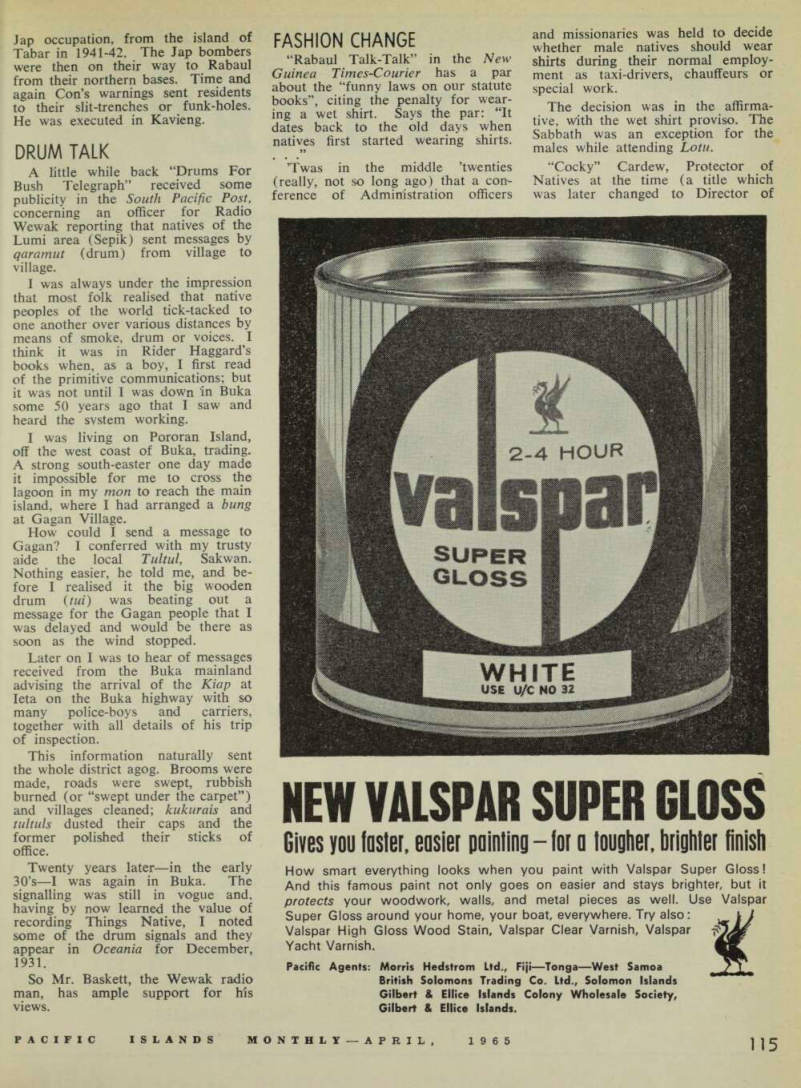
Last month I mentioned receiving word from “Blue” Allan about Bulominski’s grave at Kavieng. What I did not mention was that the same “Blue” Allan had sent me a photograph, taken in the 1930’5, of a cricket team in Kavieng.
IT is little actions like this which appeal to my retrospective soul. (Yes, I know; I live in the past—and I like it. So what?) Other oldm t ers , s £" d me ., ol< V newspapers: Rabaul Times, Morobe News and even sometimes an eruption copy of the Times and other odds and ends present with the past.
Behind readers m 30 years time W . lll I nfc JUS i aS I ? ter f ted m the events of 1965, if, and when recorded.
Blue Allan’s photo, reproduced here, shows a few of the men who “played the game’’ in more ways than one. Some of them helped the Territory’s future.
Taking the players seriatim: The first, happy, smiling face is that of Handsome Harry Hugo, a man who even today is—or was a few days ago, anyway—one of the strongest supporters of sport for all sections of the community. So far as I know he is still going strong in Rabaul.
Then comes G. C. (“Josh”) Holmes, a well-known and very popular identity with the NG public in the 20’s and 30’s; he was store manager for the Exproboard and WRC, eventually going to London as WRC representative. It is not so
very long since he retired to a rural home in England. He is the father of Heather Seale, wife of the present DC of Kavieng.
Next in line is J. H. (“Bert”) Jones, one of the oldest of Administrative officials in length of service and ex perience. In the early ’twenties he served as a medical assistant with the PHD. Transferring to District Services he soon rose to ADO, and DO and after World War II was an Australian representative at the United Nations in New York. He has now retired.
Club manager Comes then Vic Maxwell, who, at the time of the photo, was manager of the Kavieng Club, but, nonethe less, an experienced planter both in Papua and New Guinea. Vic has passed on.
Next are Bill Mosman —hefty, stolid Bill, an early-1920 arrival for the Exproboard and in coconuts ever since; and Frank Boisen, the well known school teacher and one of the pioneer members of the Education Department, who is still doing good work.
The bald-headed chappie is Con Page, Snr., manager for WRC in Rabaul and Kavieng at various times.
He was the father of Con, Jr., sitting at his feet in the photo. The padded batsman is Jack Comerford, manager of the Bank of NSW in Kavieng.
Seated are, first, a player whose name 1 think was Ashby; next is A.
M. {“Mick”) Ryan, one-time post master at Rabaul. 1 saw him last, post-war in Canberra with the Department of Territories.
The lad with the book and pencil is unidentified and then comes the inimitable Les Corbett, whom I remember so well on the baseball field in Rabaul at one time. For many years he was with the WRC firm and then, post-war, switched to Colyer, Watson. I did hear that, after long years of good service up there, he has at last retired.
The last of the row on the grass is C. L. {“Con”) Page, Jr., the Coastwatcher—the man to whom Rabaul owes the mostest for the timely warnings he gave, before the
Kavieng cricket team of the 1930'5. See above for details.
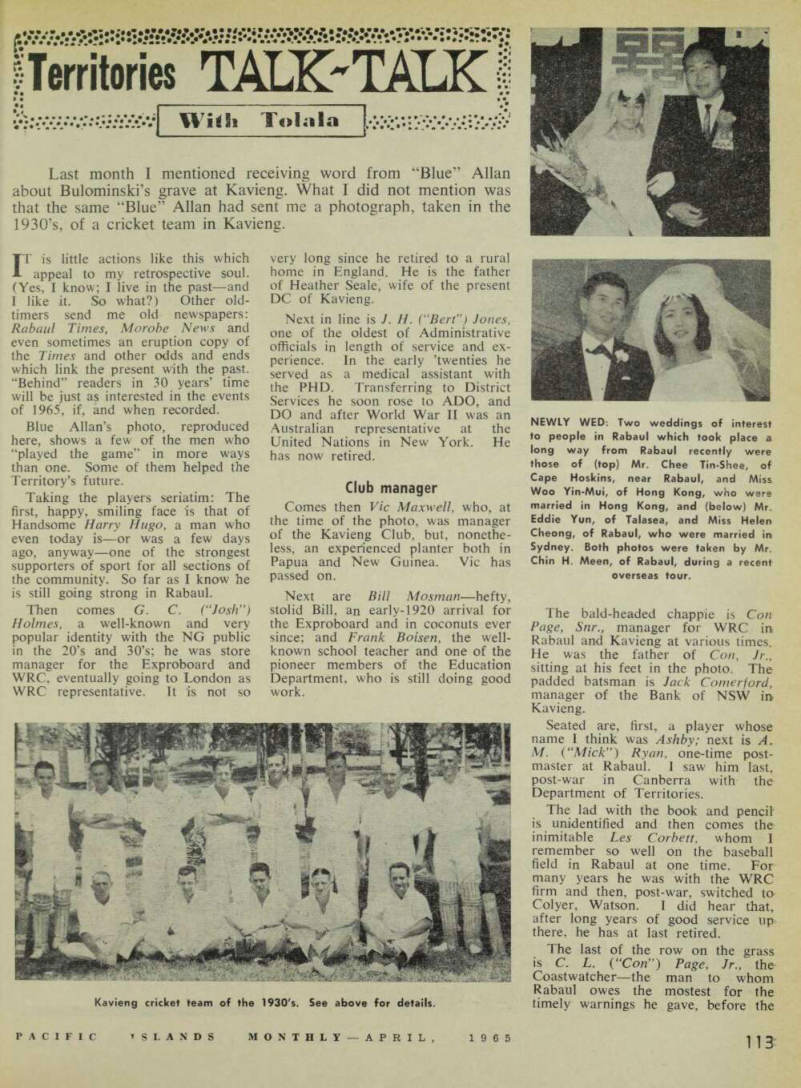
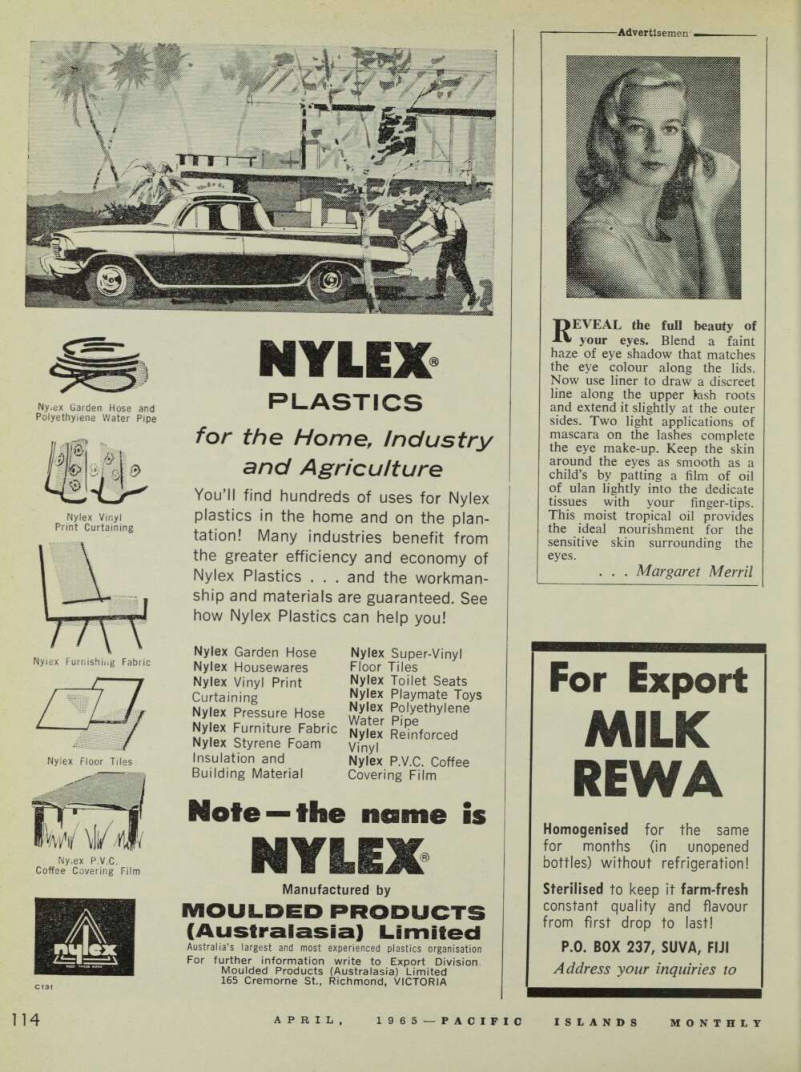
NEWLY WED: Two weddings of interest to people in Rabaul which took place a long way from Rabaul recently were those of (top) Mr. Chee Tin-Shee, of Cape Hoskins, near Rabaul, and Miss Woo Yin-Mui, of Hong Kong, who were married in Hong Kong, and (below) Mr.
Eddie Yun, of Talasea, and Miss Helen Cheong, of Rabaul, who were married in Sydney. Both photos were taken by Mr.
Chin H. Meen, of Rabaul, during a recent overseas tour.
Jap occupation, from the island of Tabar in 1941-42. The Jap bombers were then on their way to Rabaul from their northern bases. Time and again Con’s warnings sent residents to their slit-trenches or funk-holes.
He was executed in Kavieng.
Drum Talk
A little while back “Drums For Bush Telegraph” received some publicity in the South Pacific Post, concerning an officer for Radio Wewak reporting that natives of the Lumi area (Sepik) sent messages by qaramut (drum) from village to village.
I was always under the impression that most folk realised that native peoples of the world tick-tacked to one another over various distances by means of smoke, drum or voices. I think it was in Rider Haggard’s books when, as a boy, I first read of the primitive communications; but it was not until I was down in Buka some 50 years ago that I saw and heard the svstem working.
I was living on Pororan Island, off the west coast of Buka, trading.
A strong south-easter one day made it impossible for me to cross the lagoon in my mon to reach the main island, where I had arranged a bung at Gagan Village.
How could I send a message to Gagan? I conferred with my trusty aide the local Tultul, Sakwan.
Nothing easier, he told me, and be fore I realised it the big wooden drum (tui) was beating out a message for the Gagan people that I was delayed and would be there as soon as the wind stopped.
Later on I was to hear of messages received from the Buka mainland advising the arrival of the Kiap at leta on the Buka highway with so many police-boys and carriers, together with all details of his trip of inspection.
This information naturally sent the whole district agog. Brooms were made, roads were swept, rubbish burned (or “swept under the carpet”) and villages cleaned; kukurais and tultuls dusted their caps and the former polished their sticks of office.
Twenty years later—in the early 30’s—I was again in Buka. The signalling was still in vogue and, having by now learned the value of recording Things Native, I noted some of the drum signals and they appear in Oceania for December, 1931.
So Mr. Baskett, the Wewak radio man, has ample support for his views.
Fashion Change
“Rabaul Talk-Talk” in the New Guinea Times-Courier has a par about the “funny laws on our statute books”, citing the penalty for wear ing a wet shirt. Says the par: “It dates back to the old days when natives first started wearing shirts. »> Twas in the middle ’twenties (really, not so long ago) that a con ference of Administration officers
and missionaries was held to decide whether male natives should wear shirts during their normal employ ment as taxi-drivers, chauffeurs or special work.
The decision was in the affirma tive, with the wet shirt proviso. The Sabbath was an exception for the males while attending Lotu.
“Cocky” Cardew, Protector of Natives at the time (a title which was later changed to Director of
Native Affairs) and who, incident ally, was on loan from the Papuan Service, plugged for topless dresses for women (as it was in Papua in those days) but the Methodists wouldn’t come at that.
The current Federal Minister look ing after the Territory was one, George Pearce, a potential knight and a PC, as well as an enthusiastic Methodist.
So the dirty, crumby mary’s blouses remained, but there was no regulation telling the ladies not to wear wet top covering.
A few decades ago in NG the European men in the towns were particularly careful of their attire; they tucked their shirt tails inside their pants; the Chinese then, mostly, wore the tails outside; the native had none.
In more recent years, with the Declaration of Human Rights and a tendency for the Greater Freedoms, the European (especially if a tourist) wears his shirt-tails, such as they are these days, outside his pants and the Asian, for the most part, is careful to tuck his in, while the native follows suit.
An Experiment
“Granny” in her column in The Sydney Morning Herald recently ran a par with the heading “Coals to Newcastle” about some coconuts from Ceylon being sent to NG and the BSIP by air as “part of a Department of Territories and Unilever experiment to discover the best species of coconuts for planting in these areas.”
I am inclined to the belief that “Granny” has worked up her par from a hand-out from the D. of TVs effective public relations officer, desiring some impressive window dressing—possibly for impending visits by UN Trusteeship Council members, or the like.
It might be of interest to more recent planters that a fair number of foreign coconuts were imported into NG, to my knowledge, 50 to 60 years ago as seed nuts from the Dutch East Indies, Ceylon, Philip pines and BSIP.
A few of the German planters on the Madang-Aitape coast—more dis criminating, perhaps, than some others—obtained seed nuts from Java and some from the Philip pines. I did hear that Emma Forsayth (“Queen Emma”) brought in some Samoan nuts from time to time and they were planted on Matanata plantation (Kokopo area).
Later on, some Ceylonese nuts came in through official channels.
Choiseul Plantations estates in
Bougainville received many thousands of selected nuts from Lofung and, I think, Berande (in the BSIP) for planting at Arigua and Teopasino in particular. This I do know, for many a thousand I counted at Lofung (Shortland Islands) when I was there in 1916. Nor was there a lot of red tape to unravel over import forms, permits and quarantine restrictions from the
Bsip To Ng.
Parkinson’s Law was not then born and inter-island governments worked more in harmony.
As for the Ceylonese nuts, from my own observations they appeared little different from NG palms of the
same age. The production may be a bit higher, but one must remember there is intensive fertilising in Ceylon as compared with NG, also the nuts there are picked from the palms, and not allowed to fall as in NG.
And don’t forget that NG is not always on the receiving end. It also gives. „ Sugar experts from Hawaii found the best sugar cane from up around the Madang district many a year ago, and every so often they return for NG cane for booster purposes.
Or they did up to a few years ago.