Cruising Yachts
pp. 101-109 · Read in the full issue
Pacific Shipping And Cruising Yachts
£1,625 Damages To Salvors In Yacht Theft Case
In March, almost two years after their 50 ft yacht Cythera was stolen from Lord Howe Island, Mr. and Mrs. Peter Fen ton, of Sydney, were at the losing end of a court case in volving the recovery of the
yacht.
Mr. Justice Macfarlan, In
the Admiralty Division of the NSW Supreme Court, awarded £1,625 to a French shipping com pany, Societe Maritime Caledonienne, in an action listed as against “the ship Cythera and her cargo”.
The £1,625 was made up of £l,lOO as the cost of repairs to the Colorado del Mar, £2OO as the value of the time rendered in salvage services, £225 as the value of the time lost in having the repairs made, and £lOO as salvage.
Mr. Justice Macfarlan dismissed a counter claim for damage to the Cythera.
The Cythera was stolen by two of the crew, Derrick Brewin and Daniel James Barrie, while Mr. and Mrs. Fenton were at a dance.
Several days later, the Colorado
del Mar and Cythera were involved in a collision near Norfolk Island, while the Colorado del Mar was trying to capture the yacht.
Brewin and Barrie were arrested; and in June, 1963, in Sydney Quarter Sessions, they were each sentenced to four years’ imprison ment for having stolen the yacht.
Brewin told Mr. Justice Marfarlan that the Colorado del Mar would not have hit the Cythera if the Colorado del Mar had not changed course.
He said he and Barrie had out manoeuvred the Colorado del Mar for about an hour, and had then tried to trick their pursuers into thinking they had surrendered by taking the sails down.
Barrie then saw the Colorado del Mar coming towards them and altered course 90 degrees.
The Colorado del Mar hit Cythera, but would not have done so if she had kept on her course after Cythera changed hers.
During the hearing of this case the Tamata (formerly Colorado del Mar ) was on the slip as Suva for repairs estimated at £F25,000.
More than 40 dented plates were to be removed and replaced.
The Tamata was damaged when she went aground on Beqa Reef, Fiji, on December 15 while on a voyage from Suva to Vila.
The ship’s name was changed from Colorado del Mar several months ago when she was sold by the Societe Maritime Caledonienne to another company for use on the Noumea-Wallis Island-Suva run.
Ship Wrecked On New
Caledonian Reef
A 1,000-ton former Liberty ship, the Ever-Prosperity, struck a reef about four miles off La Foa, New Caledonia, on February 26 and became a total loss.
The Ever Prosperity was in ballast and on her way to Noumea to lift nickel ore for Japan.
She was flying the Liberian flag, was commanded by an Englishman, had a Chinese crew, and was under charter to a Japanese firm.
The Ever Prosperity was wrecked near the spot where the world’s biggest sailing ship, the France, came to grief many years ago.
New Burns Philp
Ship Launched
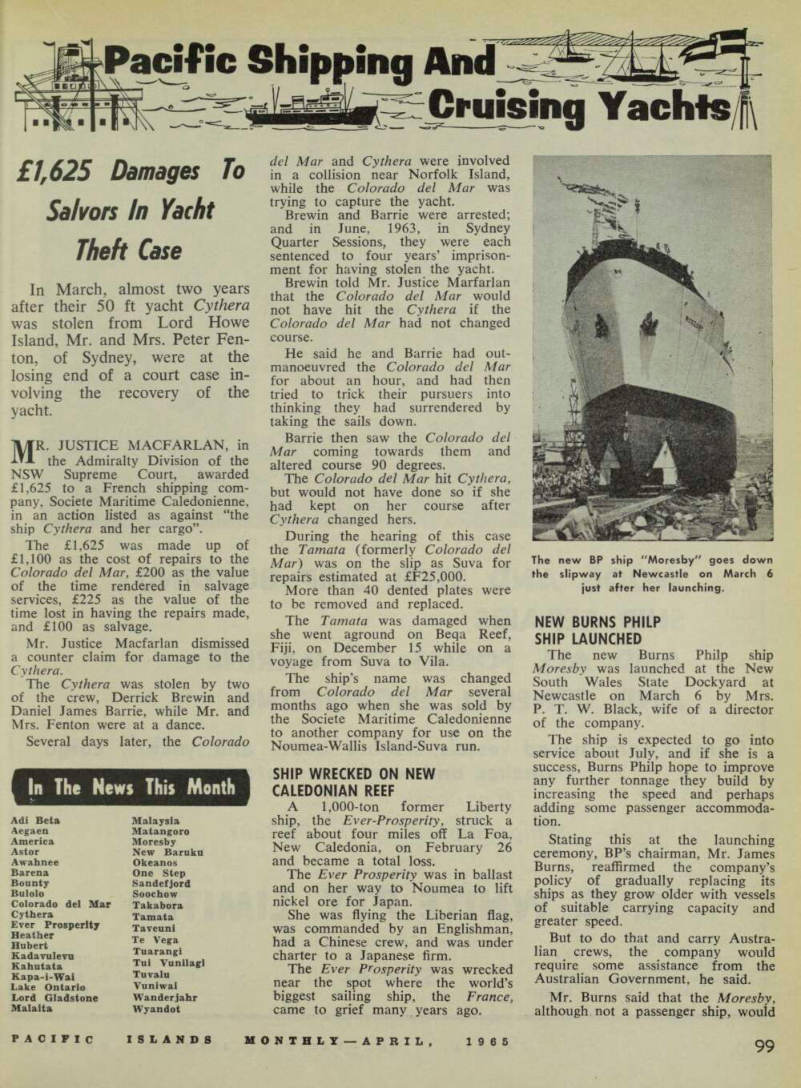
The new Burns Philp ship Moresby was launched at the New South Wales State Dockyard at Newcastle on March 6 by Mrs.
P, T. W. Black, wife of a director of the company.
The ship is expected to go into service about July, and if she is a success. Burns Philp hope to improve any further tonnage they build by increasing the speed and perhaps adding some passenger accommoda tion.
Stating this at the launching ceremony, BP’s chairman, Mr. James Burns, reaffirmed the company’s policy of gradually replacing its ships as they grow older with vessels of suitable carrying capacity and greater speed.
But to do that and carry Austra lian crews, the company would require some assistance from the Australian Government, he said.
Mr. Burns said that the Moresby, although not a passenger ship, would
The new BP ship "Moresby" goes down the slipway at Newcastle on March 6 just after her launching.
be faster than any other ship in the BP fleet except the Bulolo, and would be capable of carrying about 4,000 tons of cargo.
It was intended to replace one of the five ships at present engaged in the Australian P-NG trade with the Moresby.
Mr. Burns did not name the ship to be replaced, but it is expected it will be the Malaita.
New Fiji Ship Gets
An Old Name
The Governor of Fiji, Sir Derek Jakeway, named Fiji’s newest ship, the Vuniwai, on February 27. The Vuniwai, a motor ship designed and built by the Fiji Public Works Department for the Medical Depart ment, will be used for transferring patients and medical staff from island to island.
The ship took her name from another Fiji-built vessel which had been renamed Kapa-i-Wai the pre vious day by the Member for Natural Resources, Ratu K. K. T. Mara.
Kapa-i-Wai (which apparently can also be written Kapaiwai) was a name given by the late King George Tupou I of Tonga to the grandfather of the late Ratu Sir Lala Sukuna because of his great skill as a navigator. In Tongan it means “sea raider” or “conqueror from across the sea”, Ratu Mara was also named after this chief—the two K’s in his initials standing for Kamisese Kapaiwai.
The new Vuniwai was launched in August last year. She is 75 ft long with a beam of 20 ft and a draught of 7 ft 6 in. She can carry up to 30 tons of cargo. She is powered with two Gardner 6LX engines and her cruising speed is 10 knots.
The Vuniwai left Suva on her maiden voyage on March 3 when she carried the Deputy Director of Medical Services Dr. D. W. Book less, to the Makogai Leper Station.
Two Fined For Carrying
Too Many Passengers
Two ships’ masters were fined in Fiji recently for carrying more passengers in their ships than they were licensed to do. In each case, the magistrates recalled the Kada vulevu disaster of March, 1964, in which about 90 people lost their lives when the heavily overloaded ship overturned.
In the first case, in February, the master was charged with carrying 43 passengers without a certificate from the Fiji Marine Board and was
fined £lOO in the Magistrate’s Court at Lautoka.
The master, Saimone Naivalu, of Nacula, in the Yasawas, pleaded guilty to the charge, after some witnesses had given evidence. He had earlier pleaded not guilty.
Prosecution witnesses said that the Adi Beta, of which Saimone was the master, was intercepted near Bekana Island in Lautoka Harbour with 43 passengers on board.
In a statement to the police, Saimone was alleged to have ad mitted that he had made arrange ments to take 20 working men from Lautoka to Bua in Vanua Levu, and that for the voyage the men would
buy six drums of oil valued at £4O for the engine. He did not charge any fare.
The police said in court that an investigation revealed that there were 11 women, 27 men and five children on board, besides the crew of 10.
The cargo consisted of suitcases and mats, 32 4-gallon drums of kerosene in the stem and another 21 4-gallon drums on the foredeck.
A further investigation revealed that Saimone was paid £7O by the passengers, and Saimone admitted that during an interview with a police officer.
Saimone told the court he was not aware of the regulations and wanted
to know why the police had not stopped him from sailing at the wharf.
Fining Saimone, the magistrate, Mr. Arthur Jeddere-Fisher, said that with the “awful warning” of the Kadavulevu disaster not 12 months old, it was “the duty of a captain to see what number of passengers is in his vessel, and not to sail until the surplus has left the vessel.”
In the second case of overloading, Samisoni Ulitu, master of the Fiji auxiliary cutter, Tui Vunilagi, was fined £8 for carrying eight passengers in excess of the permitted loading.
The magistrate, Mr. I. R. Thomp son, imposing the fine, said that since the loss of the Kadavulevu, it was expected that masters of ships would be careful to ensure that the pas sengers or loads did not exceed what was allowed by the certificate.
"Floating Classroom"
In Rabaul
Te Vega, Stanford University’s “floating classroom” and oceano graphic research vessel, called at Rabaul in March on the homeward leg of a three-year cruise extending from California to the east coast of Africa.
Te Vega last called at Rabaul in September, 1963, and has since taken part in the International Indian Ocean Expedition and has taught students as far as Mombasa, Kenya.
The ship’s complement is 16 crew, four professors and 12 students who return to the US after three months study in marine biology. An Aus tralian student recently was Paulette McWilliams.
Te Vega is a 135 ft schooner, which, before being modified for scientific purposes, used to carry tourists between Honolulu and Tahiti.
Ship Explosion And
Mercy Dash
An explosion in the engine room of the Swedish freighter Lake Ontario, 6,750 tons, when she was about 720 miles south of Noumea on March 2, resulted in her being towed 800 miles to Brisbane. The Lake Ontario was bound for the US from Brisbane when the explosion occurred, followed by fire. She was taken in tow by the Dutch freighter Van Cloon. During the tow the RAN anti-submarine frigate Yarra dashed from Sydney to take off a badly burnt engineer.
Rarotonga Harbour
Obstruction To Go
The wreck of the well-known Cook Islands trader, Taveuni, is being demolished in Rarotonga’s Avarua Harbour by the owners, Island Merchants Ltd., to free the harbour of a navigational obstruction.
The Taveuni was stranded more than a year ago after she broke her moorings in a high wind while lying in the harbour with a faulty engine.
Better Harbour
Wanted At Aoba
An engineer attached to the French Navy in New Caledonia re cently made a preliminary survey of Lolowai Bay, on the east coast of Aoba, New Hebrides, to see if the channel into the bay could be im
proved for the benefit of inter island shipping.
At present the bay is navigable for many ships for only a few hours near the high tides.
It is the only safe anchorage in the Maewo-Aoba-Pentecost area.
Fiji Cutter Adrift
For Two Days
The master and eight crewmen of the 30-ton Fiji cutter Tui Vunilagi, lived on biscuit and water for two days while she was adrift for four days in March.
She was on her way to Suva from Nairai in Lomaiviti—under sail be cause her batteries were flat. She
made steady progress until she was becalmed.
A strong current swept the Tui Vunilagi past Batiki and as far south as Kadavu.
The tide then carried her towards Nasilai, at the south-east corner of Viti Levu, where the Tuvalu took her in tow to Suva.
The Tui Vunilagi was without radio-telephone, and attracted the attention of the Tuvalu by flashing a torch.
Fatality In Ship
Explosion
Peter Nago, a senior mechanic, died in the Moli Mission Clinic, Choiseul, BSIP, on February 4 from burns and shock suffered in an explosion in the New Baruku on February 3.
The New Baruku, owned by Kwan How Yuan Pty. Ltd., was off Vurago on the Choiseul coast when there was an explosion in the engine room.
Carrying a full load of copra, she burned all night and drifted ashore at Vurago, burning out on the beach about midday on February 4.
All that remains are her machinery, some copper-sheathing and a few charred pieces of wood.
A second mechanic in the engine room was also badly burned, but he was later reported to be making a slow recovery in the Gizo hospital.
The remaining eight members of the crew were unhurt.
Big Barge To Be
Built In Fiji
The Fiji Public Works Department is to construct the largest ship ever built in the Colony to carry earth moving equipment and vehicles between the islands.
The vessel, a landing barge, will be 110 ft long, with a 26 ft beam, and drawing 4 ft 6 in. She will be powered by twin engines, each of 250 hp., and will be equipped with a ramp, similar to those on war time invasion barges, to facilitate loading and unloading of equipment.
Overseas Wharves
For Madang
The first stage of a project to provide the New Guinea port of Madang with two new overseas wharves is expected to cost about £575,000.
Tenders called last year are now being considered.
These cover the construction of the first wharf, which will be 450 ft long and 40 ft wide, and will have
a concrete deck and steel tubular piles.
The contract for this wharf will also include a cargo shed 300 ft by 80 ft, a shed for fertiliser 80 ft by 40 ft, two concrete approach ramps, a fenced open-storage area, a fire-protection sprinkler system, sealed approach roads, and cathodic protection for the wharf piles.
The wharf is expected to be finished in 1966.
Tenders for a second wharf of the same specifications will be called later.
The new wharves are needed to handle the big volume of freight passing through Madang to and from the Highlands.
New P-Ng Ship For
Service In Sepik
The P-NG Administration general purpose ship, Barena, was launched at the Toboi shipyard, Rabaul, on February 10, and will go into service in the Sepik District.
She is the second of four such 64 ft vessels for the Administration.
The other two are due for delivery this month and in August.
Sixteen apprentices learning ship building worked on the construction of the Barena.
French Firms Expected
To Win Contract
French firms are expected to win a contract to build two 15,000-ton ships needed by Societe le Nickel in New Caledonia, even though
Japanese interests could build the ships much more cheaply, according to PlM’s Noumea correspondent, The company needs the ships to carry ore between coastal mines in
The new P-NG ship "Barena".
Photo: Chin H. Meen.
New Caledonia and the Noumea smelters.
New Caledonian opinion is that France will get the contracts because the French shipbuilding industry is in the doldrums.
Two representatives of a Japanese shipbuilding firm were recently in Noumea seeking orders to build the ships.
Service From Australia
To Malaysia Started
The Austasia Line introduced a new service from Australia to Malaysia, via Port Moresby, in February with the 8,206-ton Malaysia, a combined passenger cargo ship.
The ship was formerly the Hubert and belonged to the Booth Line, operating from England to the Caribbean and South America.
She carries 77 passengers in first class, and 82 in tourist class.
The round voyage, which originates in Melbourne, takes about 50 days.
After Melbourne, the Malaysia calls at Sydney, Brisbane, Townsville (optional). Port Moresby, Singa pore, Malacca, Penang and Pt.
Swettenham.
She then returns to Singapore, to sail for Melbourne, via Sydney.
U.S. Visitor To
Pitcairn
The United States Navy supply ship, USNS Wyandot, called at Pit cairn Island in March to deliver and collect mail, and unload 20 drums of diesel oil.
The South Pacific Office last year asked the United States Government to allow US Navy ships in the South Pacific to call at Pitcairn whenever possible to maintain the islanders’ link with the outside world, and also provide a market for Pitcairn handicrafts and curios.
The US Government agreed, and it is likely that other US ships will call at Pitcairn in future.
The number of ships calling at Pitcairn in recent years has dropped appreciably.
There are now 77 Pitcairners on the island, plus 14 “non-Pitcairners”.
New Master For
"Soochow"
Captain J. F. Pook, of the China Navigation Co., flew to Papua on March 14 to take command of the Soochow. The previous master, Captain Frank Hindle, had died earlier that day while berthing the ship at Samarai. (See “Deaths of Islands People”).
British Ship On
New Guinea Reef
The Lord Gladstone, 11,299 tons, owned by Ships Finance and Management Co. Ltd., London, went aground on Tingwon Reef, about 160 miles NW of Rabaul on March 6.
The first, second and third tanks were holed, and the bottom was buckled.
After six unsuccessful attempts in four days to refloat the ship, a salvage expert was sent up from Australia. A Japanese tug, Hayashio Maru, was later engaged in Japan to try to salvage the ship.
The master reported to Lloyds soon a^ter the stranding that the Position was not dangerous and he no mtentlon of disembarking
tiie crew
Damaged In Hurricane
Beacons at the mouth of the Vunivadra and Navuloa Rivers in the Rewa Delta of Fiji were damaged in .the hurricane which swept past Fiji in February, Four beacons were blown down on the north-east side of Laucala Bay at the entrance to Vunivadra Canal.