Bird Of The Islands
p. 95 · Read in the full issue
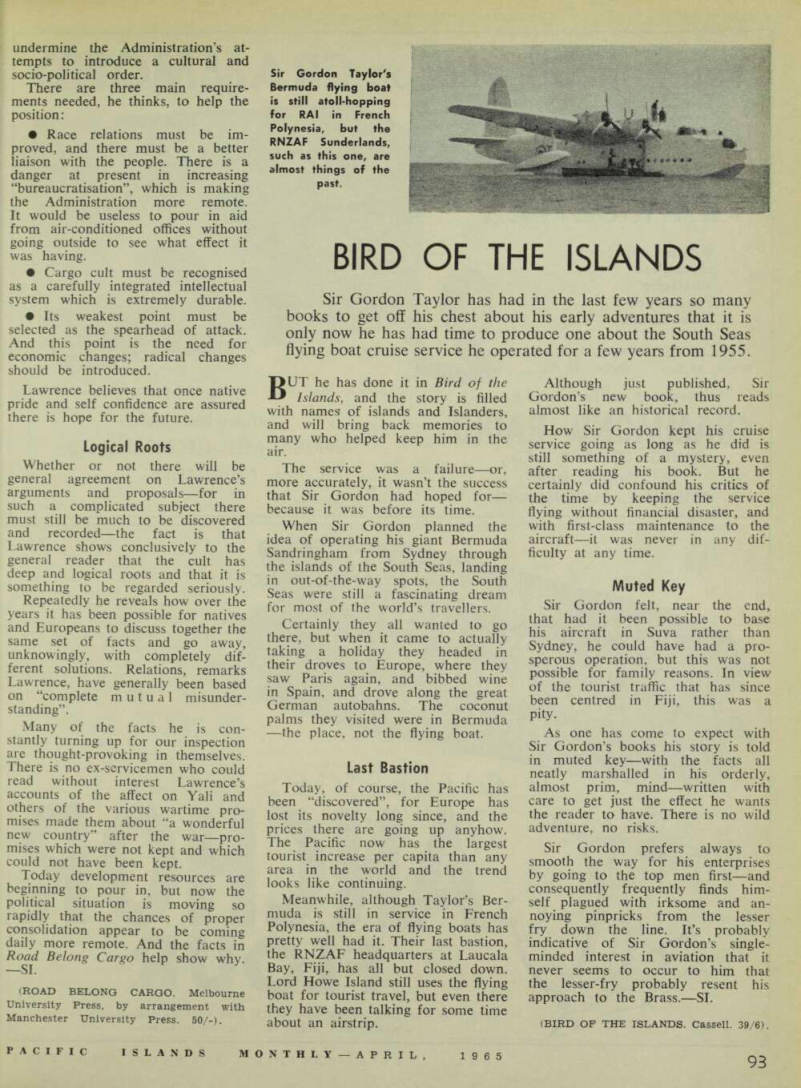
Sir Gordon Taylor has had in the last few years so many books to get off his chest about his early adventures that it is only now he has had time to produce one about the South Seas flying boat cruise service he operated for a few years from 1955.
BUT he has done it in Bird of the Islands, and the story is filled with names of islands and Islanders, and will bring back memories to many who helped keep him in the air.
The service was a failure—or, more accurately, it wasn’t the success that Sir Gordon had hoped for— because it was before its time.
When Sir Gordon planned the idea of operating his giant Bermuda Sandringham from Sydney through the islands of the South Seas, landing in out-of-the-way spots, the South Seas were still a fascinating dream for most of the world’s travellers.
Certainly they all wanted to go there, but when it came to actually taking a holiday they headed in their droves to Europe, where they saw Paris again, and bibbed wine in Spain, and drove along the great German autobahns. The coconut palms they visited were in Bermuda —the place, not the flying boat.
Last Bastion Today, of course, the Pacific has been “discovered”, for Europe has lost its novelty long since, and the prices there are going up anyhow.
The Pacific now has the largest tourist increase per capita than any area in the world and the trend looks like continuing.
Meanwhile, although Taylor’s Ber muda is still in service in French Polynesia, the era of flying boats has pretty well had it. Their last bastion, the RNZAF headquarters at Laucala Bay, Fiji, has all but closed down.
Lord Howe Island still uses the flying boat for tourist travel, but even there they have been talking for some time about an airstrip.
Although just published, Sir Gordon’s new book, thus reads almost like an historical record.
How Sir Gordon kept his cruise service going as long as he did is still something of a mystery, even after reading his book. But he certainly did confound his critics of the time by keeping the service flying without financial disaster, and with first-class maintenance to the aircraft—it was never in any dif ficulty at any time.
Muted Key
Sir Gordon felt, near the end, that had it been possible to base his aircraft in Suva rather than Sydney, he could have had a pro sperous operation, but this was not possible for family reasons. In view of the tourist traffic that has since been centred in Fiji, this was a pity.
As one has come to expect with Sir Gordon’s books his story is told in muted key—with the facts all neatly marshalled in his orderly, almost prim, mind—written with care to get just the effect he wants the reader to have. There is no wild adventure, no risks.
Sir Gordon prefers always to smooth the way for his enterprises by going to the top men first—and consequently frequently finds him self plagued with irksome and an noying pinpricks from the lesser fry down the line. It’s probably indicative of Sir Gordon’s single minded interest in aviation that it never seems to occur to him that the lesser-fry probably resent his approach to the Brass.—Sl.
(Bird Of The Islands. Cassell. 39/6).
Sir Gordon Taylor's Bermuda flying boat is still atoll-hopping for RAI in French Polynesia, but the RNZAF Sunderlands, such as this one, are almost things of the past.