Sea-Slugging
p. 89 · Read in the full issue
Days In The
Trobriands
By Basil Hall
Not long ago, I noticed quan tities of trepang lying in the few inches of water covering reefs
surrounding Stephens Island in
Torres Strait.
NO one bothers to collect them i now, for the Stephens family (30 adults and 34 children), headed by that virile personality, Ned Stephens, are more interested in their lugger and the price of gold-lip MOP.
But to me those sea slugs brought back memories of a launch boy who steered by a sense of smell—back before the War.
We were feeling our way across the lagoon at Kiriwina (Trobriand Islands) in the middle of an early morning mist that reduced visibility to a few yards. It felt and looked like cotton wool, and all the helms man could do was to point the launch towards a smell that grew more and more unpleasant all the time. It was at its worst when we hit the beach down Sinaketta way.
Iron Troughs
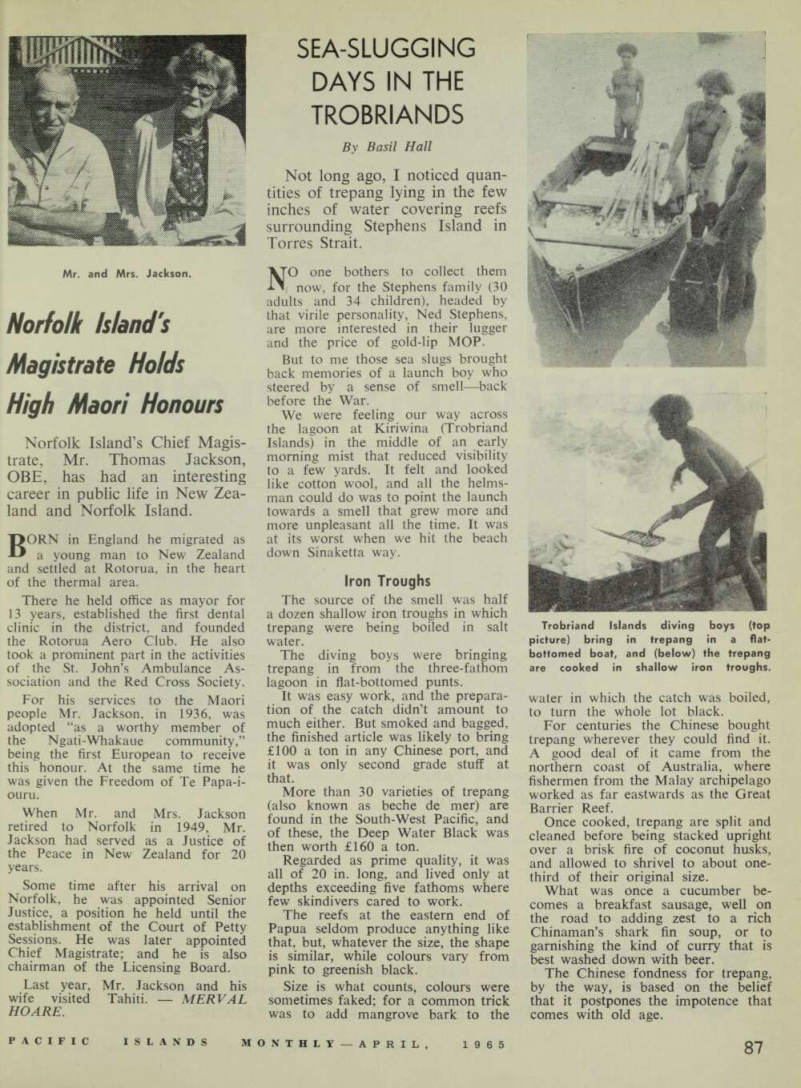
The source of the smell was half a dozen shallow iron troughs in which trepang were being boiled in salt water.
The diving boys were bringing trepang in from the three-fathom lagoon in flat-bottomed punts.
It was easy work, and the prepara tion of the catch didn’t amount to much either. But smoked and bagged, the finished article was likely to bring £lOO a ton in any Chinese port, and it was only second grade stuff at that.
More than 30 varieties of trepang (also known as beche de mer) are found in the South-West Pacific, and of these, the Deep Water Black was then worth £l6O a ton.
Regarded as prime quality, it was all of 20 in. long, and lived only at depths exceeding five fathoms where few skindivers cared to work.
The reefs at the eastern end of Papua seldom produce anything like that, but, whatever the size, the shape is similar, while colours vary from pink to greenish black.
Size is what counts, colours were sometimes faked; for a common trick was to add mangrove bark to the
water in which the catch was boiled, to turn the whole lot black.
For centuries the Chinese bought trepang wherever they could find it.
A good deal of it came from the northern coast of Australia, where fishermen from the Malay archipelago worked as far eastwards as the Great Barrier Reef.
Once cooked, trepang are split and cleaned before being stacked upright over a brisk fire of coconut husks, and allowed to shrivel to about one third of their original size.
What was once a cucumber be comes a breakfast sausage, well on the road to adding zest to a rich Chinaman’s shark fin soup, or to garnishing the kind of curry that is best washed down with beer.
The Chinese fondness for trepang, by the way, is based on the belief that it postpones the impotence that comes with old age.
Trobriand Islands diving boys (top picture) bring in trepang in a flat bottomed boat, and (below) the trepang are cooked in shallow iron troughs.