Tahiti
p. 87 · Read in the full issue
He Painted Tahiti - But Who Was He ?
By Robert Langdon
FOR the past 10 or 15 years, Mr.
John Earnshaw, a Sydney engineer and spare-time historian, has had a mysterious painting hanging on one of the walls of his home.
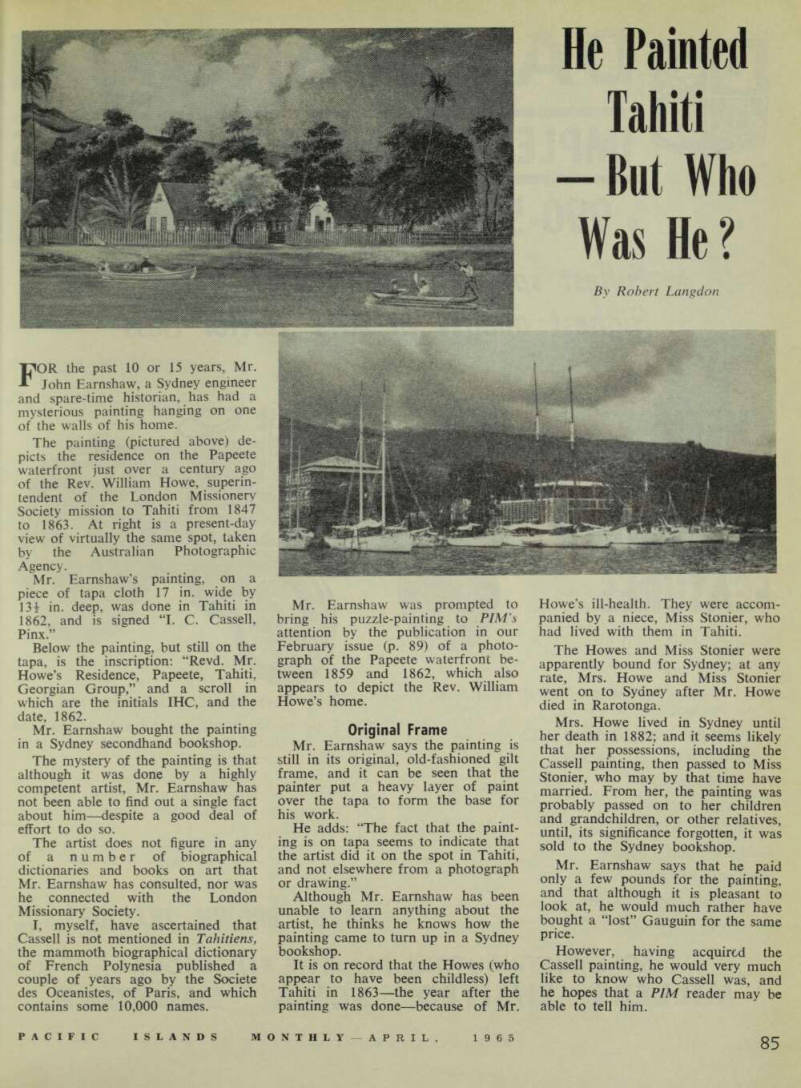
The painting (pictured above) de picts the residence on the Papeete waterfront just over a century ago of the Rev. William Howe, superin tendent of the London Missionery Society mission to Tahiti from 1847 to 1863. At right is a present-day view of virtually the same spot, taken by the Australian Photographic Agency.
Mr. Earnshaw’s painting, on a piece of tapa cloth 17 in. wide by 13i in, deep, was done in Tahiti in 1862, and is signed “I. C. Cassell, Pinx ”
Below the painting, but still on the tapa, is the inscription: “Revd. Mr.
Howe’s Residence, Papeete, Tahiti, Georgian Group,” and a scroll in which are the initials IHC, and the date, 1862.
Mr. Earnshaw bought the painting in a Sydney secondhand bookshop.
The mystery of the painting is that although it was done by a highly competent artist, Mr. Earnshaw has not been able to find out a single fact about him—despite a good deal of effort to do so.
The artist does not figure in any of a number of biographical dictionaries and books on art that Mr. Earnshaw has consulted, nor was he connected with the London Missionary Society.
I, myself, have ascertained that Cassell is not mentioned in Tahitiens, the mammoth biographical dictionary of French Polynesia published a couple of years ago by the Societe des Oceanistes, of Paris, and which contains some 10,000 names.
Mr. Earnshaw was prompted to bring his puzzle-painting to PlM’s attention by the publication in our February issue (p. 89) of a photo graph of the Papeete waterfront be tween 1859 and 1862, which also appears to depict the Rev. William Howe’s home.
Original Frame
Mr. Earnshaw says the painting is still in its original, old-fashioned gilt frame, and it can be seen that the painter put a heavy layer of paint over the tapa to form the base for his work.
He adds: “The fact that the paint ing is on tapa seems to indicate that the artist did it on the spot in Tahiti, and not elsewhere from a photograph or drawing.”
Although Mr. Earnshaw has been unable to learn anything about the artist, he thinks he knows how the painting came to turn up in a Sydney bookshop.
It is on record that the Howes (who appear to have been childless) left Tahiti in 1863 —the year after the painting was done—because of Mr.
Howe’s ill-health. They were accom panied by a niece, Miss Stonier, who had lived with them in Tahiti.
The Howes and Miss Stonier were apparently bound for Sydney; at any rate, Mrs. Howe and Miss Stonier went on to Sydney after Mr. Howe died in Rarotonga.
Mrs. Howe lived in Sydney until her death in 1882; and it seems likely that her possessions, including the Cassell painting, then passed to Miss Stonier, who may by that time have married. From her, the painting was probably passed on to her children and grandchildren, or other relatives, until, its significance forgotten, it was sold to the Sydney bookshop.
Mr. Earnshaw says that he paid only a few pounds for the painting, and that although it is pleasant to look at, he would much rather have bought a “lost” Gauguin for the same price.
However, having acquired the Cassell painting, he would very much like to know who Cassell was, and he hopes that a PIM reader may be able to tell him.