Optimism, Progress
pp. 69-73 · Read in the full issue



Come To The Solomons After 50 Years Of Stagnation
By R. W. Robson, who recently visited the Solomons.
For 50 years until the end of 1950 or there abouts, the Solomon Islands were at the un coveted end of the British colonial world. They were overlooked by officialdom and virtually ig nored by private enterprise.
NOW, because of US thinking, United Nations pressures, and the loss of much of Britain’s old colonial empire, this Cinderella ter ritory has assumed considerable importance in the eyes of the Colonial Office, and private enter prise is beginning to discover its riches.
Where there used to be a few government departments each housing a few pale and shrinking Englishmen, who seemed convinced that they were suffering punishment in banish ment, now there are large staffs of enthusiastic, jolly men from Africa and other countries that have re jected the Union Jack, who are putting into Agriculture, Public Works, Health and Education a know-how and drive that is being felt throughout the archipelago.
In a social sense, Honiara, with its comfortably and expensively-housed public servants, has become one of the most delightful places in the South Seas.
Independence
The aim of these officials appears to be to prepare the 130,000 Melane sians of the Protectorate for in dependence.
Given time, there seems no reason why this cannot be accomplished— so long as Britain continues to provide the Protectorate with the same generous developmental funds as in 1963 and 1964, so long as the Administration is not harried by political pressures, and so long as capital is forthcoming to exploit the many natural resources.
But with the growing population threat from Asia, I am one who fears that time will run out long before the present generation of capable British officials can really
get stuck into the job of nationbuilding to which they are applying themselves with such enthusiasm.
Meanwhile, the Solomons are still peaceful, pleasant and politically uncomplicated. Nationalist agitators do not appear to have arisen there yet, and the Melanesians generally are quiet and well-disposed towards their British mentors and rulers.
Economically, the Solomons are pulsing with a spirit of optimism and progress. The Old Country, one way and another, is pouring in millions of pounds; and private enterprise, although inclined to be scared off at first, is putting its questing nose more and more into this rapidlydeveloping world. .. , £ , ...
Already, four big timber-getting organisations, with plenty of money from all over the world, are at work, and more are coming in. — e .. . j -pv The Southern Mining and Development Company, an offshoot of the world-wide corporation known as INCA, has been prospecting for nickel, and although it will not say a word about its activities, the Government and public insist on being optimistic. The company has recently been working on Isabel, after finding substantial but in-
sufficiently rich nickel ore on Choiseul.
There could be rich minerals in the Solomons. That financial genius and one-time Queensland Premier, the late E. G. Theodore, a quarter century ago earmarked a large sum of Fiji goldmines money for pro specting the gold indications in the Guadalcanal hills. But he withdrew Jh e whole enterprise soon after World War II with solemn curses upon the Socialist laws brought in by the new British Labour Govern ment to ensure that a large part of any gold produced m the Solomons should f° directly into the Exchequer. (p llB ’ **l? way, iv° u * who knew the political history of Queensland s former Premier, had £ f side) y ’, , . man 18 c 9 nvm . ce d that th e Solomons are rich m minerals is the Protectorates Chief Geologist, T h r , mupr ‘.. . , , Be has not only insisted that there is gold in them thar hills he has tirelessly produced evidence of mineral wealth in many places.
Now, at long last, he has managed to arrange for an aerial geophysical survey to be held in the Protectorate, which, he says, will help to achieve
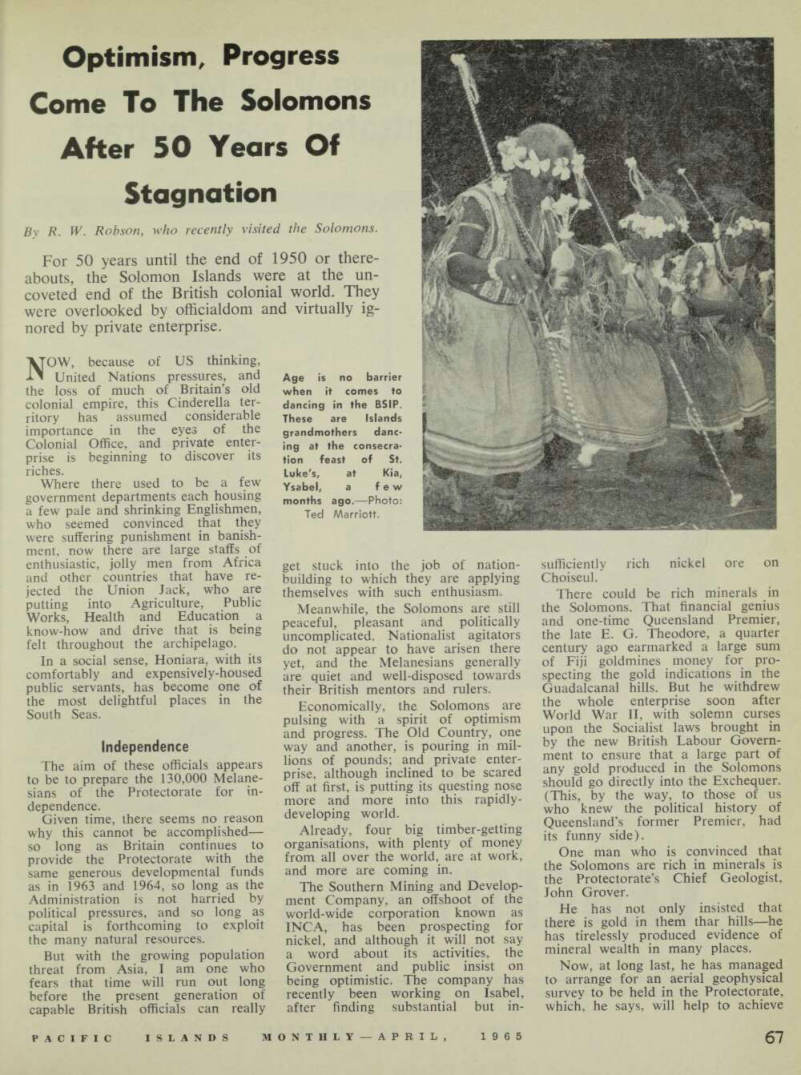
Age is no barrier when it comes to dancing in the BSIP.
These are Islands grandmothers danc ing at the consecra tion feast of St.
Luke's, at Kia, Ysabel, a few months ago. Photo: Ted Marriott.
inside 10 years what would ordinarily take 50 years or more.
The survey may reveal that Cinderella does, indeed, wear a slipper of gold, or, if not gold, of nickel or copper or something equally stimulating to the country’s economy.
Hitherto, it has been coconuts, coconuts all the way, with the Lever Plantations in the Russells at the heart of the planting. Now, a score of real experts (“best lot of agri cultural fellows I’ve ever seen” was one description given me) are cruising around the Protectorate, encouraging growers of coconuts and cocoa. The general idea is to establish a race of Solomons peasant farmers.
Why Not Food Crops?
Myself, I could get no real ex plantation of why the abundant talents of these agriculture men are kept in the two watertight com partments of coconuts and cocoa.
Why don’t they encourage food crops in some of these fertile islands, so they can at least feed a popula tion that each year buys about £200,000 worth of foreign rice?
I travelled for hours across the extraordinarily fertile, well-watered plains of Guadalcanal, and there I found good roads and bridges, a very few scattered native villages and, outside the plantations of Lever and of a Catholic institution, only one farmer —Ken Dalrymple Hay, a leading businessman of Honiara.
On Mr. Hay’s farm I saw acres of soya beans, acres of experimental rice, sorghum, maize—everything the mind of a tropical farmer could covet—all growing healthily, without menace of pests.
And I saw a herd of 60 cattle, rolling fat—and not another beast in all those hundreds of square miles which are lushly covered with native vegetation.
“Must have cost you a pretty penny to get those animals in here,”
I said.
Guadalcanal’s lonely farmer grin ned.
"Mongrels"
“They’re a lot of mongrels,” he said. “Bought ’em cheap from the Administration. They were a Govern ment experiment—left to forage for themselves, I think. Anyway, they began to die off. Lumps of rubbish in their stomachs.
“We cleared the ground a bit, let them feed on the shoots that come after this coarse stuff is burned off.
And look at ’em now.”
Someone said that all cattle here abouts —there are pitifully few in
the places I visited—have TB.
Well, I never saw healthier and livelier animals than those on Guadalcanal.
Mr. Hay has a queer moaning thing on his car—sounds like the roar of a concupiscent bull —and at its sound all the cows began to twist and caracole, and the males came racing up offering fight—and a dozen native children shrieked in delight.
Hay and his bull-roarer are well known along this road.
So much for the economic side.
The picture there is attracive, and full of promise.
One is not quite so impressed with the social side. There are 130,000 Melanesians more or less. What little literacy there is has been introduced by the Christian Missions. It is New Guinea over again.
The British, like the Australians, plan eventual self-government—but seem to have ignored the obvious fact that in a country of many languages (there are scores, in the Solomons) native education must be planned far back. Suitable natives first must be found and educated and trained as village school teachers, before officialdom can even approach the vast problems of providing a medium through which it can instruct an indigenous race in the principles and methods of self-government.
Perhaps the Australian-New Guinea and British-Solomons administration officials sometimes talk to each other, and exchange experiences about native primary education in relation to the pressures upon them to organise self-government.
If so, the BSIP officials will know that the idea of introducing self government to a mostly illiterate society is sheer foolishness. In this field, as in most spheres of human endeavour, the cart may not travel before the horse.
Among the 130,000 people in the Solomons, there are estimated to be between 30,000 and 40,000 children suitable for education. Up to mid -1963, primary education was being provided by 12 Government or Local Council schools, and 487 Mission schools.
There appeared to be some 17,000 children “receiving instruction”; but of the 880 teachers employed only some 180 were classified as “qualified”.
However, in the last year or two, the Administration has made more money and more skilled teachers available for a herculean task, and so the outlook for the future is some what rosier.
• See also "Strenuous Work Be hind New Political Step", p. 72.