Development Scheme
pp. 63-65 · Read in the full issue

Setback For Fiji’s Largest Development Scheme
From Beryl Cates, in Suva
Among the devastation caused by the hurricane in the Fiji Group from February 7 to 10 was that suffered on the 600-acre land resettlement scheme at Lomaivuna. An estimate of the damage indicates that 50 per cent, of the plantings will be out of production for about a year, while the remainder will take six to nine months to be brought into production again.
THIS is a tremendous setback, not only to the scheme, but to the banana industry as a whole, since nearly half the Colony’s export of bananas to New Zealand came from Lomaivuna.
The scheme is in Naitasiri Province about 30 miles by road from Suva.
A great deal of the province is under virgin bush, and much of the topography of the area is highly inter sected.
Before the establishment of Lomai vuna, the main development along this section of the country was that done by the many Fijian villages pro ducing crops for subsistence and the Suva market.
Today the Lomaivuna farmer settlement scheme has the greater part of its 600 acres planted with bananas as the main crop.
Since last November, regular ex ports of fruit have been made to New Zealand and to date a total of 18,828 cases, worth nearly £27,000, have been exported.
Scheme's Design
The scheme was designed to bring into cultivation unproductive land under virgin bush to provide employment and a remunerative standard of living for people from over-populated areas of the Colony.
The first stage has catered for 100 settler units each with approximately 10 acres of land. Each farmer settler now has five acres under cultivation and the remaining five acres still under bush as reserve land. This reserve land at a later stage will be planted to a longer term perennial crop, possibly rubber, if an associ ated proving trial is successful.
The 600 people, including families, were settled on the scheme from various parts of the Colony. None had previously any experience of banana production but all were will ing to learn.
Today the atmosphere everywhere,
on the farms, in the homes, central amenities and managerial offices, is one of industrious activity, pride in the various accomplishments, and, de spite the recent destruction, general confidence in the future of the scheme.
The scheme has 5f miles of metalled roads, first class wooden workers’ cottages, an 11 kva elec tricity unit, a school, dispensary and playing fields. As well, the Suva Co operative Society operates a new branch store on the site in which all of the workers are shareholders; and the PMG’s Department has a post office and savings bank to which latter all workers contribute regularly.
This is operated for the PMG by the scheme’s administrative staff.
Settlers Live Well The settlers work hard, eat and live well, growing the bulk of their food requirements on their acre subsist ence crop area.
The settlement scheme is operated under the aegis of the Fiji Govern ment’s Land Development Authority and the Fiji Development Company (a wholly owned subsidiary of the Commonwealth Development Cor poration) manages it.
The managers were responsible for selection of the site, framing the scheme plans and implementing it in line with the LDA policy. Finance for the entire scheme was provided by the Fiji Government through the Land Development Authority which is under the chairmanship of Ratu K. K. T. Mara, Member for Natural Resources.
The manager of the Fiji Develop ment Company Ltd., Mr. S. Hunter, has been intimately associated with the scheme since its inception, carry ing out the initial investigations and site selection.
A native of Scotland, Mr. Hunter, apart from having every detail of the Lomaivuna project at his fingertips, administers the Commonwealth De-
velopment Corporation’s interests in a wide variety of projects in the SW Pacific. These projects embrace agri cultural enterprises producing bananas, as well as pilot scheme trials on long-term perennial crops, including oil palms and rubber, plus irrigated rice in the Solomons.
The company has also investments in housing and timber, including the Pacific Lumber Company, whose mill supplies clean-cut, treated timber to both local and overseas markets.
A graduate in Agricultural Science from Edinburgh University, and the holder of a degree in Tropical Agri culture from the University of Trinidad, Mr, Hunter had wide ex perience with tropical development work in the West Indies, West Africa and Malaya before he made a three-month trip to Fiji in 1961 to carry out investigation work for the Colonial Development Cor poration.
He returned to Fiji in 1962 to begin the task of implementing the large-scale development scheme, and in mid-1963 bulldozers, tip trucks and graders began the task of road construction at Lomaivuna.
At the same time felling the bush on the 600 acres began, with Fijian labour under contract. A contribut ing factor to the success of the land clearance operations was the ready
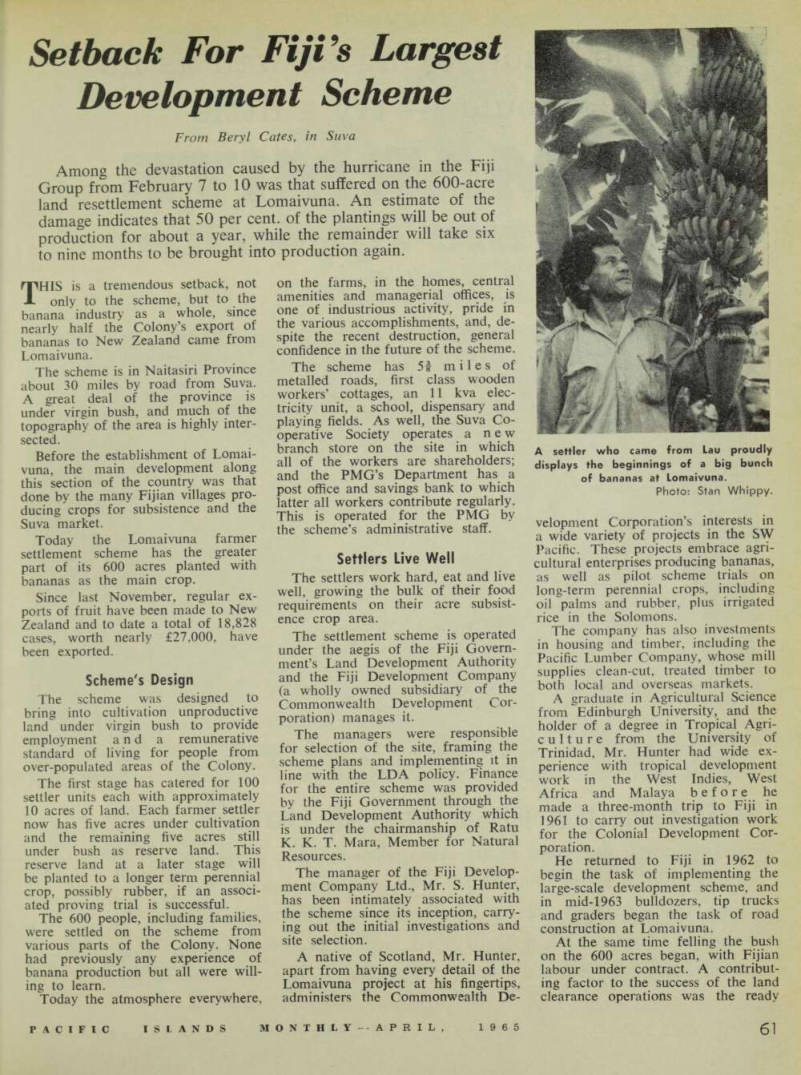
A settler who came from Lau proudly displays the beginnings of a big bunch of bananas at Lomaivuna.
Photo: Stan Whippy.
co-operation of the Fijian Affairs Board which interested itself in every detail of the contract and ensured the co-operation of the Fijian land owners.
The important post of scheme man ager was undertaken by Mr. R. F.
Burness, who was seconded from the Fiji Agriculture Department for the purpose. Mr. Burness is a graduate of the Gatton Agriculture College, with much previous agricultural ex perience in Queensland. He had had 12 years’ experience with the Fiji Agriculture Department before tak ing up the post of Lomaivuna scheme manager.
The assistant manager is Mr. J.
Kingdon, who puts in long hours in the interests of the settlers whom he knows well.
The human relationships and social aspects of such a large scheme of this type are all important, and from the start it was necessary for the man agement to be of the right calibre.
Incorporated in the scheme is a 10-acre rubber trial planting which was established in mid-1963 with clonal seed imported from Sabah. To date, progress is encouraging and growth is described by Mr. Hunter as being “marginally less good to that of similar material age for age in Malaysia. This difference results from the fact that the Pacific climate has a distinctly hot and cold season.”
Nursery
The year before the arrival of the settlers, a nursery had been estab lished on the site and initially the farmers worked communally on the holdings planting with stock from the nursery.
Plantings completed, farmers be came responsible for their own in dividual holdings, working in accord ance with the mind of the manage ment, which follows the best modern methods of agriculture.
The “Black Leaf Streak” disease, which has caused havoc in other banana growing areas in Fiji, is kept in strict control at Lomaivuna by regular two-weekly sprayings of banana misting oil. Malayan leaf spot disease is effectively controlled by regular applications of copper in oil.
Settlers themselves do the spraying and dusting necessary for the con trol of scab moth.
Under the watchful eye of Mr.
Burness detailed control action is taken against all disease and the re sult is good quality clean fruit for market.
Rush periods are encountered dur ing banana packing periods, and at these times it has been the policy
to recruit outside labour. To date, farmers have undertaken their own packing on their own holdings with outside help which has not proved entirely satisfactory.
A central packing shed is envisaged in which skilled packers will be used to ensure all fruit is graded to a uniform size. Bunches harvested by the settlers themselves will be trans ported to the central packing shed and payment to the farmer calcu lated on a bunch basis in relation to the number of hands it contains.
Consideration is now being given to an extension of the scheme. This would provide holdings for 100 more settlers and their families after which time the population on the settlement could be close to 1,000.
The Lomaivuna land settlement scheme has come a long way since its establishment 18 months ago, and it is a fine example of what can be achieved where a high level of co operation exists, particularly between management and settlers working to a clear, agreed plan with a common ultimate objective. Demonstrated has been a pattern of development to serve as a blueprint for future schemes of this scale.
Great credit is due to the settlers for their enthusiasm and co-opera tion and their willingness to adapt themselves to a new way of life. They have shown, too, their ability to learn quickly new agricultural methods.
Keen interest in Lomaivuna is be ing taken in the Pacific and the methods of agriculture being used there for this, the largest land de velopment scheme yet undertaken in Fiji, has already shown itself to be a worthwhile venture.
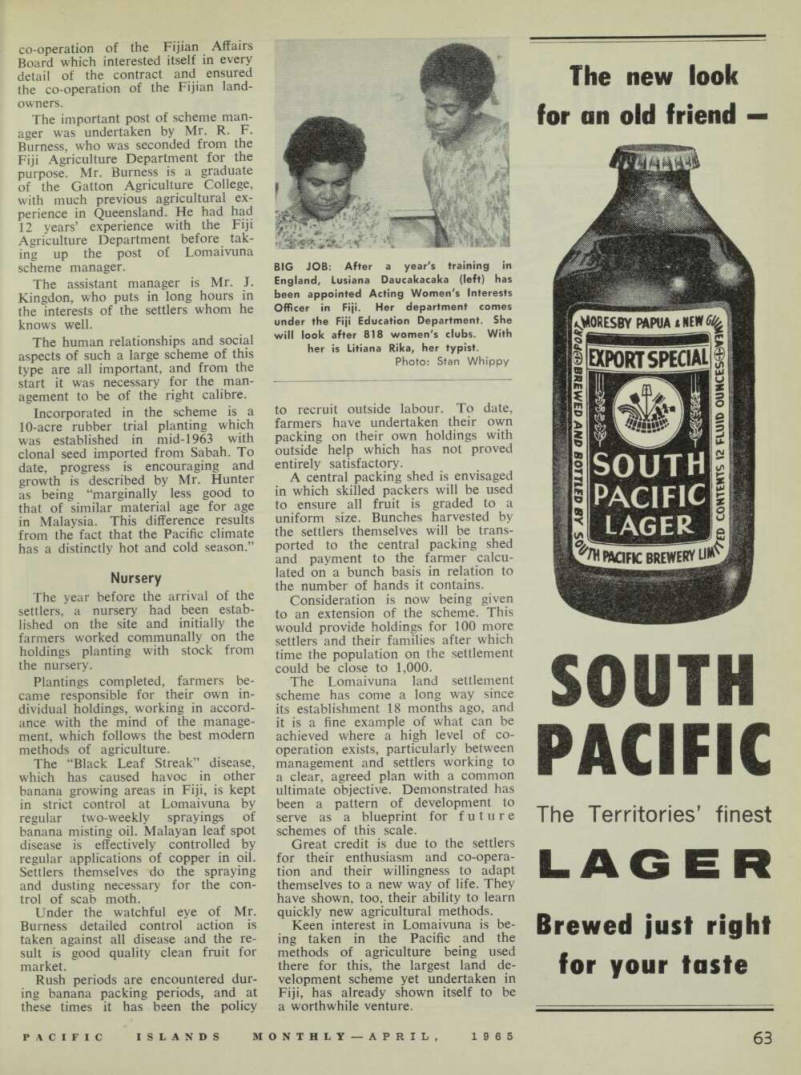
BIG JOB; After a year's training in England, Lusiana Daucakacaka (left) has been appointed Acting Women's Interests Officer in Fiji. Her department comes under the Fiji Education Department. She will look after 818 women's clubs. With her is Litiana Rika, her typist.
Photo: Stan Whippy