Pioneer Fiji Flying Boat
pp. 55-57 · Read in the full issue
May Come Out Off "Mothballs" After 34 Years
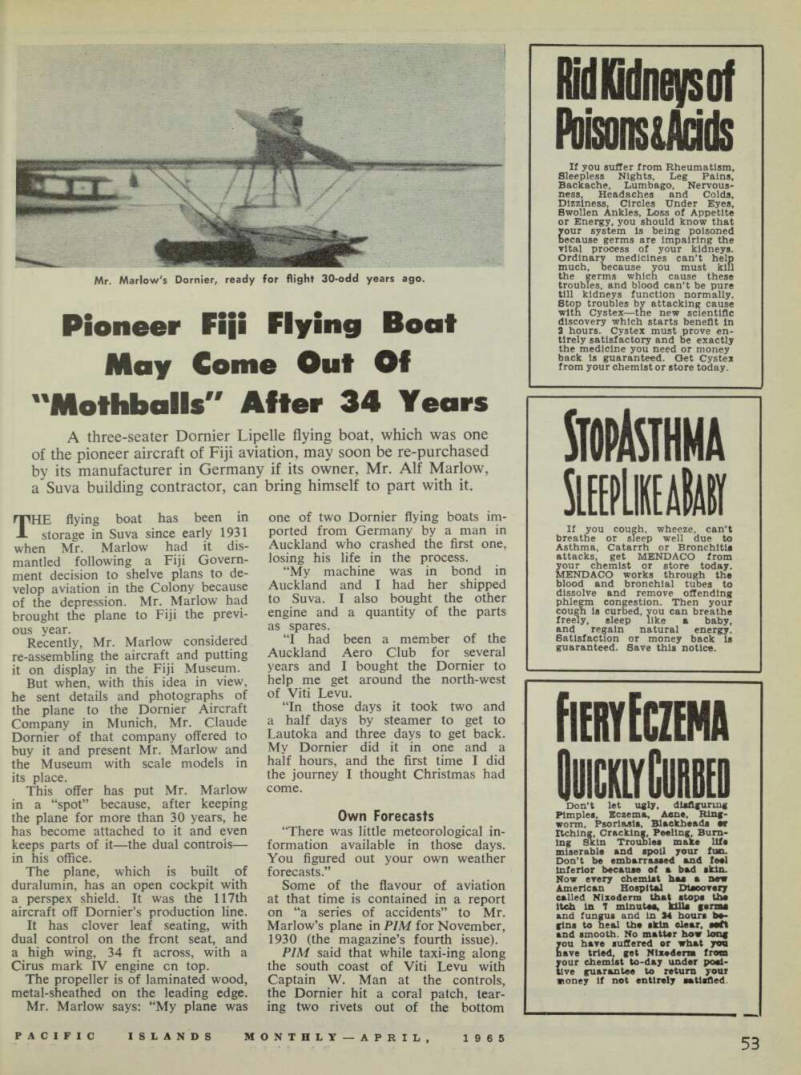
A three-seater Dornier Lipelle flying boat, which was one of the pioneer aircraft of Fiji aviation, may soon be re-purchased by its manufacturer in Germany if its owner, Mr. Alf Marlow, a Suva building contractor, can bring himself to part with it.
THE flying boat has been in storage in Suva since early 1931 when Mr. Marlow had it dis mantled following a Fiji Govern ment decision to shelve plans to de velop aviation in the Colony because of the depression. Mr. Marlow had brought the plane to Fiji the previ ous year.
Recently, Mr. Marlow considered re-assembling the aircraft and putting it on display in the Fiji Museum.
But when, with this idea in view, he sent details and photographs of the plane to the Dornier Aircraft Company in Munich, Mr. Claude Dornier of that company offered to buy it and present Mr. Marlow and the Museum with scale models in its place.
This offer has put Mr, Marlow in a “spot” because, after keeping the plane for more than 30 years, he has become attached to it and even keeps parts of it—the dual controls— in his office.
The plane, which is built of duralumin, has an open cockpit with a perspex shield. It was the 117th aircraft off Dornier’s production line.
It has clover leaf seating, with dual control on the front seat, and a high wing, 34 ft across, with a Cirus mark IV engine cn top.
The propeller is of laminated wood, metal-sheathed on the leading edge.
Mr. Marlow says: “My plane was
one of two Dornier flying boats im ported from Germany by a man in Auckland who crashed the first one, losing his life in the process.
“My machine was in bond in Auckland and I had her shipped to Suva. I also bought the other engine and a quantity of the parts as spares.
“I had been a member of the Auckland Aero Club for several years and I bought the Dornier to help me get around the north-west of Viti Levu.
“In those days it took two and a half days by steamer to get to Lautoka and three days to get back.
My Dornier did it in one and a half hours, and the first time I did the journey I thought Christmas had come.
Own Forecasts “There was little meteorological in formation available in those days.
You figured out your own weather forecasts.”
Some of the flavour of aviation at that time is contained in a report on “a series of accidents” to Mr.
Marlow’s plane in PIM for November, 1930 (the magazine’s fourth issue).
PIM said that while taxi-ing along the south coast of Viti Levu with Captain W. Man at the controls, the Dornier hit a coral patch, tear ing two rivets out of the bottom
Mr. Marlow's Dornler, ready for flight 30-odd years ago.
and blowing the cylinder head gaskets.
“After a lot of bother and hard travelling,” PIM went on, “the spare parts were taken overland to the flying boat, and repairs were effected.
“Captain Man flew to Sigatoka, where the plane was fully tested, but the revolutions again dropped below the minimum in the air, and further investigations showed that the valves required regrinding, copper from the blown cylinder head gaskets having been deposited in the valve seatings.
“Again this was remedied, and after a test of an hour in the air, passengers were taken up for joy rides.
“After a while, when the revolu tions again dropped, a forced land ing became necessary, so the plane made for the river, and safely landed upon the water.
“It was slackening speed when the pilot suddenly saw several natives bathing in the river, right in front of the machine. All would probably have gone well, but the passenger got ‘the wind up’, and in his trepida tion, kicked or hit the throttle wide open, and to avoid killing the natives, Captain Man had to make straight for the bank.
“Happily no one was hurt, but the luckless plane came home to Suva in a cutter in pieces. . .”
End Of Career After the flying boat was repaired in Suva, she took to the air again.
But it was not long before her fly ing career came to an end.
Her last flight was in a hurricane that devastated part of Viti Levu in early 1931.
In May, 1931, PIM reported that Mr. Marlow’s pilot, Captain Man, had returned to Auckland, and that Mr. Marlow had dismantled the Dornier and had stored it “until times improved.”
Captain Man was quoted as telling the Auckland Press that conditions in Fiji were “almost ideal” for fly ing, as “land-locked water abounded on every coast, and many of them contained beaches of good hard sand upon which a flying boat or seaplane could be hauled up.”
Captain Man said he did not find hurricanes a drawback to aviation in the Colony as there was “always fairly good warning of their approach”; and he was convinced that when the depression lifted fly ing boats and seaplanes would be widely used.