The Parish Pump Political
pp. 47-51 · Read in the full issue
Party Is A Force To Be Reckoned With
The New Guinea Political Scene, by Stuart Inder Whatever the fate of New Guinea’s Public Service Amend ment Bill—and it looks very much as if Canberra will topple it on technical grounds —you should make no mistake that its stormy passage through the House of Assembly marked a crucial milestone in New Guinea politics.
WHETHER or not the bill should have been passed, whether or not it was introduced for the wrong reasons, whether or not it was an example of mob rule, aren’t the most significant points. The fact that it happened at all is the fact that should be pasted in your hat for future reference.
And having got that fact firmly established, only then is it worth while examining in detail the reasons why it happened.
The fact that it happened is fair
warning that the New Guinea elec torate cannot be controlled by any body with any certainty. And that goes for the elected members them selves, for there is not unanimous support, by any means, for the Leader of the Elected Members, Mr. John Guise.
It is a stage that had to be reached, once Australia agreed to establish an Assembly with a big elected majority.
Sir Hugh Foot knew this when his Visiting Mission recommended the step. Sir Hugh knew better than anybody, with his British colonial experience, that once such a legisla ture had been established the pres sure would really be on, from the in side as well as the outside. The fact that pressure from the inside is not called pressure at all —it is euphemistically known as “ex perience”—seems to blind people to its existence.
Too Fast
My personal view is that things are going too fast in New Guinea in many ways, yet I don’t think there is any likelihood of a political blow-up, certainly not in the life of this parliament.
It would take several head-on collisions with the Minister before tempers would rise high enough to blow any lids off, and there are currently not enough issues, not enough principles, in the offing for any real collisions to develop.
The principle behind the February argument was that the time had come for Canberra to ease up on the reins—to ease up, mind you, not to give the horse its head in a run away gallop. P-NG wants to have some local control of the Public Service.
If Canberra, or Port Moresby, believe there was any other prin-
ciple at stake then they are deluding themselves. They are deluding them selves if they believe it was a few elected members leading the blind, or if they believe that one or two European elected members engineer ed the situation, and then were led by the ignorant mob.
These are delusions that could be dangerous if they are allowed to persist. If Canberra believes them then it is completely out of touch with what is really developing in the House of Assembly.
Simply, the elected members do not trust Canberra. (Over)
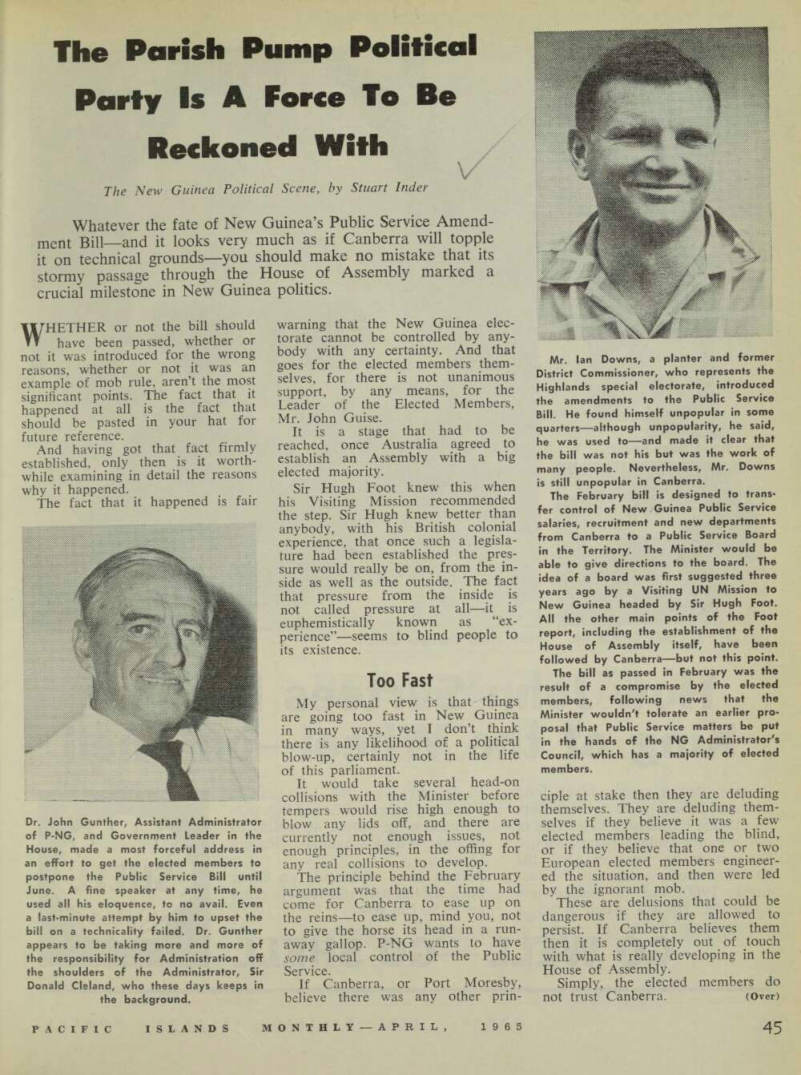
Dr. John Gunther, Assistant Administrator of P-NG, and Government Leader in the House, made a most forceful address in an effort to get the elected members to postpone the Public Service Bill until June. A fine speaker at any time, he used all his eloquence, to no avail. Even a last-minute attempt by him to upset the bill on a technicality failed. Dr. Gunther appears to be taking more and more of the responsibility for Administration off the shoulders of the Administrator, Sir Donald Cleland, who these days keeps in the background.
Mr. lan Downs, a planter and former District Commissioner, who represents the Highlands special electorate, introduced the amendments to the Public Service Bill. He found himself unpopular in some quarters —although unpopularity, he said, he was used to —and made it clear that the bill was not his but was the work of many people. Nevertheless, Mr. Downs is still unpopular in Canberra.
The February bill is designed to trans fer control of New Guinea Public Service salaries, recruitment and new departments from Canberra to a Public Service Board in the Territory. The Minister would be able to give directions to the board. The idea of a board was first suggested three years ago by a Visiting UN Mission to New Guinea headed by Sir Hugh Foot.
All the other main points of the Foot report, including the establishment of the House of Assembly itself, have been followed by Canberra—but not this point.
The bill as passed in February was the result of a compromise by the elected members, following news that the Minister wouldn't tolerate an earlier pro posal that Public Service matters be put in the hands of the NG Administrator's Council, which has a majority of elected members.
If the Public Service bill is thrown out, as apparently it will be because technically it is wobbly, then in a dozen different other ways the House will snap at Canberra —and keep on snapping until it sees some of Canberra’s powers handed over.
If Canberra is wise it will now proceed to use some ingenuity to devise ways of satisfactorily handing over at least a token of its powers to the developing parliamentary gov ernment in the Territory.
The French in the Pacific for years have used a great deal of ingenuity in controlling their pos sessions—not the least result being that they have kept the UN out of their hair, and a lot of local politicians, too.
Growing Up
The House of Assembly is growing up, and Canberra has got to realise it.
Not surprisingly, it is becoming conscious of its position.
It did not appreciate the blunt information from the Minister in February that he would not counte nance any change in the Public Service system. Nor did it appreciate Mr. Barnes for having announced in
January—before the meaure was in troduced to the House—the main details of the Pioneer Industries Bill, together with an assumption that the bill would be passed.
It did not appreciate the secret, almost underhand, way in which economic rentals were introduced— especially as this measure was certain to bring an outcry from the electorate, as it did.
It seems to me that the gaps between the people and the Admini stration, and the Administration and Canberra, are wider now than at any time, when in fact Port Moresby and Canberra should be thinking together now more than at any time. Politically, you cannot now do the things in New Guinea that you could do five years ago.
The biggest change is that there is an electorate and that it has developed a voice of sorts. The 54 elected members really are feeling the warm breath of their electors — or what they take to be the warm breath of their electors, and for all practical purposes this amounts to the same thing in politics.
There is even a unity in New Guinea —the unity of the parish pump. They want roads, bridges, airstrips, more schools, councils.
Each area wants something different but overall they all want the same thing—local development and the money from Port Moresby to finance it.
Local development is the main platform of what might be called the Parish Pump Party of Papua-New
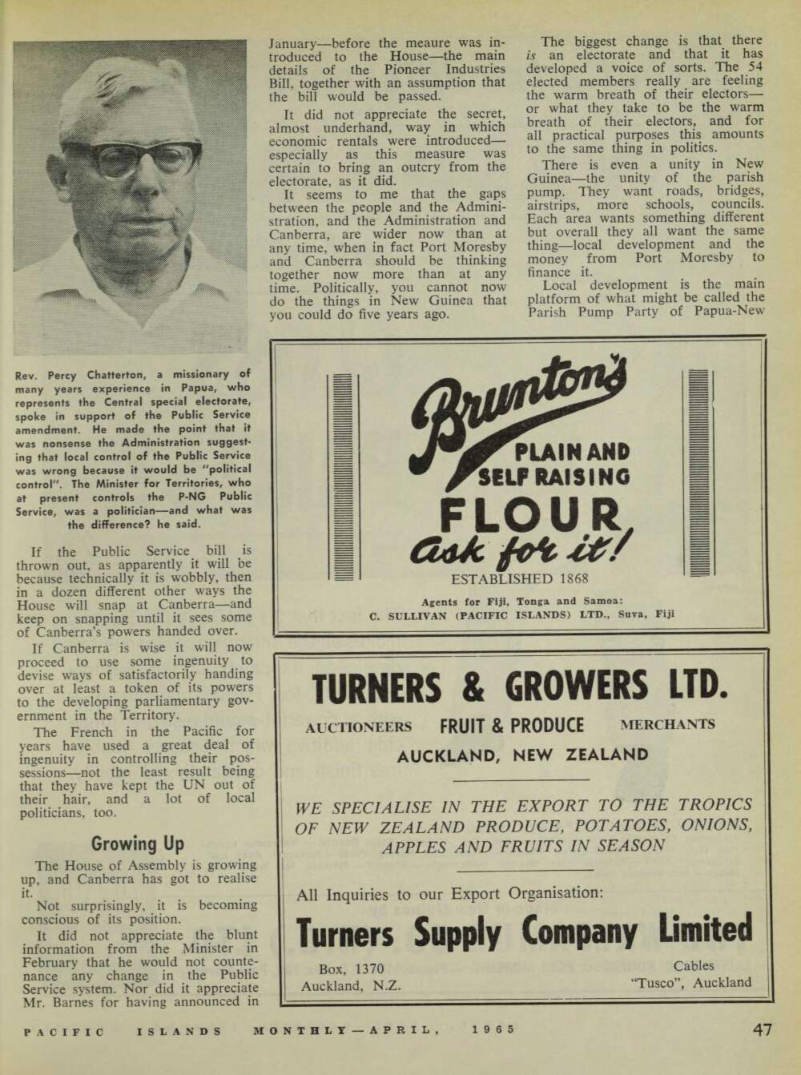
Rev. Percy Chatterton, a missionary of many years experience in Papua, who represents the Central special electorate, spoke in support of the Public Service amendment. He made the point that it was nonsense the Administration suggest ing that local control of the Public Service was wrong because it would be "political control". The Minister for Territories, who at present controls the P-NG Public Service, was a politician—and what was the difference? he said.
Guinea. And make no mistake, it’s a truly national party with virtually the entire elected membership of the House of Assembly on its executive.
Its platform transcends the barriers of language, yet every day the February meeting was in session I saw the official members of the House add to the strength of the Parish Pump Party, by the simple expedient of neglecting to put on thedr earphones when the parish pump politicians were addressing the House in Pidgin.
Resented
With two exceptions the official members know no Pidgin, a fact which is known to the Pidgin speakers and thus they resent not being heard by the people they want to reach.
The parish pump men equally resent the actions of some of the elected Europeans, especially from the special electorates, who make a practice of wandering around the corridors when native members are speaking, usually on the adjourn ment, in Pidgin, Some of the Europeans elected from open electorates are, naturally enough, more aware of the real
strength of feeling in the House than anybody and it is the influence of these men which has helped crystal lise the present strong anti-Canberra attitude in the House.
Many elected members, of both races, are honestly frightened of losing their seats unless they toe the line their electorates have drawn.
Is there anything wrong with that?
Is there any reason why they should be accused of “bowing to the mob” when they are reacting as any politician anywhere is expected to react? That is another fact that Canberra must learn to swallow.
Canberra, being remote, is blamed for some things it is probably not responsible for, but it certainly deserves much of the blame —or credit for the rise of the Parish Pump Party. The Party’s complaints are very real, for they have developed over a long period.
Pressure Now
For many years in the old Legislative Council, elected or nominated members would rise to complain that too much money was being spent in Port Moresby and not enough in other areas; that too much was being wasted on un-essentials, such as grand court houses, when it could have been spent on roads and bridges that could develop the Ter ritory.
The Administration, secure in its majority, seldom took any notice.
There was no pressure from Canberra to make it do the right thing; there was no pressure from the electorate.
Development of Port Moresby was assured; development of areas out side Moresby was left to the dedica tion or personality of a particular District Commissioner or ADO.
If your district had a live-wire at the top who could cut corners and argue with the shiny-bums in Port Moresby on their own terms, then your district went ahead.
If you had a time server, more interested perhaps in developing the local golf course, then you stagnated.
Luck Of The Draw
But why should you have to depend on the luck of the draw in the DC Stakes for your district to get a fair deal? Why shouldn’t a government that claims it is a govern ment see to it that everybody gets a fair deal?
These are questions that have been exercising New Guinean minds for some time—it is delusion to
suppose otherwise. Even if the Ad ministration did not now have the proof right there in front of it!
One of the Territory’s difficulties is that a legislature with a greater say in affairs wasn’t established years earlier than it was, so that the parish pump pressure that has now built up to something approaching a national issue could have been relieved.
As it is, Australia’s problems are still ahead, and how Canberra chooses to solve them will be a vital consideration. • Fifty-one New Hebridean students are being educated overseas in British territories this year, and two of them are at universities, one hoping to become a lawyer and the other a teacher. Missions are financ ing 12 of the students; the university students have scholarships under the Commonwealth Scholarship and Fellowship Plan; and the other students have scholarships paid for from Colonial Development and Wel fare Funds.
Mr. John Pasquarelli, crocodile skin dealer who represents the Sepik open electorate of Angoram, spoke up forcefully in the House in February against the bill aimed at making it unlawful to sell small croco dile skins. He said he would be skinned alive by the people of his electorate, who survived economically by catching and selling crocodiles of all sizes. Particularly it was a woman's work. The Sepik people used crocodiles for food. The bill was lost.
Mr. John Stuntz, a planter and former patrol officer who represents the East Papua special electorate, supported the amendment bill, although he did not agree that it should have been passed in February. He wanted it held over until June for more detailed study on technical grounds. In view of the fact that the bill
will probably be rejected because of
technical faults, his was reasonable ad vice. But the general opinion was that as the Administration had so far made no offer to compromise then its motives were suspect. It could have the bill in its lap and then clean it up. Stuntz is a clear thinker and his views carry in fluence among the elected members. They did not overlook the fact that he sup ported the principle of the bill.