United States May Take Over Line
pp. 43-45 · Read in the full issue
Islands From Britain
By a Staff Writer
There is a possibility that three islands in the northern Pacific—Fanning, Washington and Christmas—which have been under British sovereignty for three-quarters of a century, may be transferred to United States sovereignty.
IT is understood that the Australian company, Burns Philp, which is the only commercial organisation with interests in the three islands, has already been asked if it could handle its business, where necessary, through US channels.
London and Washington have re cently been looking at the possibility of the US taking control of the area, which is close to US territory, and a decision is likely to be made soon.
Britain annexed Fanning and Christmas Islands in 1888 and Washington Island in 1889 because they lay in the path of the then proposed trans-Pacific cable from Bamfield, Canada, to Southport, Queensland.
Cable and Wireless Ltd. opened a repeater station on Fanning Island in 1902, which continued to function until December, 1963, when the Bamfield-Southport cable was super seded by COMPAC. (COMPAC spans the Pacific from Honolulu to Suva without an island “hop.”).
Since the cable station on Fanning Island was closed, Britain’s original reason for wanting to control that island and the others has, of course, disappeared; and at present there appears to be no other reason why it should want to continue its control.
Strategic Value
It would not be surprising, there fore, if sovereignty over the three islands were transferred to the United States, particularly as the US is in a much better position to maintain it than Britain is, and because the islands are of considerable strategic value to the US, while they are useless in that respect to Britain.
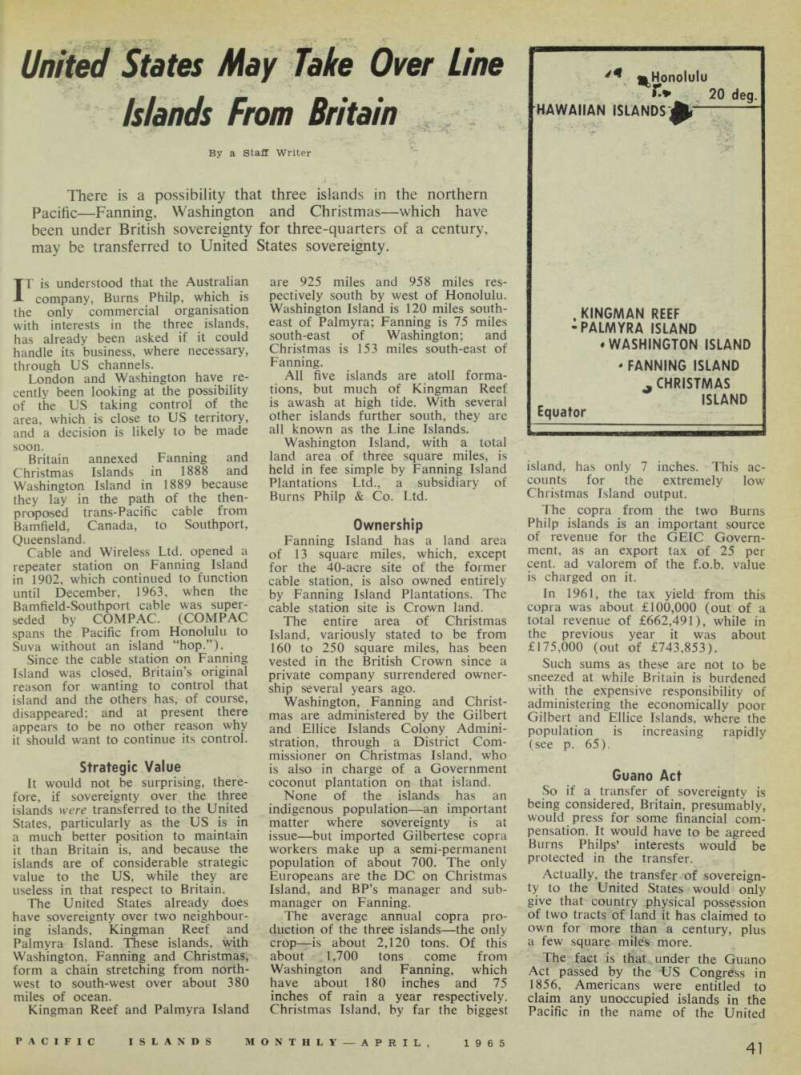
The United States already does have sovereignly over two neighbour ing islands, Kingman Reef and Palmyra Island. TTiese islands, with Washington, Fanning and Christmas, form a chain stretching from north west to south-west over about 380 miles of ocean.
Kingman Reef and Palmyra Island
are 925 miles and 958 miles res pectively south by west of Honolulu.
Washington Island is 120 miles south east of Palmyra; Fanning is 75 miles south-east of Washington; and Christmas is 153 miles south-east of Fanning.
All five islands are atoll forma tions, but much of Kingman Reef is awash at high tide. With several other islands further south, they are all known as the Line Islands.
Washington Island, with a total land area of three square miles, is held in fee simple by Fanning Island Plantations Ltd., a subsidiary of Burns Philp & Co. Ltd.
Ownership
Fanning Island has a land area of 13 square miles, which, except for the 40-acre site of the former cable station, is also owned entirely by Fanning Island Plantations. The cable station site is Crown land.
The entire area of Christmas Island, variously stated to be from 160 to 250 square miles, has been vested in the British Crown since a private company surrendered owner ship several years ago.
Washington, Fanning and Christ mas are administered by the Gilbert and Ellice Islands Colony Admini stration, through a District Com missioner on Christmas Island, who is also in charge of a Government coconut plantation on that island.
None of the islands has an indigenous population—an important matter where sovereignty is at issue—but imported Gilbertese copra workers make up a semi-permanent population of about 700. The only Europeans are the DC on Christmas Island, and BP’s manager and sub manager on Fanning.
The average annual copra pro duction of the three islands—the only crop—is about 2,120 tons. Of this about 1,700 tons come from Washington and Fanning, which have about 180 inches and 75 inches of rain a year respectively.
Christmas Island, by far the biggest
island, has only 7 inches. This ac counts for the extremely low Christmas Island output.
The copra from the two Burns Philp islands is an important source of revenue for the GEIC Govern ment, as an export tax of 25 per cent, ad valorem of the f.o.b. value is charged on it.
In 1961, the tax yield from this copra was about £lOO,OOO (out of a total revenue of £662,491), while in the previous year it was about £175,000 (out of £743,853).
Such sums as these are not to be sneezed at while Britain is burdened with the expensive responsibility of administering the economically poor Gilbert and Ellice Islands, where the population is increasing rapidly (see p. 65), Guano Act So if a transfer of sovereignty is being considered, Britain, presumably, would press for some financial com pensation. It would have to be agreed Burns Philps’ interests would be protected in the transfer.
Actually, the transfer of sovereign ty to the United States would only give that country physical possession of two tracts of land it has claimed to own for more than a century, plus a few square miles more.
The fact is that under the Guano Act passed by the US Congress in 1856, Americans were entitled to claim any unoccupied islands in the Pacific in the name of the United
States for the purpose of removing guano.
Forty-eight islands —15 of which do not exist —were claimed in this way, and among them were Washington and Christmas. Some American maps still show some of the existing islands as “claimed by US, administered by UK”.
American guano interests are not known to have made any use of Washington Island; but they did work Christmas Island for guano for several years from 1857—the year in which Captain J. L. Pendleton, of the US ship John Marshall, took formal possession of the island for his country.
However, American interest in Christmas Island lapsed in the early 1860’s, and in 1865 a British lease to the island was granted to the Anglo- Australian Guano Co. This lease was cancelled four years later at the com pany’s request, and when another British guano prospector, armed with a British lease, arrived at the island in 1871, he found it occupied by three men from Honolulu. Moreover, the USS Narrangansett had just been there and had taken formal possession again.
But the Narrangansett’s act cut no ice with Great Britain, for in 1888, Captain William Wiseman, of HMS Caroline, was sent to the island to annex it to Great Britain to make it safe for the proposed trans-Pacific cable.
The Americans protested strongly at the time, but Christmas Island has remained British ever since, although Britain had to send a
warship there in 1937 when the Americans cast covetous eyes on it for an air base.
The British company, Lever’s Pacific Plantations Ltd., was granted a 99-year lease in 1902, and this company planted nearly 73,000 coconut palms.
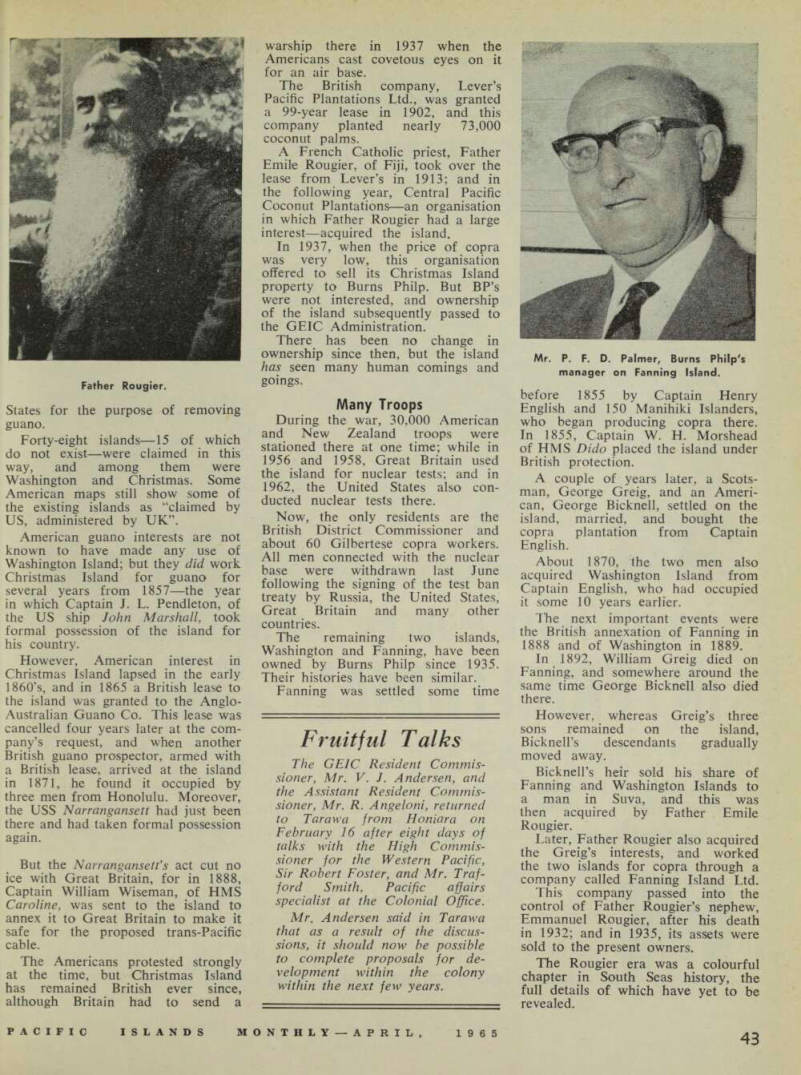
A French Catholic priest, Father Emile Rougier, of Fiji, took over the lease from Lever’s in 1913; and in the following year, Central Pacific Coconut Plantations—an organisation in which Father Rougier had a large interest—acquired the island.
In 1937, when the price of copra was very low, this organisation offered to sell its Christmas Island property to Burns Philp, But BP’s were not interested, and ownership of the island subsequently passed to the GEIC Administration.
There has been no change in ownership since then, but the island has seen many human comings and goings.
Many Troops
During the war, 30,000 American and New Zealand troops were stationed there at one time; while in 1956 and 1958, Great Britain used the island for nuclear tests; and in 1962, the United States also con ducted nuclear tests there.
Now, the only residents are the British District Commissioner and about 60 Gilbertese copra workers.
All men connected with the nuclear base were withdrawn last June following the signing of the test ban treaty by Russia, the United States, Great Britain and many other countries.
The remaining two islands, Washington and Fanning, have been owned by Burns Philp since 1935.
Their histories have been similar.
Fanning was settled some time
before 1855 by Captain Henry English and 150 Manihiki Islanders, who began producing copra there.
In 1855, Captain W. H. Morshead of HMS Dido placed the island under British protection.
A couple of years later, a Scots man, George Greig, and an Ameri can, George Bicknell, settled on the island, married, and bought the copra plantation from Captain English.
About 1870, the two men also acquired Washington Island from Captain English, who had occupied it some 10 years earlier.
The next important events were the British annexation of Fanning in 1888 and of Washington in 1889.
In 1892, William Greig died on Fanning, and somewhere around the same time George Bicknell also died there.
However, whereas Greig’s three sons remained on the island, Bicknell’s descendants gradually moved away.
Bicknell’s heir sold his share of Fanning and Washington Islands to a man in Suva, and this was then acquired by Father Emile Rougier.
Later, Father Rougier also acquired the Greig’s interests, and worked the two islands for copra through a company called Fanning Island Ltd.
This company passed into the control of Father Rougier’s nephew, Emmanuel Rougier, after his death in 1932; and in 1935, its assets were sold to the present owners.
The Rougier era was a colourful chapter in South Seas history, the full details of which have yet to be revealed.
Father Rougier.
Mr. P. F. D. Palmer, Burns Philp's manager on Fanning Island.