Lost "Pandora" Logbook Turns
pp. 35-37 · Read in the full issue
New Light On The "Bounty" Mutiny
Lost "Pandora" Logbook Turns Up In U.K. After 170 Years
By Robert Langdon
The logbook of the commander of HMS Pandora, an important document in the mutiny on the Bounty story, has recently come to light in London after having been “lost” for more than 170 years.
THE logbook has been presented to the Admiralty Library, along with other documents of the Pan dora’s commander, Captain Edward Edwards.
The Pandora was the ship that was sent to the Pacific in 1790-91 to find and arrest the Bounty mutineers following the return to London of the Bounty’s commander, Captain Bligh, after his famous open boat voyage.
The Pandora arrived in Tahiti in March, 1791; arrested the 10 mutineers who were there; confiscated a handsome, 33 ft schooner they had built; and then set off westwards— with the schooner as a tender —in search of the nine mutineers, who, it was found many years later, had settled on Pitcafrn Island.
After becoming separated from
the schooner off Samoa, the Pandora headed for the Dutch East Indies.
But on August 28, 1791, she was wrecked near the northern tip of Australia while trying to find a passage through the Great Barrier Reef.
The survivors of the shipwreck, including Captain Edwards and six mutineers, reached Timor in the ship’s boats, and from there they went on to Batavia by other vessels.
From Batavia, Captain Edwards wrote a long report to the Admiralty on the Pandora’s voyage which duly reached the Admiralty, and which, in accordance with the regulations, was eventually passed on to the Public Record Office, London, where it now is.
Until now, this report and a small book written by the Pandora’s
surgeon, George Hamilton, were the only major sources of information available on the Pandora’s voyage.
However, because of many precise details in Captain Edwards’ report, historians of the Bounty affair always felt that the Pandora’s log book must have been preserved, and it now appears that the logbook re mained in the possession of Edwards’ descendants until it was given to the Admiralty Library.
A microfilm of the logbook and accompanying documents has since been acquired by Sydney’s Mitchell Library, and I believe I am the first writer to have studied the papers for 120 years. The only other writer known to have seen them was Admiral W. H. Smyth, who, it was discovered recently, borrowed them from the Edwards family and wrote about them briefly in the United Services Journal in 1843.
At first sight neither the logbook nor the accompanying papers seem to throw any sensationally new light on the Bounty story, but comparison of some of the material in them with that from other sources reveals plenty of “meat” for the experts to chew over.
For example, the papers ac companying the logbook include extracts from the journals of two Bounty midshipmen, Peter Heywood and George Stewart, which will
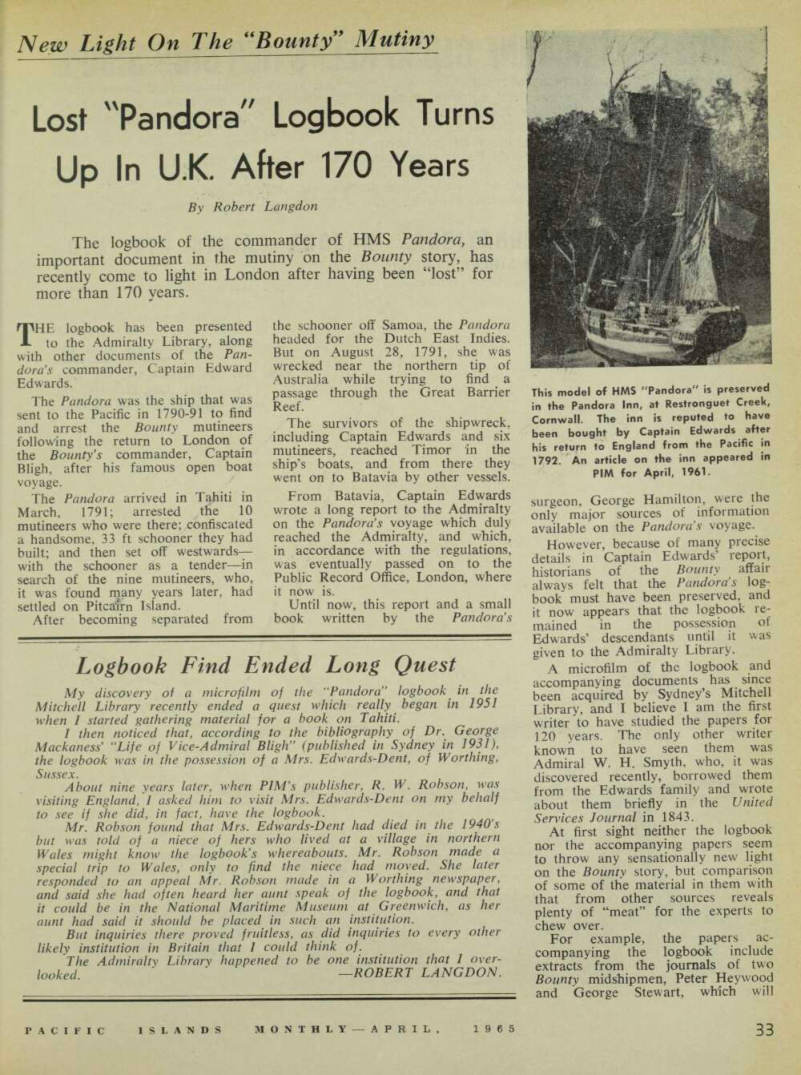
This model of HMS "Pandora" is preserved in the Pandora Inn, at Restronguet Creek, Cornwall. The inn is reputed to have been bought by Captain Edwards after his return to England from the Pacific in 1792. An article on the inn appeared in PIM for April, 1961.
make it necessary to re-appraise the reliability of the so-called journal of lames Morrison, the Bounty’s boat swain’s mate.
Morrison’s journal is the main arsenal for the many attacks that various, writers down the years have made on Bligh.
Most writers until now have assumed that all of its pages, or at least many of the contentious ones, were written up from notes made contemporaneously with the events described.
However, the extracts from the journals of Heywood and Stewart—• the journals themselves were ap parently lost in the Pandora —prove that this was certainly not the case during the period immediately after the mutiny.
So the reliability of Morrison’s journal as a whole is now called in question.
Midshipman's Narrative
Similarly, information in Edwards’ logbook will make it necessary for historians to reassess the reliability of the recently-discovered narrative of Midshipman David Thomas Renouard of the Pandora (PIM, Aug., 1961, p. 29), which is an important document in Fiji’s history.
Renouard was one of nine men from the Pandora who were detailed to sail in the Bounty mutineers’ schooner after Captain Edwards fitted it out in Tahiti as a tender to the Pandora.
After the Pandora and the tender became separated off Samoa, the tender headed southwards for Nomuka in the Tonga Group, which was the appointed place of rendez vous in case of separation.
However, as the schooner had no
charts and no means of fixing longitude, it finished up at some other island, which was apparently in Fiji.
There, a month was spent waiting fruitlessly for the Pandora; then the schooner made for, and reached, the Dutch East Indies.
Over the past half-century or so, several historians have speculated on the identity of the island at which the schooner spent its month, for if this was, in fact, in Fiji, the schooner’s crew would have been the first Europeans to live in close contact with the Fijians.
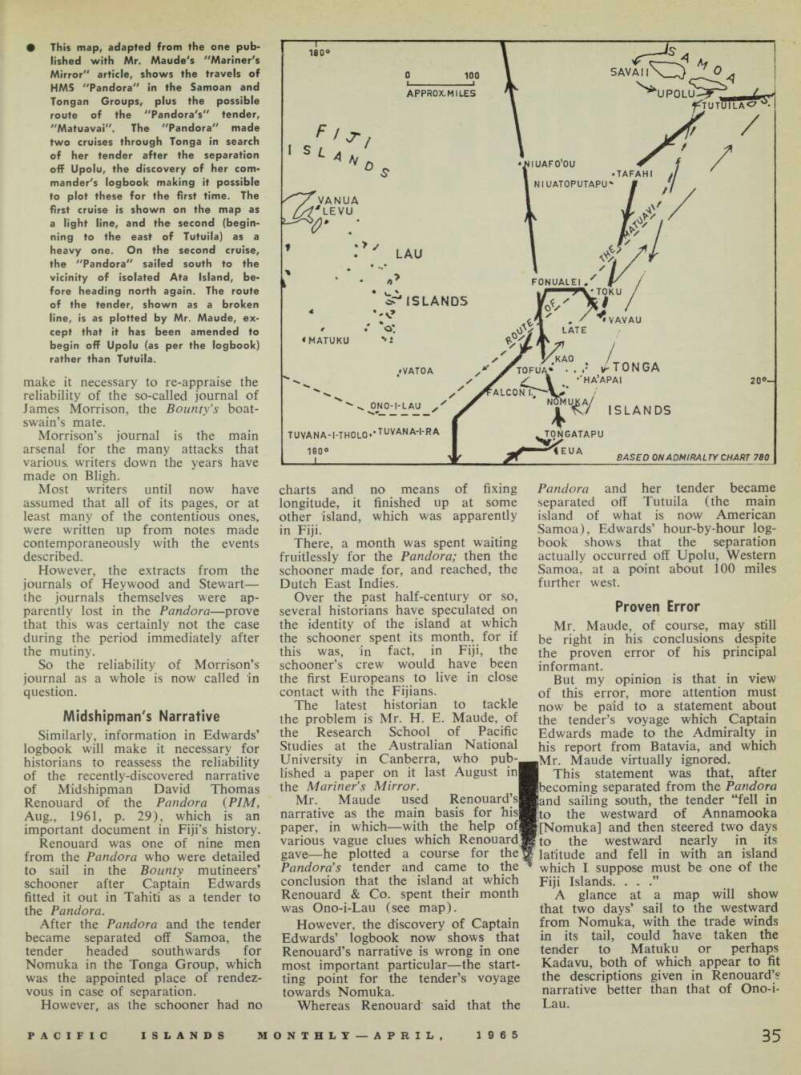
The latest historian to tackle the problem is Mr. H. E. Maude, of the Research School of Pacific Studies at the Australian National University in Canberra, who pub lished a paper on it last August ini the Mariner’s Mirror. Mr. Maude used Renouard’sl narrative as the main basis for hisl paper, in which—with the help ofi various vague clues which Renouardl gave—he plotted a course for the* Pandora’s tender and came to the conclusion that the island at which Renouard & Co. spent their month was Ono-i-Lau (see map).
However, the discovery of Captain Edwards’ logbook now shows that Renouard’s narrative is wrong in one most important particular—the start ting point for the tender’s voyage towards Nomuka.
Whereas Renouard said that the
Pandora and her tender became separated off Tutuila (the main island of what is now American Samoa), Edwards’ hour-by-hour log book shows that the separation actually occurred off Upolu, Western Samoa, at a point about 100 miles further west.
Proven Error Mr. Maude, of course, may still be right in his conclusions despite the proven error of his principal informant.
But my opinion is that in view of this error, more attention must now be paid to a statement about the tender’s voyage which Captain Edwards made to the Admiralty in his report from Batavia, and which -Mr. Maude virtually ignored. This statement was that, after ■becoming separated from the Pandora land sailing south, the tender “fell in ito the westward of Annamooka l[Nomuka] and then steered two days *to the westward nearly in its 1 latitude and fell in with an island which I suppose must be one of the Fiji Islands. . . .”
A glance at a map will show that two days’ sail to the westward from Nomuka, with the trade winds in its tail, could have taken the tender to Matuku or perhaps Kadavu, both of which appear to fit the descriptions given in Renouard’s narrative better than that of Ono-i- Lau.
This map, adapted from the one pub lished with Mr. Maude's "Mariner's Mirror" article, shows the travels of HMS "Pandora" in the Samoan and Tongan Groups, plus the possible route of the "Pandora's" tender, "Matuavai". The "Pandora" made two cruises through Tonga in search of her tender after the separation off Upolu, the discovery of her com mander's logbook making it possible to plot these for the first time. The first cruise is shown on the map as a light line, and the second (begin ning to the east of Tutuila) as a heavy one. On the second cruise, the "Pandora" sailed south to the vicinity of isolated Ata Island, be fore heading north again. The route of the tender, shown as a broken line, is as plotted by Mr. Maude, ex cept that it has been amended to begin off Upolu (as per the logbook) rather than Tutuila.