A University - But
p. 28 · Read in the full issue
New Guinea Will Have
What Of The Money?
By O. H. K. Spate
I think my reaction to the announcement by the Minister for Territories of the proposals for a university in New Guinea will be shared by most people interested in New Guinea affairs —better late than never.
IT is a year since the report of the Currie Commission was pre sented, and this is, after all, rather longer than the normal period of gestation. But it is a big step forward, and it will take a great effort if the university is to start work, even in a modest way, by the date of 1966 mentioned by Mr.
Hasluck, then Minister for Terri tories, in the House of Representa tives as long ago as 1962.
The need for a university in the Territory cannot be overstressed.
Now that we have a House of Assembly with an elected indigenous majority, political advancement is well ahead of economic and educa tional development, and this could be very dangerous.
At present we have only one indi genous graduate, who took his degree in agriculture at the end of last year; by the end of this year there will be a few more, including very probably one with an honours degree.
It is not that the indigenous people lack the intelligence for higher educa tion. On my last night in Port Moresby, I spent four solid hours in very solid argument—over the beer—with half-a-dozen Papuans, who kept me pretty much on my toes. I have no hesitation in saying that at least three of them were good university material.
But so far only a trickle of people have had even a full secondary course. Perhaps it seemed 10 or 12 years ago as if there was plenty of time before us; but time is the scarcest commodity in this world of new nationalisms.
Urgent
It is, then, of urgent importance to give New Guineans access to higher education. Even from an economic point of view, it will be cheaper in the long run to enable them to do many of the jobs now done by expatriates, who are costly and may even be needed here at home.
This is true of all sectors —agriculture, public health, commerce, eventually secondary industry, and above all, in the range of admini strative tasks needed for running the country. And this can be much better done in institutions, both academic and higher technical ones, on the spot and adapted to the real needs of the country and the people.
In saying this I do not mean to imply that the University of New Guinea should be just a narrowly utilitarian technical college; far from it.
But there is no doubt that it is very wasteful to train New Guineans
on Australian syllabuses, which con tain much that is irrelevant or even sheer mental cruelty—the language of King Lear, for example.
On the other hand, much that is not stressed in Australian courses should be added to meet New Guinea conditions. In field sciences like geology, for example, there would be a good deal of difference in emphasis: the study of recent volcanoes, for example, is not of great significance here, but it is vital to New Guinea.
Staffing, of course, will be a crucial problem. To some extent we will have to appeal to people who have a sense of mission. But New Guinea is not without its attractions. In all the field and social sciences—geology, zoology, botany, anthropology, sociology, geography—the island is
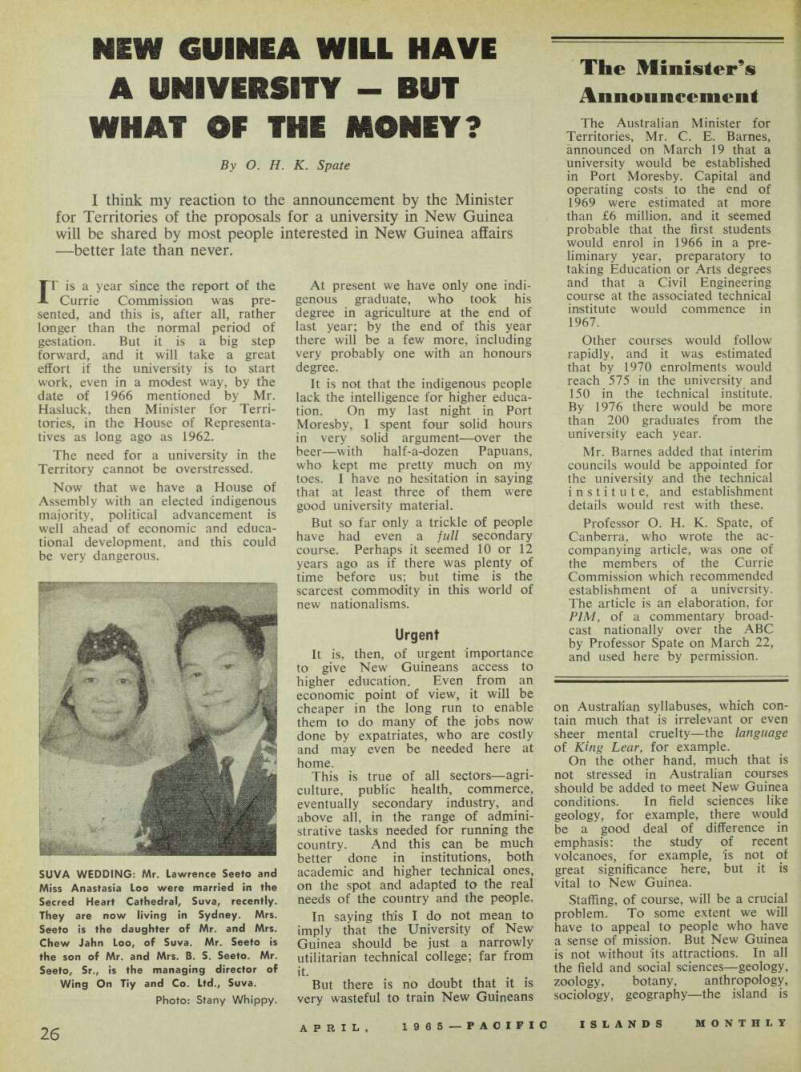
SUVA WEDDING: Mr. Lawrence Seeto and Miss Anastasia Loo were married in the Secred Heart Cathedral, Suva, recently.
They are now living in Sydney. Mrs.
Seeto is the daughter of Mr. and Mrs.
Chew Jahn Loo, of Suva. Mr. Seeto is the son of Mr. and Mrs. B. S. Seeto. Mr.
Seeto, Sr., is the managing director of Wing On Tiy and Co. Ltd., Suva.
Photo: Stany Whippy.