Tropicalities
pp. 23-27 · Read in the full issue
A new journal devoted to affairs in New Guinea, the Pacific and South-East Asia will appear in April. Known as New Guinea, it is a quarterly published by the Council on New Guinea Affair^/
NEW GUINEA, a 96-page quality magazine illustrated with line drawings by prominent Australian artists, is obviously designed to provide a vehicle for intelligent, literate debate on the problems of New Guinea.
The Council, which has this aim as one of its projects, secs New Guinea’s problems not only as internal ones of political, economic and social development, but as external ones which now face Australia with a major task.
What are New Guinea’s future relations with Australia to be? How are they likely to be affected by White Australia? What is New Guinea’s place in the context of developments in Asia, or in the Pacific? What is it in the emerging interest shown in New Guinea by Africans with whom, as the Guise delegation to Nairobi last December showed. New Guineans already feel a marked affinity?
We’ve seen early copies of New Guinea and it is not an academic magazine, although academics are prominent contributors. Others in clude top journalists, politicians, native leaders, and businessmen.
The first issue of New Guinea contains articles by Tom Mboya (Kenya’s Development Minister) on the future of New Guinea, Oala Oala-Rarua on “Wage Cuts and Racial Discrimination,” F. M. Hewitt on “Problems of Private Investment,”
Charles Rowley on “The Debate That Wasn’t,” John Kerr on the new university, Tom Millar on “Defending New Guinea” and Keith Levy on the Madang-Hagen Road.
Other articles deal with the Press, the World Bank report, the Pacific and China in South East Asia.
Other contributors include Neil Mclnnes, Peter Hastings, O. H. K.
Spate, Kevin Martin, Henry Mayer, P. W. E. Curtin, Ric Shand and Gavin Souter.
According to its editor, Peter Hastings, former editor of The Bul letin, future issues will include articles on Labour Party thinking on New
Guinea, the position of the Chinese in the Territory, Indonesian admini stration in outlying territories, pro files of indigenous and European leaders in the Territory, profiles of South-East Asian leaders, articles on South-East Asia and the Pacific, New Guinea and the UN, the future of rubber, coffee, cocoa and timber in the Territory, education and the elite, book reviews and a discussion section.
The quarterly will be on sale in Papua-New Guinea and Australia and will cost 5/- for single copies.
Sign Of A Thaw
In The Air War?
IT is not usual for the Bulletin d’lnformation, the weekly news letter of the French Administration in the New Hebrides, to include editorial comment in its reportage of the local scene.
But some crept into the issue for March 19 in a report on local aviation.
The report said that on March 13, a Drover aircraft of New Hebrides Airways made a trip from Vila to Norsup, Malekula, and back, carrying five passengers and urgent mail.
It was the first time that an NHA plane had landed at Norsup—the Drover being under charter to Hebridair, whose Dornier 28 (which usually serves Norsup), was in Noumea for an overhaul.
Commented the Bulletin : “At a time when the need for some sort of association between the two local airline companies is becoming more and more obvious, the facts de monstrate the value of an aerial pool in the archipelago.”
The point of the Bulletin’s remarks is that a minor war has been going on in the New Hebrides for some time over internal air transport.
While business has been expanding, New Hebrides Airways, a British company with New Hebridean share holders, and the first in the field, (Over)
has resisted attempts by Hebridair, a French company, to move into areas that it pioneered.
Mr. Bob Paul, the head of New Hebrides Airways, indicated in an interview with The Fiji Times last year that Hebridair was not easy to co-operate with, when he said: “The French will not meet anyone half way. They want everything for them selves.”
However, the fact that Mr. Paul’s company has now done the Vila- Norsup-Vila charter flight for Hebridar could be a sign that there is a more friendly feeling between the rivals,
“Veejay" Hits The
Home Trail
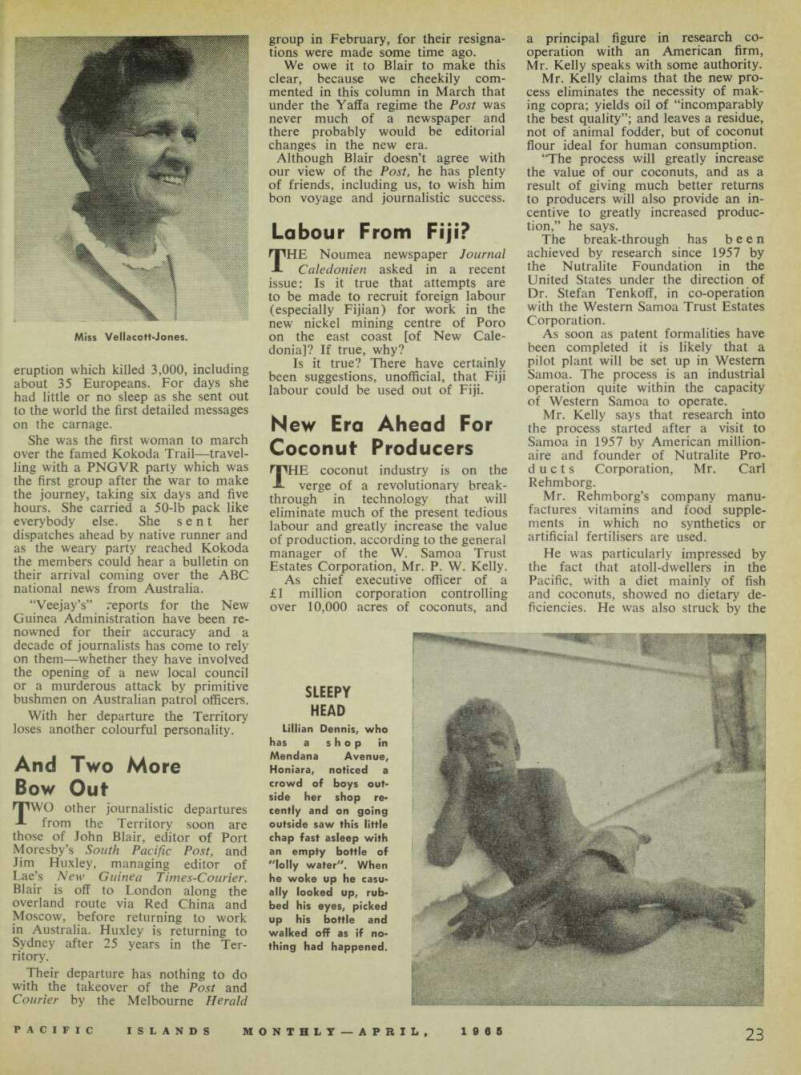
rpHE thousands of words that have . been pouring out of New Guinea in recent weeks about the activities of the visiting United Nations Mission are a kind of journalistic swan song for the Territory’s principal informa tion officer, and best known reporter, Miss K. Vellacott-Jones.
She is travelling throughout the Territory with the mission and re porting her last big story after 16 years in the Territory as a journalist —l2 of them as PRO for the Admin istration.
In May, “Veejay” (she is also known as “Helicopter”, “Apricot- Jones” and “Kate”) packs her battered portable and sets off for a European vacation before heading for Canada, where she will settle down to some radio writing.
Born in Somerset, England, but reared in Saskatchewan, Canada, “Veejay” found her way to Port Moresby in 1949 after a journalistic career which had already taken her to many out of the way places, and after a wartime and post-war Army career with the British Women’s Auxiliary Service which took her to India and Burma, Sumatra, Java and Japan.
In the Territory she organised the present radio news service for the Australian Broadcasting Commission and for four years was the ABC’s only journalist in New Guinea. She achieved a reputation for going any where after a story, and in that era of transport shortages she would thumb a lift by jeep, canoe or plane to collect the facts. For several days she was the only reporter on the scene of the big 1951 Mt. Lamington
eruption which killed 3,000, including about 35 Europeans. For days she had little or no sleep as she sent out to the world the first detailed messages on the carnage.
She was the first woman to march over the famed Kokoda Trail—travel ling with a PNGVR party which was the first group after the war to make the journey, taking six days and five hours. She carried a 50-lb pack like everybody else. She sent her dispatches ahead by native runner and as the weary party reached Kokoda the members could hear a bulletin on their arrival coming over the ABC national news from Australia.
“Veejay’s” reports for the New Guinea Administration have been re nowned for their accuracy and a decade of journalists has come to rely on them—whether they have involved the opening of a new local council or a murderous attack by primitive bushmen on Australian patrol officers.
With her departure the Territory loses another colourful personality.
And Two More
Bow Out
fIWVO other journalistic departures A from the Territory soon are those of John Blair, editor of Port Moresby’s South Pacific Post, and Jim Huxley, managing editor of Lae’s New Guinea Times-Courier.
Blair is off to London along the overland route via Red China and Moscow, before returning to work in Australia. Huxley is returning to Sydney after 25 years in the Ter ritory.
Their departure has nothing to do with the takeover of the Post and Courier by the Melbourne Herald
group in February, for their resigna tions were made some time ago.
We owe it to Blair to make this clear, because we cheekily com mented in this column in March that under the Yaffa regime the Post was never much of a newspaper and there probably would be editorial changes in the new era.
Although Blair doesn’t agree with our view of the Post, he has plenty of friends, including us, to wish him bon voyage and journalistic success.
Labour From Fiji?
THE Noumea newspaper Journal Caledonien asked in a recent issue: Is it true that attempts are to be made to recruit foreign labour (especially Fijian) for work in the new nickel mining centre of Poro on the east coast [of New Cale donia]? If true, why?
Is it true? There have certainly been suggestions, unofficial, that Fiji labour could be used out of Fiji.
New Era Ahead For
Coconut Producers
THE coconut industry is on the verge of a revolutionary break through in technology that will eliminate much of the present tedious labour and greatly increase the value of production, according to the general manager of the W. Samoa Trust Estates Corporation, Mr. P. W. Kelly.
As chief executive officer of a £1 million corporation controlling over 10,000 acres of coconuts, and
a principal figure in research co operation with an American firm, Mr. Kelly speaks with some authority.
Mr. Kelly claims that the new pro cess eliminates the necessity of mak ing copra; yields oil of “incomparably the best quality”; and leaves a residue, not of animal fodder, but of coconut flour ideal for human consumption.
“The process will greatly increase the value of our coconuts, and as a result of giving much better returns to producers will also provide an in centive to greatly increased produc tion,” he says.
The break-through has been achieved by research since 1957 by the Nutralite Foundation in the United States under the direction of Dr. Stefan Tenkoff, in co-operation with the Western Samoa Trust Estates Corporation.
As soon as patent formalities have been completed it is likely that a pilot plant will be set up in Western Samoa. The process is an industrial operation quite within the capacity of Western Samoa to operate.
Mr. Kelly says that research into the process started after a visit to Samoa in 1957 by American million aire and founder of Nutralite Pro ducts Corporation, Mr. Carl Rehmborg.
Mr. Rehmborg’s company manu factures vitamins and food supple ments in which no synthetics or artificial fertilisers are used.
He was particularly impressed by the fact that atoll-dwellers in the Pacific, with a diet mainly of fish and coconuts, showed no dietary de ficiencies. He was also struck by the
Miss Vellacott-Jones.
Sleepy
Head
Lillian Dennis, who has a shop in Mendana Avenue, Honiara, noticed a crowd of boys out side her shop re cently and on going outside saw this little chap fast asleep with an empty bottle of "lolly water". When he woke up he casu ally looked up, rub bed his eyes, picked up his bottle and walked off as if no thing had happened.
lack of technological advances in pro cessing the coconut.
It is still in the horse and buggy days,” he said. “The labour and re turns associated with copra will never get the people out of grass huts.”
As a result, both out of scientific interest and a genuine desire to help Islands people, he instituted research by the Nutralite Foundation, a philanthropic organisation, into the properties and processing possibilities of the coconut.
Research last year culminated in the perfection of a process yielding the purest coconut oil ever produced, leaving the residue of coconut flour.
Samples of the oil have already been sent to leading buyers and have brought enthusiastic reports, Mr.
Kelly says.
He adds; “It is now over to the engineers to design the factory. There is no question that this is a break through that should immeasurably improve the lot of coconut producers throughout the world.”
Churchill's Role In
The New Hebrides
THE recent death of Sir Winston Churchill and the subsequent publicity campaign to raise money for scholarships in his memory has reminded old Pacific hand, Lew Friday, who now lives in Sydney, that as a young man Churchill played an important role in the establish ment of the Condominium Adminis tration in the New Hebrides, The Condominium was set up by a convention between Britain and France on October 20, 1906, and was officially proclaimed in Vila on December 2, 1907.
Friday writes: “Winston Churchill, as Under secretary of State for the Colonies, played a big part in helping to create this compromise solution to a problem which had caused much bad blood between the French and British settlers in the New Hebrides.
“Australian observers commended the part he played in the complicated and tedious business of setting up the Joint Administration, whose aim was to assure the better protection of life and property by establishing a region of joint influence, in which the subjects and citizens of the two Signatory Powers should enjoy equal rights of residence and personal pro tection and trade, while each of the two Powers retained jurisdiction over its subjects or citizens, without exercis ing a separate control over the Group.
“To a man, the Presbyterian missionaries, who swayed Australian opinion from their headquarters in Victoria, gave Winston Churchill high praise for his ‘remarkable knowledge of New Hebridean affairs’.
“ ‘There are few things concerning the Group that he does not seem to know,’ the Rev. M. Prater, a missionary at Paama and one of their spokesmen, wrote at the time. T have been corresponding with the young Minister for some months and am astonished at his wide knowledge of the affairs with which we are so much occupied. Mr. Dale, of the Colonial Office, also knows the New Hebrides to his finger tips, and another who shows genuine interest is Lord Elgin.’ ” • The population of Oceania is likely to double by the year 2,000 AD., according to the United Nations Department of Economic and Social Affairs. The world population, ap proximately 3,000 million in 1960, may also double by the end of the century.