Nauruans, Where Now ?
p. 17 · Read in the full issue
By a Staff Writer
Australia has finally accepted the refusal of the Nauruans to be resettled on Curtis Island, off Queensland, when Nauru's phosphate supplies are worked out.
IT has officially discarded the Curtis Island scheme and has informed landholders that it won’t continue with negotiations to acquire the land there.
The Government’s action means that Australia now has no specific Nauruan resettlement scheme before it.
The only proposal at present in front of it is the proposal of the Nauruans themselves that they be allowed to remain on Nauru and become independent. This proposal will be discussed in Canberra soon at a meeting between the Government and Nauruan leaders.
The Government’s action on Curtis Island has finally spelled finish to a huge and detailed development scheme which the Nauruans themselves regarded as very generous.
The 200-square mile island, about the same size as Singapore, was to have been developed by Australia with roads, houses, shops, schools, harbour facilities and a commercial fishing industry, at an initial cash outlay of at least £ll million. The freehold of all this was to be presented to the Nauruan community, at present numbering 3,000.
Because of the present and planned industrial expansion of the nearby city of Gladstone, on the mainland, some observers predicted that Curtis
Island, after development, would one day “be worth the value of another Singapore”.
The Nauruans were to move to their new home over a period of years, and were to be given local government powers and become Aus tralian citizens.
The many details of the scheme were put in the hands of a special Nauru Resettlement Officer with the Department of Territories, Mr. Reg Marsh, who was appointed early in 1962 to that position.
They Want Independence
The scheme broke down following a conference in Canberra in mid -1964 when the Nauruans said that both Curtis Island and the scheme itself were good, but that they wouldn’t accept Curtis unless they were promised full sovereign rights there. They did not want to lose their identity and become Aus tralians.
Australia replied that it was un able to give sovereignty.
After this conference, Australia thought the Nauruans might change their minds but it soon became obvious that they were adamant and that their nationalism was extremely strong. The recent decision on Curtis was taken so that Curtis landowners would not have their holdings frozen any longer than was necessary.
The Administrator of Nauru, Mr.
R. S. Leydin, and the Head Chief, Hammer Deßoburt, will attend the Canberra talks, probably in May.
Representatives of an Australian firm of economic advisers retained by the Nauru Council will attend.
Also in Canberra will be public relations consultants who have been retained by the Council.
The agenda includes phosphate royalties, the rate of phosphate extraction, the ownership of the deposits (the Nauruans wish to con trol them), establishment of a Legislative Council “and subsequent independence”, and rehabilitation of Nauru by importing soil to fill the worked out phosphate fields.
In late , April Nauru was to be visited by the UN Mission at present touring New Guinea. Its report no doubt will be read with great interest by Australia before the Government decides what step to take next— whether to agree with the Nauruans’ request for an independent Nauru or whether to search for yet another resettlement island.
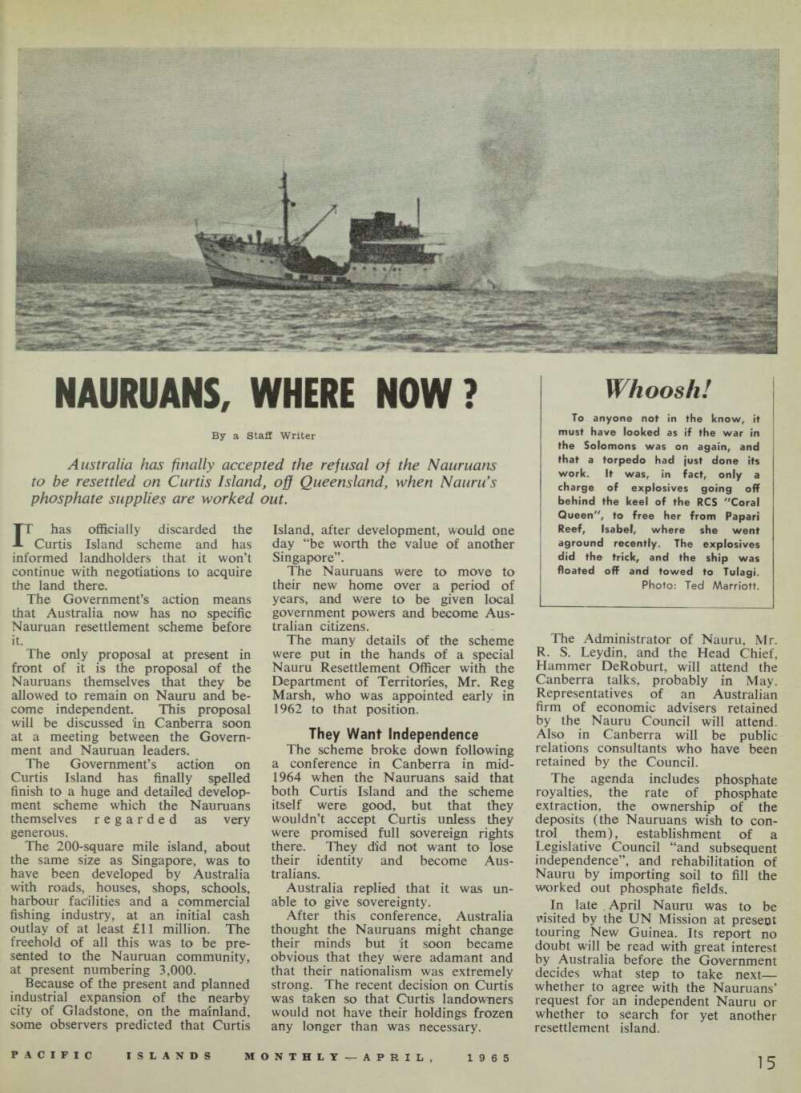
Whoosh!
To anyone not in the know, it must have looked as if the war in the Solomons was on again, and that a torpedo had just done its work. It was, in fact, only a charge of explosives going off behind the keel of the RCS "Coral Queen", to free her from Papari Reef, Isabel, where she went aground recently. The explosives did the trick, and the ship was floated off and towed to Tulagi.
Photo: Ted Marriott.