Cook Islands
pp. 14-146 · Read in the full issue
Prepare For
Big Election
The 15 far-flung islands of the Cook Group have been ex
periencing unprecedented activity
and excitement lately as the date draws near for the election of a new 22-member Legislative As sembly, which will begin a new era in Cook Islands history.
THE election will be held on April 20 and will be observed by six United Nations representatives—a Sudanese, a Pole, a Togolese, a Spaniard, an American and an Indian.
The new Assembly—the first with powers of full internal self-govern ment, provided it accepts the Consti tution Act passed by the New Zea land Parliament last October —will hold its first meeting on June 7.
New Zealand’s Governor-General, Sir Bernard Ferguson; the Prime Min ister, Mr. Holyoake; the Leader of the Opposition, Mr. A. H. Nordmeyer; and the Minister of Island Territories, Mr. J. R. Hanan, are among the pro minent people from New Zealand
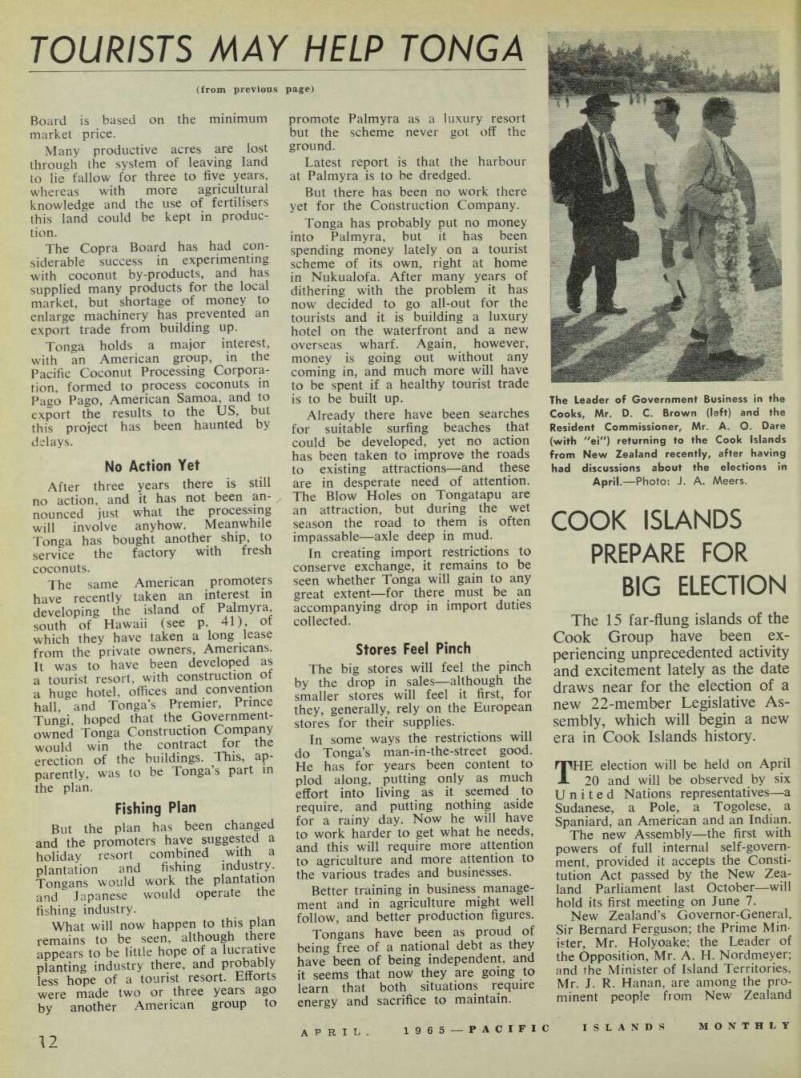
The Leader of Government Business in the Cooks, Mr. D. C. Brown (left) and the Resident Commissioner, Mr. A. O. Dare (with "ei") returning to the Cook Islands from New Zealand recently, after having had discussions about the elections in April. Photo: J. A. Meers.
who are expected to attend the As sembly’s inauguration and the accom panying celebrations to mark the at tainment of limited self-government.
A delegation of leaders from Western Samoa is also expected.
In late March a list of election candidates was publicised by Raro tonga’s Press and radio. The list shows that 66 people from Rarotonga and the outer islands will contest the 22 seats. Fifteen of the 66 are members of the Cook Islands Party, led by Mr. Albert Henry, who is debarred from standing as a candidate by the three-year residen tial clause which has been in force since 1958 and was kept in the proposed Constitution by the present Legislative Assembly.
Other candidates belong to a political party formed in Rarotonga last November—the Cook Islands Labour Party. A spokesman for this party says it is formed of working people and will do its best for working people, growers, and those with little or no income.
A third party, the Unity Party, is also rumoured to exist, but if so, it has issued no information to the public.
About half of the election candida tes appear to be people who are not known to belong to any Cook Islands political party and who are not members of the present Legislative Assembly, New To islanders The party system is brand new to the Cooks. In the past Cook Islanders voted for persons they liked and knew something about, and it seems probable that they will do so again in the April elections. Persona lities will probably influence more votes than the broad ideals of party platforms.
Mr. Mel Taylor, a Maori-speaking public relations officer in NZ’s Maori Affairs Department and Department of Island Territories, arrived in Rarotonga early in March to explain the whys and wherefores of the election to the people.
After a few days in Rarotonga he flew to Aitutaki, and then accom panied an RNZAF Sunderland to the outer islands for air-drops of information pamphlets. This was filmed by New Zealand’s National Film Unit.
Landings were made at Manihiki and Penrhyn, where Mr. Taylor found the islanders apprehensive about changes, and anxious to know if the New Zealand subsidy would be continued under internal self government and whether they would continue to be New Zealand citizens.
Throughout the Group, Mr. Taylor found that the degree of understand ing of the proposed Constitution and the new system of government seemed to vary widely.
The six United Nations represent atives who will observe the election are due to arrive in Rarotonga on April 8 with Mr. G. Hensley, head of the Pacific Desk in the NZ De partment of External Affairs.
Their leader is Mr. Omar Adeel, of Sudan, who is a former chief delegate of his country to the United Nations. The other UN represent atives are Messrs. L. Stembach (Poland), H. F. A. Pradas (Spain), B O. Dormeno, (Togo), C.
Sivasankar (India) and J. Lewis (United States), Messrs. Adeel, Lewis and Sivasankar will stay on Rarotonga for the election; Mr. Stembach will go to Aitutaki; Mr. Pradas will go to Mangaia; and, if shipping permits, Mr. Dormeno will go to Atiu.
Four members of the mission are expected to stay in the Cook Islands for the first meeting of the Legis lative Assembly, whose only business will be to debate a motion asking the Government to bring the Constitution Act into force.
This Act provides for full self-Gov ernment, but allows for continued association with New Zealand and
(Continued on page 144)
a common citizenship—that of New Zealand.
Other features are that the control of foreign affairs and defence will be vested in New Zealand; that the Cook Islands Cabinet will consist of a Premier and four other Ministers; and that a candidate for election to the Assembly must reside in the Cook Islands for three years before the election.
There is no certainty that the in coming Assembly will accept the Constitution Act as it stands. It could reject it in toto or it could demand amendments of one sort and another.
The impossibility of predicting the attitude of the new Assembly towards the Constitution Act no doubt prompted the present Cook Islands Executive Committee, headed by the Leader of Government Business, Mr.
D. C. Brown, to choose June 7 as the date for the new Assembly’s first sit ting.
June 7 is the Queen’s Birthday, so if the Assembly should reject the Con stitution Act in toto or should de mand amendments, which would de lay bringing the Act into force, the team of dignitaries coming from New Zealand for the opening of the As sembly will still have something to celebrate, even if it is not internal self-government in the Cook Islands