Mixed Reaction To UN's
pp. 11-12 · Read in the full issue
Mission To New Guinea
From a Special New Guinea Correspondent
Every tourist knows that the way to get the most out of a visit to a country is to swot up on it beforehand. In New Guinea, as the visiting mission of inspection from the United Nations Trusteeship Council got into its stride in late March, people were asking why all the four members hadn't done their home work before they came.
TERRITORIANS were justifiably annoyed to find that the team, whose report could have the widest international repercussions on Aus tralia’s trusteeship, contained at least one member who did not know that Japan had occupied most of the area during the last war.
As the itinerary unravelled, Admi nistration officers who attended the boring succession of public meetings in council houses throughout the Highlands became more and more amazed at the naivete of the questions some of the Mission members asked.
With only an hour to an hour and a half at each stop, much time was taken up, asking, and translating questions seeking basic information on such things as the composition and function of councils, respon sibility for road construction, and produce prices.
Much of the information probed for so laboriously was in the latest New Guinea annual report, proof copies of which were specially pulled for the Mission’s tour, and which travelled safely around in the special zipper brief cases, gold-embossed with the proclamation “United Nations Visiting Mission to New Guinea and Nauru, 1965”, and the member’s name.
But not all the fault for the
Mission’s ignorance could be laid at the door of the individual members.
A supposed briefing session in Port Moresby had been devoted almost entirely to discussion of administra tive detail, and the Mission arrived in the field pretty well unbriefed on Australian policy and its application.
And the crisis of the United Nations itself has cast its shadow on the Mission. Although the member nations of the party—Britain, the
United States, Liberia and France— were nominated in the first week in December last, ratification had to wait for the General Assembly’s session.
Due to the argument over voting rights, this session did no business, and the Mission’s visit was finally approved only three weeks before it landed in New Guinea. Two members, Mr. Andre Naudy, France, and Mr. Dermot J. Swan, England, were last-minute replacements for the original nominees.
The Mission was travelling to a very tight budget—s2s,ooo US had to take it to New Guinea and back to New York again—another result of the international financial crisis.
United Nations missions are sup posed to work as a team, with members sublimating personal in terests to the international weal.
However, despite strenuous attempts by members and secretariat to stress the cohesion of the group, it quickly became apparent that Mr. Andre Naudy was going to have a difficult job to keep his team together.
Mr. Nathaniel Eastman, of Liberia, carrying a large anti-colonial chip, very early set about gathering in formation to support his thesis that Australia had been deliberately pro crastinating in her task of leading New Guinea to independence. Mr.
Dwight Dickinson of America worked assiduously to counter his efforts.
And England’s Mr. Swan, ap pearing urbane and ineffectual, followed them around, apparently enjoying New Guinea immensely.
Goroka Rotarians received pro bably the biggest snub of the tour.
The club, seeking to impress the Mission with its sense of equality, invited the Mission to dine with it, and Mr. Eastman to address it. Mr!
Eastman declined, “on general prin ciples,” he said.
He had found that the Goroka Rotary Club had no native members, and that three local New Guineans, invited to window-dress the dinner]
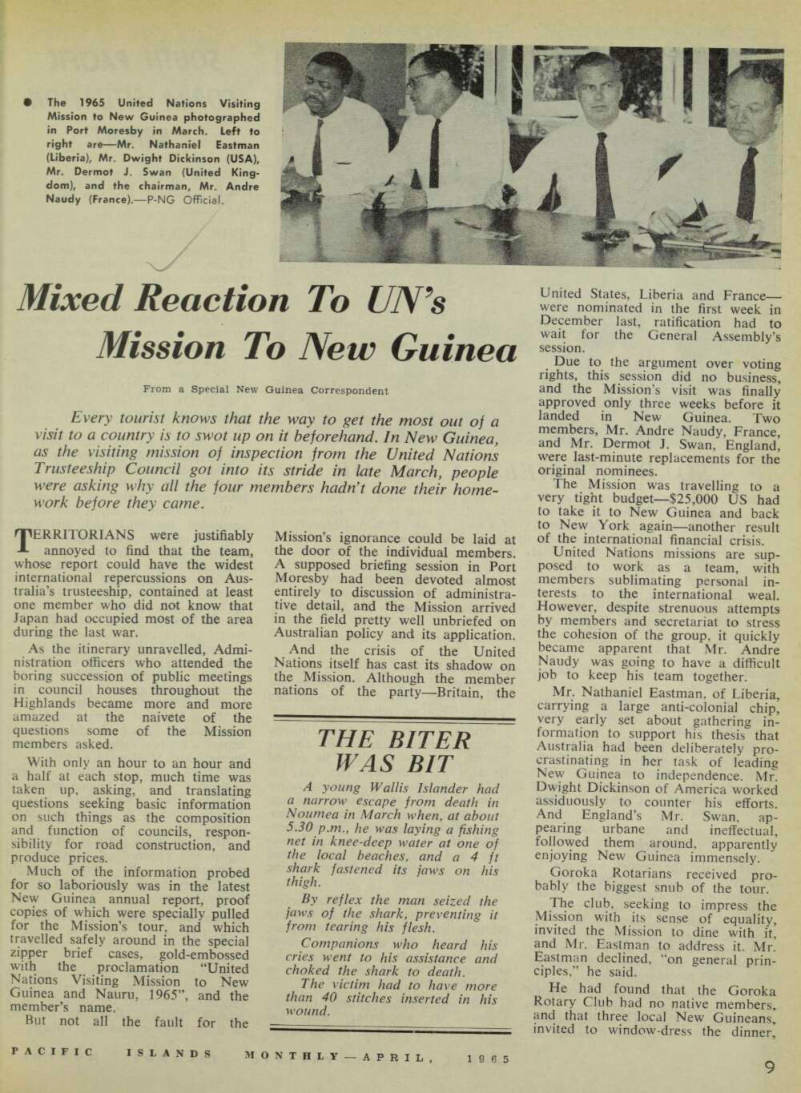
The 1965 United Nations Visiting Mission to New Guinea photographed in Port Moresby in March. Left to right are—Mr. Nathaniel Eastman (Liberia), Mr. Dwight Dickinson (USA), Mr. Dermot J. Swan (United King dom), and the chairman, Mr. Andre Naudy (France). P-NG Official.
were the first to attend a Rotary dinner there A meeting with Madang Rotary was eliminated, on advice, to avoid a similar situation.
The Visiting Mission will end its New Guinea inspection on April 15 with final discussions in Port Moresby, and will present its report to the Trusteeship Council in about four months time. r rnrises "
Obviously the report will not be a classic signpost to New Guinea progress in the fashion of: the Foot report -tress 4 ’ d P the ticularly adult edl ucatioin 1 need to deveiop a sense ofßational
responsibility amongtheNewGumea
people may well prove to be among its salient recommendations.
Yet it may contain some surprises too. Government officers, concentrating on the private discussions, rather than the public meetings of
the tour, already believe that pressure for accelerated political development will come from an unexpected quarter-France, not Liberia, Andre Naudy has been quietly comparing New Guinea with former French colonies in which he served from 1932 onwards. He has the widest political and administrative experience of any Mission member, As a member of the French delega tion which negotiated the indepen dence of the Cameroons, his know ledge and judgment can be expected t o play a decisive role in formulating recommendations, And Mr Eastman? Well> obse rvers are thinking that perhaps he is more realistic than he would like to appear, Privatel he has already to ld some Australian§ that a too-early in d d would lead on i y to gkSdshed and chaos. . x , But what, many people m New Guinea are wondering, will too early” prove to be for the Territory.