Fiji's Plans For Political
pp. 9-10 · Read in the full issue
Reforms Menaced By Inter-Racial Distrust
From a Suva Correspondent
Difficulties are developing in Fiji which could threaten the success of the constitutional conference to be held in London on July 28. The conference has been called by the Colonial Office so that it may introduce changes in the constitution of Fiji, aimed at making progress towards self-government.
ALL the 18 unofficial members of Fiji’s Legislative Council have been invited to the conference—six Fijians, six Indians and six Euro peans.
Fiji now has a population of nearly half a million and is qualified and competent to exercise self government. But the procedure to achieve this is open to criticism.
Efforts now being made in Fiji to work out a satisfactory procedure have themselves caused added difficulties, because much of what is going on has not been passed on to the man in the street, and while
developments remain a mystery to him they naturally raise suspicions in his mind.
The really troublesome factors are the determination of the Fijians to resist any change which may undermine their inalienable land rights; the formulation of some system under which the limited amount of agricultural land in Fiji may be made available for the use of any race so long as it does not interfere with titles; and a voting system for future elections.
Possibilities On the voting system the extreme possibilities are a common roll giving one man one vote—a system which would load the dice heavily in favour of the numerically superior Indians—or a continuation of the present communal roll system with each race voting separately for a candidate of its own.
But there are many variations in between, and about these there has been little discussion in Fiji, and little knowledge.
The Indians appear to favour a common roll, with most people ap pearing to want communal rolls at this stage of the Colony’s develop ment.
Another franchise problem is how to ensure representation of minority groups such as Chinese, Rotumans and other Pacific Islanders in Fiji, who are not at present re presented.
These matters of land and voting procedures dominate all present dis cussions and obviously are filled with explosive material.
The need for constitutional reform has been apparent for many years but Governor after Governor did little or nothing about it.
With the departure of the last Governor, however, the Fiji Admini stration began to apply itself
seriously to the long-delayed task.
Mr. P. D. Macdonald, while Acting- Governor, went to some pains to bring together the political leaders of the several communities with a view to ironing out their differences and preparing something tangible for a plan of constitutional reform.
When the new Governor, Sir Derek Jakeway arrived in Fiji early in 1964, he carried on from there, and has done some very effective work.
Discussions between the Governor and Legislative Council members have been going on—behind closed doors—but the Governor’s plan to get the unofficial members to decide what should be discussed in London has been defeated because of the reluctance of the Indians to give any definite undertakings and the refusal of the Fijians to give any undertakings unless the Indians do so.
At one of these closed meetings it was agreed that all races wanted to see a continuing link with the Crown and continued UK respon sibility for defence and external affairs. But the vital matters of land ownership and the common roll were left for further discussion.
In early March there was a further meeting with the Governor,
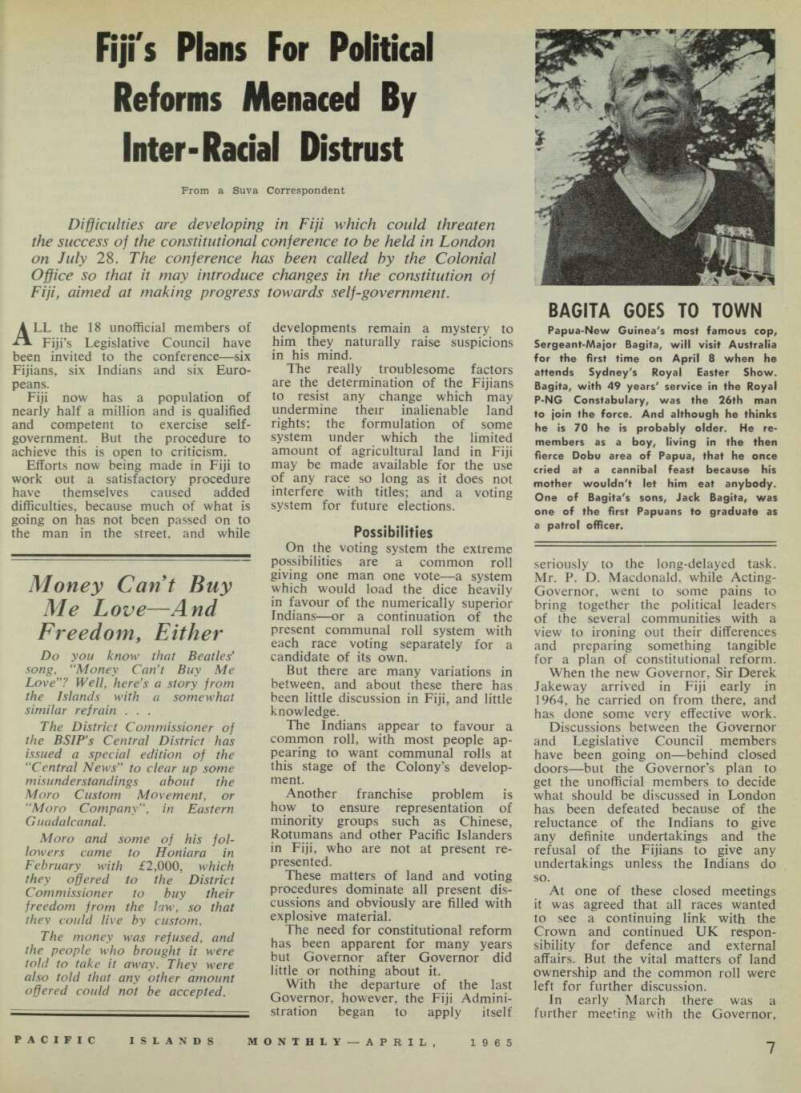
Bagita Goes To Town
Papua-New Guinea's most famous cop, Sergeant-Major Bagita, will visit Australia for the first time on April 8 when he attends Sydney's Royal Easter Show.
Bagita, with 49 years' service in the Royal P-NG Constabulary, was the 26th man to join the force. And although he thinks he is 70 he is probably older. He re members as a boy, living in the then fierce Dobu area of Papua, that he once cried at a cannibal feast because his mother wouldn't let him eat anybody.
One of Bagita's sons. Jack Bagita, was one of the first Papuans to graduate as a patrol officer.
which was expected to last two days during which the members were expected to get down to these basic constitutional details. But the meeting broke up early when Mr. A. D.
Patel, Member for Social Services, stated that he would contribute nothing to the discussion and would express his views only in London.
He said he had not been able to discover the views of his Indian followers.
The Fijians said that if the Indians would not talk, neither would they.
Something based on undertakings by leaders of the communities ob viously will have to be shaped up before the Colonial Office proceeds with its plans to transport the 18 non-official Legco members to London. If it is not possible to get some measure of agreement before July there would appear to be little chance of the London conference agreeing to the plan of reform which the Colonial Office wants to get into early operation.
Another conference with the Governor has been fixed for early April. Efforts are being made to bring Mr. Patel into a more reasonable frame of mind and if nothing is achieved at the April discussion the whole plan for a London conference could be in jeopardy.
Mr. Patel is recognised as one of the most able Fiji-Indian leaders in sight and he could do a great deal for the Colony. He is at present in a position where he could wreck the Colonial Office plan.
Meanwhile, at the end of March, the Fijians were taking the initiative.
They called a meeting and obtained agreement from the unofficial members of Legco that ownership of land, and the use of land, were not matters for the London discus 1 sion, because land ownership was beyond question, and the use of it was something to be discussed by the people concerned.
It must be said that the Govern ment and the Colonial Office certainly have made some of the problems for themselves. One of their errors is the decision to send the Legislative Council to London, for when this Legco was elected in 1963 the important issues involved in constitutional reform were not
prominent. If Fiji’s communities had then been asked to select men com petent to express in London the varying views on the structure of a future Fiji Government different people might have been elected to that Legco, It is most important that the Indian community as a whole be adequately represented in London, but as things are at present the meeting will be dominated by Mr.
A. D. Patel and his supporters, who certainly do not represent the great majority of Indians in Fiji in relation to constitutional reform.
There is also the fear that Mr.
Patel, if allowed to go to London in his present mood, and un committed, will use the occasion to express distrust of the Europeans in Fiji and gain glorification at the hands of Afro-Asian sympathisers.
He would be able to put his views on all subjects without the handicap of having them discussed in Fiji, where the people of Fiji would possibly put another complexion on things.
Right Course
If the Government had taken what obviously was the right course in preparing for this London discussion it would have organised a constitu tional convention of some kind for the whole of Fiji, where the issues could have been thrashed out, where the minor communities could have had a voice, and where the people might have had a chance to elect at least some of the representatives to go to the London conference and submit recommendations.
If, in that way, Mr. A. D. Patel, and people who think with him, should still have been sent to London as the representatives of public opinion in Fiji, then nothing more could be said.
Mr. Patel has made the excuse, as one reason why he will not talk before he goes to London, that any thing that he or his supporters say in these discussions behind doors sooner or later is published in The Fiji Times to his embarrassment.
The Fiji Times has reported that in the peculiar circumstances, and as an organ of public opinion, it has the strongest objection to vital decisions covering the future govern ment of Fiji being made in “private” and that it will publish whatever details of these conferences it can obtain.
If there is to be harmony in Fiji in the future, there must be com plete honesty now by all the com munities in these discussions—and a fair amount of compromise.
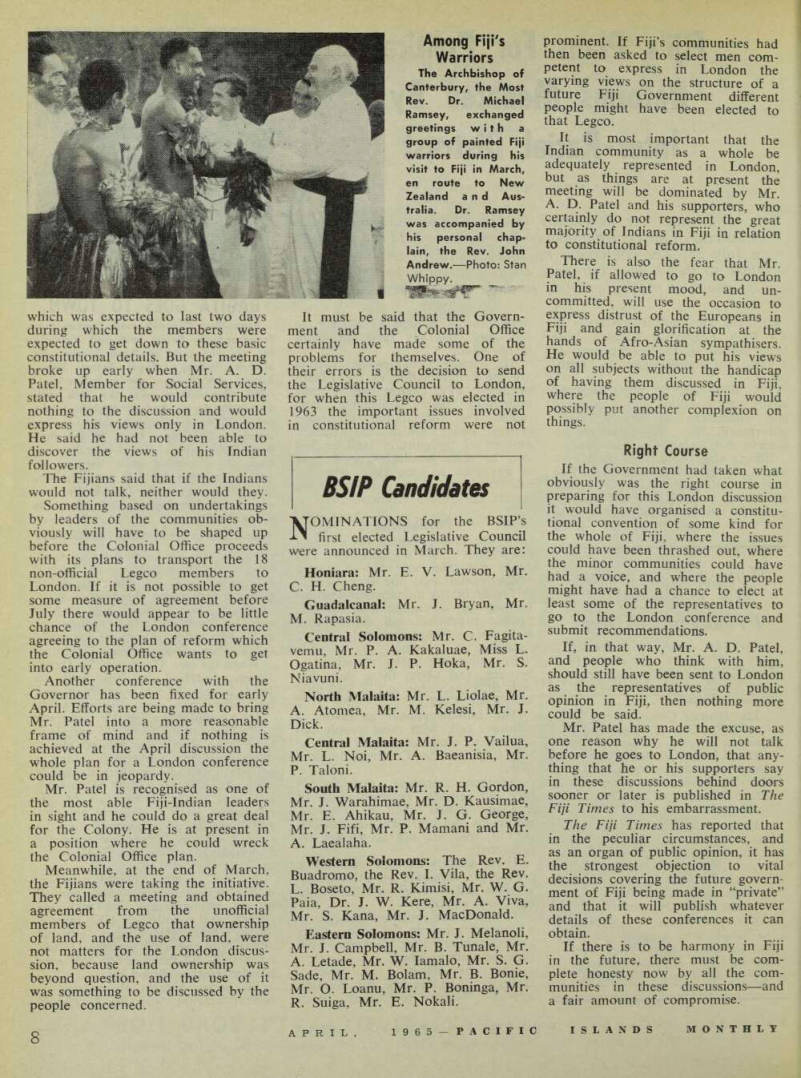
Among Fiji's
Warriors
The Archbishop of Canterbury, the Most Rev. Dr. Michael Ramsey, exchanged greetings with a group of painted Fiji warriors during his visit to Fiji in March, en route to New Zealand and Aus tralia. Dr. Ramsey was accompanied by his personal chap lain, the Rev. John Andrew. Photo: Stan Whippy.