P-NG Newspaper EI Dorado
pp. 133-137 · Read in the full issue
Pacific Commerce and Produce
Melbourne Group Moves Into P-NG Newspaper EI Dorado
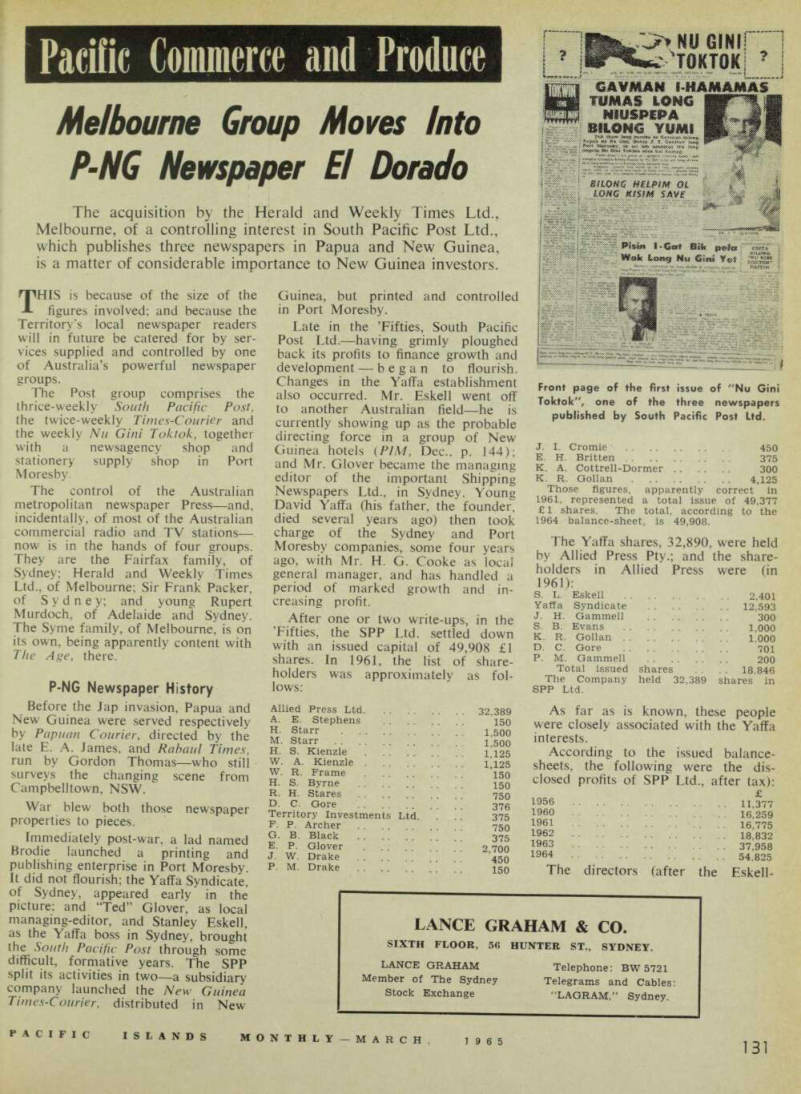
The acquisition by the Herald and Weekly Times Ltd., Melbourne, of a controlling interest in South Pacific Post Ltd., which publishes three newspapers in Papua and New Guinea, is a matter of considerable importance to New Guinea investors.
THIS is because of the size of the figures involved; and because the Territory’s local newspaper readers will in future be catered for by ser vices supplied and controlled by one of Australia’s powerful newspaper groups.
The Post group comprises the thrice-weekly South Pacific Post, the twice-weekly Times-Courier and the weekly Nu Gini Toktok, together with a newsagency shop and stationery supply shop in Port Moresby.
The control of the Australian metropolitan newspaper Press—and, incidentally, of most of the Australian commercial radio and TV stations— now is in the hands of four groups.
They are the Fairfax family, of Sydney; Herald and Weekly Times Ltd., of Melbourne; Sir Frank Packer, of Sydney; and young Rupert Murdoch, of Adelaide and Sydney.
The Syme family, of Melbourne, is on its own, being apparently content with The Age, there.
P-NG Newspaper History
Before the Jap invasion, Papua and New Guinea were served respectively by Papuan Courier , directed by the late E. A. James, and Rabaul Times, run by Gordon Thomas—who still surveys the changing scene from Campbelltown, NSW.
War blew both those newspaper properties to pieces.
Immediately post-war, a lad named Brodie launched a printing and publishing enterprise in Port Moresby.
It did not flourish; the Yaffa Syndicate, of Sydney, appeared early in the picture; and “Ted” Glover, as local managing-editor, and Stanley Eskell, as the Yaffa boss in Sydney, brought the South Pacific Post through some difficult, formative years. The SPP split its activities in two—a subsidiary company launched the New Guinea Times-Courier, distributed in New
Guinea, but printed and controlled in Port Moresby.
Late in the ’Fifties, South Pacific
Post Ltd.—having grimly ploughed
back its profits to finance growth and development began to flourish.
Changes in the Yaffa establishment also occurred. Mr. Eskell went off to another Australian field—he is currently showing up as the probable directing force in a group of New Guinea hotels ( PIM, Dec., p. 144); and Mr. Glover became the managing editor of the important Shipping Newspapers Ltd., in Sydney. Young David Yaffa (his father, the founder, died several years ago) then took charge of the Sydney and Port Moresby companies, some four years ago, with Mr. H. G. Cooke as local general manager, and has handled a period of marked growth and in creasing profit.
After one or two write-ups, in the ’Fifties, the SPP Ltd. settled down with an issued capital of 49,908 £1 shares. In 1961, the list of share holders was approximately as fol lows: Allied Press Ltd 32,389 A. E. Stephens 159 H. Starr 1,500 M - Starr 1,500 H. S. Kienzle 1,125 W. A. Kienzle 1 125 W. R. Frame ’l5O H. S. Byrne 150 R. H. Stares 750 D. C. Gore 37 6 Territory Investments Ltd. . . 375 F. P. Archer 750 G. B. Black 375 E. P. Glover 2,700 J. W. Drake ’459 P. M. Drake 159
J. I. Cromie 450 E. H. Britten 375 K. A. Cottrell-Dormer 300 K. R. Gollan 4,125 Those figures, apparently correct in 1961, represented a total issue of 49,377 £1 shares. The total, according to the 1964 balance-sheet, is 49,908.
The Yaffa shares, 32,890, were held
by Allied Press Pty.; and the share
holders in Allied Press were (in
1961): S. L. Eskell 2.401 Yaffa Syndicate 12,593 J. H. Gammell 300 S. B. Evans 1,000 K. R. Gollan 1,000 D. C. Gore 701 P. M. Gammell 200 Total issued shares 18,846 The Company held 32,389 shares in SPP Ltd.
As far as is known, these people
were closely associated with the Yaffa
interests.
According to the issued balance
sheets, the following were the dis
closed profits of SPP Ltd., after tax):
Front page of the first issue of "Nu Gini Toktok", one of the three newspapers published by South Pacific Post Ltd.
1956 h ĥħ,377 h1960 1ĥ,259 1961 16,775 1962 18,832 1963 37,958 1964 54.825
The directors (after the
Eskell-
Glover regime) were Messrs. David Yaffa, E. P. Glover, J. Fairfax Ross and H. G. Cooke. They followed a very careful policy in pushing dividends up slowly from 10 to 15 and finally 20 per cent., and using accumulating funds for development.
Real And Potential Values This obviously is a valuable pro perty, and it was anticipated in 1964 that there would be some hectic take over bids.
There was a big question-mark over New Guinea enterprise, how ever. Obviously, Papua-New Guinea trading is greatly stimulated by Aus tralia’s policy of making the Terri tory each year an unconditional grant of anything up to £3O million. (It is expected to be £44,500,000 in 1965-66).
Naturally, a great deal of that un earned money has gone to the enrich ment of private enterprise in the Territory. If, for any reason—of which there is no sign now—Aus tralia’s annual grant is much reduced, there must be an agonising readjust ment of the Territory’s economic structure.
There were indications in 1964 that David Yaffa was prepared to sell— at a price. In the opinion of this com mentator, he not only analysed the general situation with wisdom—he also was remarkably successful in handling this sale to the Melbourne Herald group.
There is a provision in the SPP
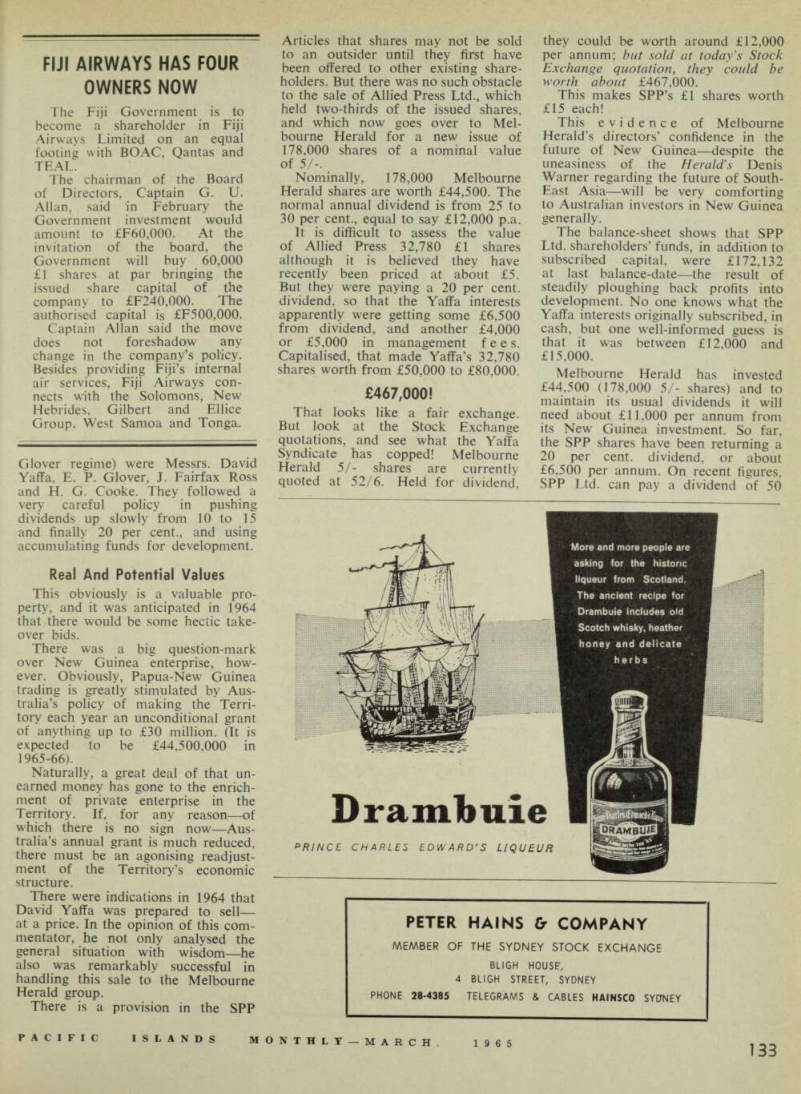
Articles that shares may not be sold to an outsider until they first have been offered to other existing share holders. But there was no such obstacle to the sale of Allied Press Ltd., which held two-thirds of the issued shares, and which now goes over to Mel bourne Herald for a new issue of 178,000 shares of a nominal value of 5/-.
Nominally, 178,000 Melbourne Herald shares are worth £44,500. The normal annual dividend is from 25 to 30 per cent., equal to say £12,000 p.a.
It is difficult to assess the value of Allied Press 32,780 £1 shares although it is believed they have recently been priced at about £5.
But they were paying a 20 per cent, dividend, so that the Yaffa interests apparently were getting some £6,500 from dividend, and another £4,000 or £5,000 in management fees.
Capitalised, that made Yaffa’s 32,780 shares worth from £50,000 to £BO,OOO. £467,000!
That looks like a fair exchange.
But look at the Stock Exchange quotations, and see what the Yaffa Syndicate has copped! Melbourne Herald 5/- shares are currently quoted at 52/6. Held for dividend.
they could be worth around £12,000 per annum; but sold at today’s Stock Exchange quotation, they could be worth about £467,000.
This makes SPP’s £1 shares worth £l5 each!
This evidence of Melbourne Herald’s directors’ confidence in the future of New Guinea—despite the uneasiness of the Herald’s Denis Warner regarding the future of South- East Asia—will be very comforting to Australian investors in New Guinea generally.
The balance-sheet shows that SPP Ltd. shareholders’ funds, in addition to subscribed capital, were £172,132 at last balance-date—the result of steadily ploughing back profits into development. No one knows what the Yaffa interests originally subscribed, in cash, but one well-informed guess is that it was between £12,000 and £15,000.
Melbourne Herald has invested £44,500 (178,000 5/- shares) and to maintain its usual dividends it will need about £ll,OOO per annum from its New Guinea investment. So far, the SPP shares have been returning a 20 per cent, dividend, or about £6,500 per annum. On recent figures, SPP Ltd. can pay a dividend of 50
per cent., if Melbourne Herald should require it.
Where does all this leave the owners of the SPP shares (one-third of the total issue) which were not in this sale to Melbourne Herald? They are mostly well-known Territory residents, and they appear to be sitting on the pig’s back. Melbourne Herald may buy their shares on the same generous terms as are disclosed in the Yaffa deal; but if Herald does not, Herald has got to see to it that those shares return a handsome dividend. —RWR.
Fiji Stock Exchange
Proposed
A GROUP of Fiji businessmen, mainly accoutants, have formed a company with the object of setting up a Stock Exchange in Fiji. The company. Stock Exchanges (Fiji) Limited, has a nominal capital of £F500.000 in £1 shares.
According to the Articles of Asso ciation, object is to provide a market in Fiji for, and thereby facil itate, the buying of shares, stocks, debentures, debenture stocks, bonds, obligations, and securities issued or guaranteed by any company, by the Fiji Government, by other govern ments, or by various other bodies.
Decimals For Samoa;
Tonga Investigating
WESTERN SAMOA, which uses New Zealand coins but its own banknotes, will change to decimal currency in July, 1967, This is the
same date as the changeover in New Zealand.
Announcing the changeover in February, Western Samoa’s Minister of Finance, Mr. G. F. D. Betham, said the units of currency would be the tala (dollar) and sene (cent).
A New Zealand Treasury official, Mr. C. C. Kilpatrick, arrived in Apia in February to advise on the problems of conversion.
Meanwhile, a Decimal Currency Committee has been set up in Tonga to advise the Government on decimalisation of the currency.
The Tongan Government has so far made no decision to change to decimals, but the Government newspaper Chronicle says it has “contemplated” doing so for some time.
Tonga at present uses its own 4/-, 10/-, £1 and £5 notes, plus Australian coins.
W. R. Carpenter Has
Buoyant Half-Year
W. R. Carpenter Holdings Ltd. will pay an unchanged interim dividend of 1\ per cent, for the half year ended December 31.
The directors expect to maintain the present full rate of 15 per cent, on capital, to be enlarged by a one for-five bonus issue to be made on shares held on March 31.
From July to December last year, the compay had improved results from its copra, neon and insurance interests, but cocoa earned less. Group merchandise sales showed a satis factory increase.
The copra mill operated at full
capacity and estate production was satisfactory. Higher world prices con tributed to the better earnings from copra.
Morobe Hotels Out
Of Receivership
Morobe hotels ltd. is in possession of the Goroka Hotel and the Wau Hotel, and Hotel Cecil Ltd. is in possession of the Cecil Hotel at Lae.
Mr. Stanley Eskell, MLC, of Syd ney. told PIM early in March that the hotels, which had been under receivership since 1962, came out of receivership on February 1.
Mr. Eskell said that Morobe Hotels Ltd, paid-up capital was owned by Sangara Holdings Ltd., which owns all the shares in Hotel Cecil Ltd.
Mr. Eskell is executive director of Sangara Holdings Ltd., and along with Messrs. L. Richardson, FCA, Sydney, and S. Fox, Goroka, is a director of Morobe Hotels Ltd.
Questioned about a possible chal lenge to the ownership of the hotels, Mr. Eskell replied: “The managers are accounting to us and paying money into our bank account, and as far as we are concerned that is all there is to it.”
Promising Report
Prospects of establishing a profitable mining industry on Misima Island, Papua, are still good, according to a report issued to shareholders in February by Pacific Islands Mines Ltd., which, in association with Cultus Explora tions Ltd., of Canada, is engaged in surveying and developing mine leases on Misima.
The drills appear to indicate the presence of gold, silver, copper and lead in promising quantities.
More News About
Cultured Pearls
THE first cultured pearls to be pro duced in French Polynesia have raised hopes of a new and profitable industry in that territory. The pearls were produced at Bora Bora and are 10 to 14 millimetres (half an inch or thereabouts) in diameter.
Le Journal de Tahiti describes them as “perhaps the most beautiful in the world”. It says their tones, varying from black to green to rose, are “excessively rare in cultured pearls”.
Attempts to cultivate pearls in French Polynesia—at Bora Bora and Hikueru Atoll in the Tuamotus — have been under way since July, 1962,
with Japanese know-how and money from FIDES, a French aid scheme.
Meanwhile, a small raft anchored in a quiet backwater of Port Moresby’s spacious Fairfax Harbour is the key to an experiment in pearl production for New Guinea.
The raft was anchored there re cently by Pearls Pty. Ltd., an Aus tralian company which has success fully been producing cultured pearls by Japanese methods in the Torres Strait and at Kure Bay, Western Aus tralia.
Local oysters are suspended from the Port Moresby raft in baskets and every six months there will be a check of their growth, undertaken by a local agent, Mr. Neville Barnes, of Port Moresby.
After 12 months it might be possible to see whether the industry would be a paying proposition for the Terri tory. Production would take two or three years.
It is hoped any Fairfax Harbour pearls will be coloured.
New P-NG Paint
Factory
A DECISION by Taubmans In dustries to establish a paint factory at Rabaul, New Guinea, has been welcomed by the Territory’s sole existing paint factory, the Walpamur Co. (NG) Ltd., which has been estab lished in Port Moresby since 1959.
Walpamur’s managing director, Mr.
Eric Rowe, said in Port Moresby in February that a factory was needed on the New Guinea side, and the establishment of Taubmans wouldn’t interfere with expansion plans of Walpamur.
The Port Moresby factory had grown steadily and production was in
creasing. With the present big build ing programme in the Territory, plus the maintenance requirements of buildings already erected, paint de mand was good, he said, especially for latex finishes. Walpamur made a special product for the Territory, with built-in anti-fungus.
The Walpamur company employs five Europeans and a New Guinea staff of from 16 to 24, depending on needs.
Copra Prices
Continuing Upward
prices in February con- V tjnued upward, the main con tributing factory being the strong consumer demand from Europe, brought about partly as a result of the US strike, although hurricane damage to palms in Fiji and in creased political tension in South- East Asia have been additional factors.
The Papua-New Guinea Copra Marketing Board in its February survey of world trends reported average price for February shipment was agreed at £76/7/6 sterling cif UK/Continuent.
The board reported that future prospects seem to be for a continued good demand, with buoyant prices.
Bid For Guinea
Brewery Ltd.
OOUTH Pacific Brewery Ltd.. Port Moresby, in February, was mak ing a bid for Guinea Brewery Ltd.,
Lae. The two breweries are the only two in Paua-New Guinea.
South Pacific was reportedly offer ing Guinea Brewery shareholders 23/- for each GB £1 share, or two 5/- SPB shares for each GB share.
Both breweries have done well since the lifting of the ban on native drink ing in New Guinea.
P Ng Businessmen
In Hong Kong
Rabaul photographer Chin H.
Meen, who has recently been on an overseas tour, ran into a num ber of New Guinea people in Hong Kong.
Among them were Mr. Peter Lee and his brother Anton, both businessmen from Port Moresby, who are seen chatting with Chinese actors and actresses in a Chinese opera. Peter is the part owner of the new ship "Fortunate Treasure" whose arrival in New Guinea from Hong Kong was de layed in February when the captain was lost at sea on the delivery voyage and the ship re turned to Hong Kong.
In the lower picture, second from left, is Mr. Bernard Chan, of Rabaul, who was reunited in Hong Kong recently with his brothers Anton, Steven and Ludwig. Mr. Bernard Chan, accom panied by his wife and sons Aloysious and Andrew, passed through Hong Kong after a six month world tour which took in the New York World Fair, Tokyo Olympic Games, and East Berlin.