On Norfolk Island's
pp. 121-125 · Read in the full issue
Preservation Work Finished On Norfolk Island's Historic Convict Buildings
From Merval Hoare, on Norfolk Island
Work is now virtually completed on the preservation of Norfolk Island’s historic convict buildings—buildings that have been described as “one of the best groups of Australian colonial architecture that can be found”.
FINISHING touches are expected to be applied in March, and the islanders who have been working on the preservation will be used for other Government work so as to keep full employment on Norfolk.
The preservation was begun in 1962 following a grant by the Common wealth Government of £20,000, made in 1961.
It was in 1957 that the buildings were described as “one of the best groups”—the words being used by the then Minister for Territories, Mr.
Paul Hasluck (now Australia’s Min ister for External Affairs).
Mr. Hasluck always took a close interest in Norfolk’s historical legacy.
It was he who was responsible for sending to Norfolk in 1960 a Com monwealth Works Department archi tect, Mr. D. E. Limburg, who sur
veyed all the buildings and ruins and reported on what could be saved or what was worth saving. Mr. Limburg said that without attention final decay was inevitable within 30 years.
His detailed report was in the main adopted, and the Commonwealth Works Department was put in charge of the job. The supervisor on the spot has been Mr. V. Mellish.
It has always been stressed that the work has been preservation, not restoration. Complete restoration is an extremely expensive business.
The work has involved replaster ing, and the removing of certain portions of buildings and the re building of others.
The Kingston bridges have been repaired, the stone work of the creek channels has been reconditioned, and the silos, those huge underground
brick jars which for generations have been uncovered, are now closed in with concrete lids.
The last building to be treated has been the old Commissariat store, now All Saints Church, which has been used as a church since 1874, when, following the destruction of the islanders’ own church in a hurricane, Sir Hercules Robinson gave per mission to the Church of England congregation to use it for that pur pose.
As the preservation of this structure involved considerable repairs both inside and out, the Government agreed that they should be carried out as part of the preservation pro gramme.
The church committee has now leased the middle section, which is the church, from the Government on
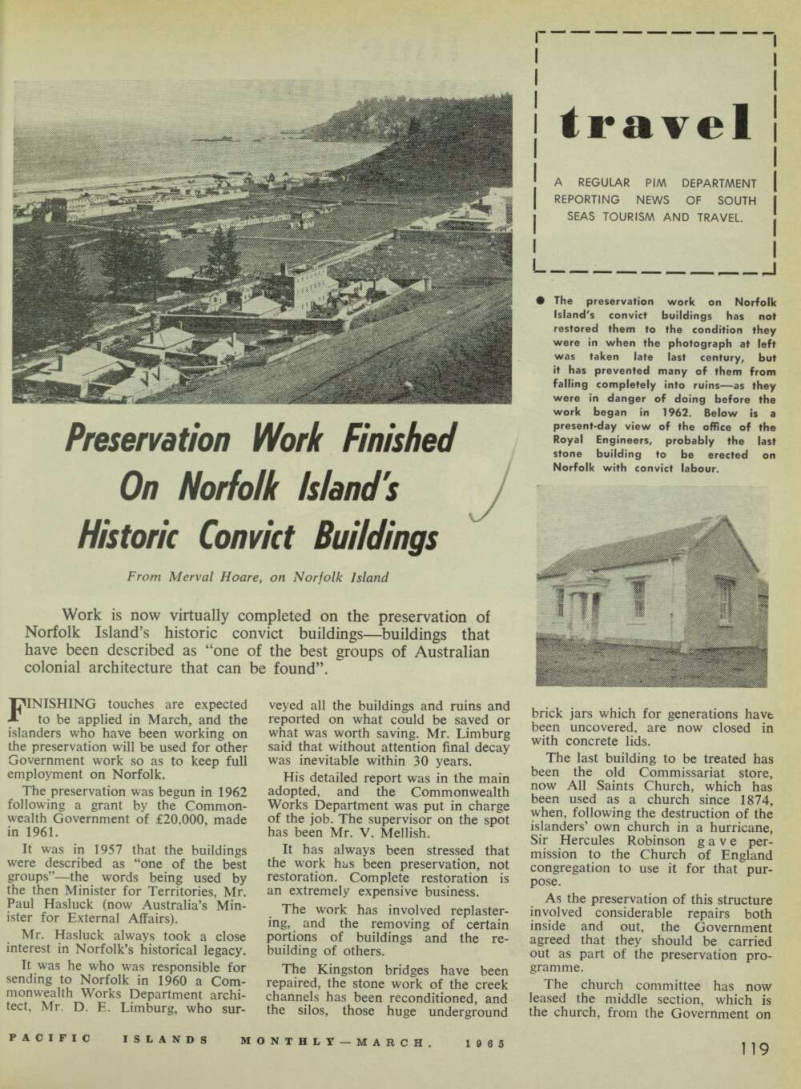
The preservation work on Norfolk Island's convict buildings has not restored them to the condition they were in when the photograph at left was taken late last century, but it has prevented many of them from falling completely into ruins—as they were in danger of doing before the work began in 1962. Below is a present-day view of the office of the Royal Engineers, probably the last stone building to be erected on Norfolk with convict labour.
a peppercorn rental of £10 a year, and has agreed to keep it in good repair.
Norfolk Island, which was the second British settlement to be estab lished in the Pacific, has had two penal settlements. The first dated from 1788 to 1814 and the second from 1825 to 1856.
During the first settlement many stone buildings were erected, but none of these is to be seen today.
When the first settlement was abandoned in 1814 the outgoing party set fire to all the buildings so that there would be no inducement for people to settle on Norfolk.
Some livestock—pigs and goats— which could not be caught before the settlement closed, increased greatly during the 11 years the island lay deserted, and the animals must have inflicted considerable damage to the shells of the old structures.
“Perfect Ruin"
When Norfolk was re-occupied in 1825 it was found that the former capital of Sydney (Kingston) was in a state “of perfect ruin”, and Cap tain Turton, the Commandant, ordered temporary quarters to be constructed from the remaining walls.
Later, under the harsh penal system which operated during most of the second settlement, a compre hensive building programme was carried out. More than two dozen large stone buildings, some rising three storeys high, were erected at Kingston.
Let’s look at these old buildings laboriously built by Norfolk convicts.
One group ranges along the water front east of Kingston pier; the other series is situated on the old convict main street called Quality Row.
Built of limestone quarried on the island, the buildings were mainly de signed by officers of the Royal Corps of Sappers and Engineers, and were made to last. In many of them the outer walls are two feet thick, and the inner walls vary in thickness from 12 to 20 inches.
Government House, situated on Quality Row and completed around 1830, is one of the earliest buildings.
In the same street are the Com missariat store, now All Saints Church, which was completed in 1835 and the new Military Barracks, dated 1836, which today houses the Administration offices.
Then there are the old Military Barracks, now used as the Adminis
tration store and workshop, and several spacious residences today occupied by Administration em ployees.
One of the most interesting build ings was the Pentagonal Prison, which was situated near the water front. Its five main radiating arms were composed of cells, and it had five narrow walls, also radiating, which separated the prison sections.
The foundations of the Pentagonal Prison are depicted in a painting by Thomas Seller dated 1835.
Owing to changes in Government policy the prison was still uncom pleted 10 years later and was probably finished around 1847.
Today this prison is in ruins, though its radiating arms are still outlined under grass-grown rubble.
Last Stone Building Near the Kingston pier are several buildings used today as boat sheds, stores and residences. One of these, the Royal Engineer’s Office, is dated 1851, and was probably the last stone building erected during the second settlement, which ended in 1856, when the Pitcairn Islanders arrived from Pitcairn to settle on Norfolk.
The newcomers immediately moved into the Kingston buildings, and some of them, with their descendants, remained in residence until early in the 1900’s.
Over the years many structures be came dilapidated. In 1870, follow ing an outbreak of typhoid on the island, the Earl of Belmore paid a visit to Norfolk, and, after inspect
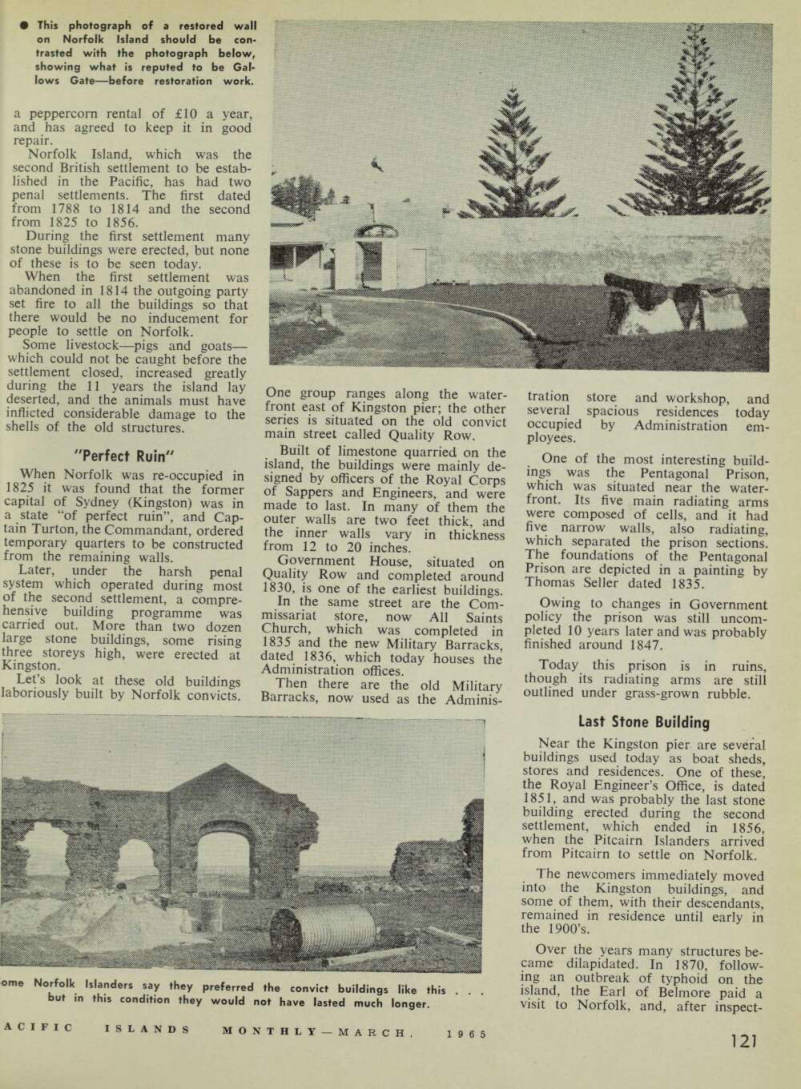
This photograph of a restored wall on Norfolk Island should be con trasted with the photograph below, showing what is reputed to be Gal lows Gate —before restoration work.
ome Norfolk Islanders say they preferred the convict buildings like this . . . but in this condition they would not have lasted much longer.
ing the buildings, recommended that some of them be demolished.
Today a number of buildings are missing, but, while many were pur posely demolished and the rubble used for sundry projects, it may be presumed that some just deteriorated and fell down through lack of maintenance.
In 1908, following years of dis cord between the tenants and the Gov ernment over the islanders’ rights to the occupancy of the Kingston build ings, nearly all of the tenants were evicted and moved “up country” to live on their allotments.
Since then, various Government departments have made use of some of the buildings; others have remained purely residential. Naturally, they have all, from time to time, required repairs, and, where these have been carried out, they have usually been done at the Government’s expense.
To some Norfolk people who do not favour the perpetuation of these relics of a harsh penal era, the pre servation of Norfolk’s historial structures may seem a waste of money [final cost is about £32,000].
But in addition to the natural attrac tions of its lovely scenery and the substantial draw of its duty-free shop ping facilities, Norfolk Island has something very unusual to offer the tourist in the pleasure and interest of rambling around the old convict settlement of Kingston.
Here in the old stone structures is tangible evidence of a large slice of Australian and Pacific history. The preservation of Norfolk’s old build ings, each of which has its own history and colourful associations, should be regarded by all as of great importance in view of the island’s booming tourist industry.