May Shine in Noumea, Too
pp. 88-89 · Read in the full issue
New Guinea's Women Athletes May Shine in Noumea, Too
This special report on progress by Papua-New Guinea's athletes in preparing for the Second South Pacific Games in Noumea in 1966 was written for PIM by MAJOR DON BARRETT, president of the P-NG Amateur Athletic Association. Major Barrett went to the First Games at Suva as manager-coach of the P-NG athletics team. He is currently taking a personal interest in the preparations for Noumea and has sold the idea to P-NG sportsmen that there must be non-stop prepara tion "from now till then".
From Don Barrett, in Rabaul P-NG’s men’s athletes, with a total of seven, won more gold medals at the First South Pacific Games in Suva than any other territory. Next year, in Noumea, their women athletes may win some gold medals, too, for P-NG’s athletes of both sexes are training hard.
SINCE Suva a great deal of atten tion has been paid in P-NG to the training of young athletes. The emphasis has been on finding and encouraging youngsters of both sexes rather than in persevering with older athletes who may already have reached their prime.
In several centres in the Territory, but particularly in the bustling Gazelle Peninsula area of New Britain, registered athletic clubs are are re quired to cater for athletes as young as 13 and 14 years.
Regular competition in a 4i-month
track season is provided for athletes of all ages and of both sexes.
In the Gazelle area regular cross country competition is provided in the “off” season to keep athletes fit and assist in body-building.
One of the most important features of P-NG’s preparations to date has been the staging of coaching camps at Malabunga, some 20 miles from Rabaul. First of the camps was held in January, 1964, and this was at tended by 25 young male athletes. It was such a success that this year the camp was extended to cater for 75
athletes—nearly half of them women.
The Rothman National Sport Foundation sponsored the visit of two well-known Australian athletes to act as coaches at the camp. These were Miss Mary Breen, an Australian rep resentative in women’s field events, and Mr. David Prince, silver medallist in 120 yards hurdles at the Perth Commonwealth Games in 1962.
The camp was an outstanding suc cess and next year at least 100 young athletes are expected to attend and again receive the benefit of expert coaching.
The Athletic Association believes regular competition is essential to even the best coaches and to this end inter-club competitions are now arranged in all centres where athletics is established.
The Territory changed officially to metric distances for all track events in 1964 in the belief that better com parison of times and performances is possible for athletes when they are running over the same distances as are used in the South Pacific Games than in running over “British” distances and using a conversion factor. / More Women Papua-New Guinea took only two women athletes to Suva. Officials ex pect that at least 12 will be selected in the team for Noumea. (Fiji’s women helped mightily in establish ing Fiji’s supremacy at the 1963 Games).
The New Guinea girls are in the main smaller than the Fijians and Samoans and it is in track events rather than field events that they are likely to make their mark.
Most of the girls who won events at the 1964 P-NG Championships
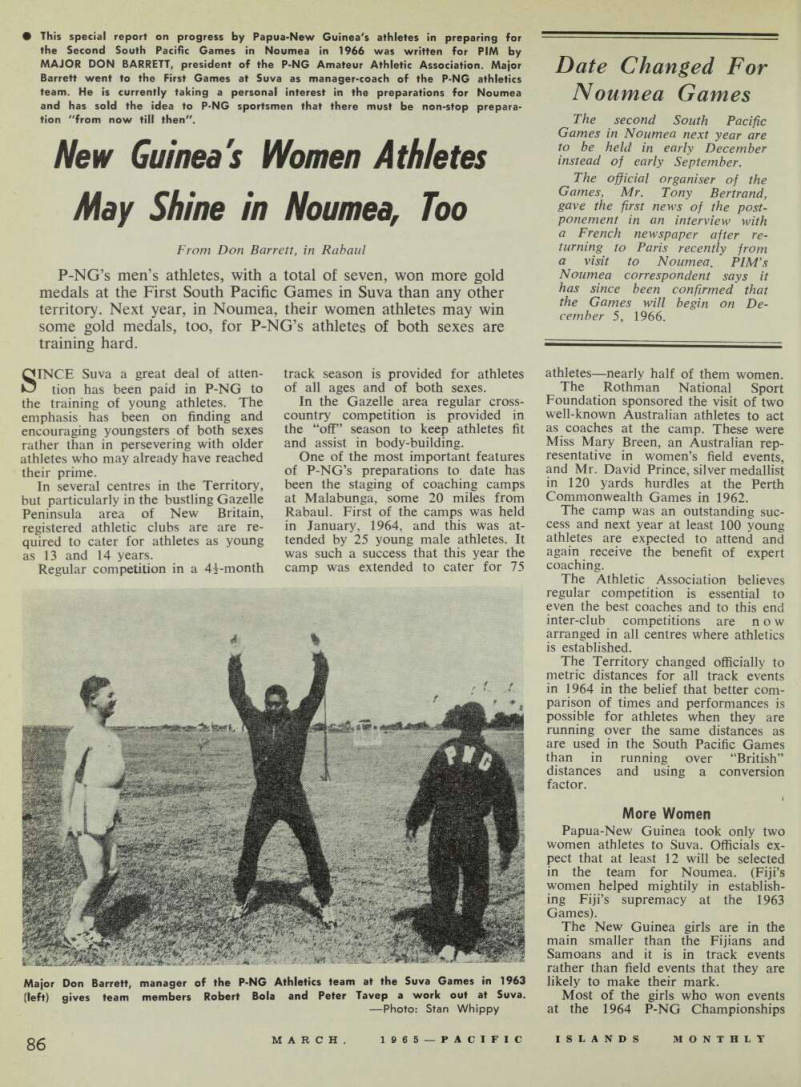
Major Don Barrett, manager of the P-NG Athletics team at the Suva Games in 1963 (left) gives team members Robert Bola and Peter Tavep a work out at Suva.
Photo: Stan Whippy
were only 16 or 17 years of age. Since then they have had the advantage of some serious coaching and are now undertaking carefully planned prepara tion for the 1965 track season. Some excellent performances should be forthcoming.
Edna Niuruna, of Gazelle, last year ran 800 metres only 2 secs, outside the winning time at Suva. This lass is just 16, has plenty of stamina and more determination than many male runners. Lightly built and with long legs she seems likely to develop into a really first-class middle distance runner. 400 Metres Event?
P-NG officials are hoping that 400 metres will be added to women’s events and mention Molly Niuruk, also of Gazelle, as a potential finalist at Noumea.
A whole batch of young women sprinters is coming forward and I’m confident that they will give serious opposition to Ana Ramacake and other Fijian stars.
Several young women hurdlers and long jumpers are also training hard and in these events, too, P-NG hopes for some success at Noumea.
One of the brightest young male stars is 17i-year-old Sailas Tita, who last year at Rabaul clocked 11 secs, for 100 metres and 23 secs, for 200 metres. He is a brother of John Vuai, who was a 200-metre finalist at Suva and a member of P-NG’s winning 4 x 100 m. and 4 x 400 m. relay teams. (He is still a top-line sprinter).
Bill Wellbourne, who is now in his second season in Rabaul, last year clocked 1,54.2 for 800 meters—and should improve this year. Damien Midi, who missed a trip to Suva, ran 49.2 for 400 metres and is already showing fine form this year, Waituka Maina, who was second in 400 metres at Suva is spending two years in Aus tralia studying, and is competing in Sydney athletics. It would not sur prise people here if this pair ran in the 48’s during 1965.
Edward Laboran is still un challenged as high jump champion but several youngsters are literally “on the way up”.
P-NG will be sure to be strong in middle-distance and distance events and the loss of Mike Joyce will probably pass unnoticed as new young stars shine. Already, before the track season has started, Tiap Uraria has run a 1,500 metres within five seconds of Joyce’s record of 4.5.1. Five thousand metres runners will turn in times at least 90 seconds better than the Suva time during this year.