Fears Of Slavery Ruined First South
pp. 83-87 · Read in the full issue

Seas Sugar Plantation 150 Years Ago
By Robert Langdon
French Polynesia, rather than Fiji, might now be the biggest sugar-producing territory in the South Pacific if an English sugar plantation, started on Moorea nearly 150 years ago, had been as successful as it easily could have been.
AS it was, the plantation collapsed in less than 12 months because King Pomare 11, of neighbouring Tahiti, feared that if it became a success, Europeans from New South Wales would take possession of both Tahiti and Moorea and either kill or enslave their people.
The plantation, originally en visaged for Tahiti, was the first of its kind to be established in the South Seas. It was also the first large-scale attempt at agriculture by Europeans on any Pacific island apart from Norfolk Island.
The man who started it was an Englishman called John Gyles, who was sent to Tahiti by the London Missionary Society in 1818 as “an agriculturist as well as a missionary”.
The idea of establishing the plantation had been suggested to the LMS directors during a visit to
London in 1809 by the Rev. Samuel Marsden, the ebullient pioneer churchman of Sydney.
Marsden, who was a confidential adviser to the Missionary Society, believed that the sugar plantation would pave the way for the con version of the Tahitians to Christianity.
He held the theory that “com merce promotes industry, industry civilisation, and civilisation opens the way for the Gospel”.
The sugar project was supported by the Rev. Henry Bicknell, of Tahiti, who happened to be in London (seeking a wife) at the same time as Marsden.
Rebellion However, nine years passed before the project was attempted, because, soon after Marsden suggested it, the missionaries abandoned Tahiti following a rebellion against Pomare 11. Tahiti was then still completely heathen, despite 12 years of effort by the missionaries.
The missionaries re-established themselves on Moorea in 1811-12, and in 1815, after Pomare had defeated his rivals in Tahiti in a bloody battle, Christianity was ac cepted holus-bolus on both Tahiti and Moorea.
Meanwhile, there was apparently no further mention of the sugar project. So when, in August, 1818, John Gyles, with his wife, small family and a sugar mill, arrived in Tahiti in Marsden’s brig Active from Sydney, the missionaries were taken completely by surprise.
However, Gyles and his family were quickly installed in the house of the Rev. W. P. Crook, in Papeete, and in less than a week, Gyles had found a valley between Papeete and Point Venus for his plantation.
On August 26, he planted some canes; then he “lined out” a place for a house which the king ordered to be put up for him.
But before Gyles and his family could move into it, the missionaries on Moorea sent him a letter urging
him to set up his plantation on their island.
As Gyles had not been entirely happy with the way things had been going in Tahiti, he got the approval of the Tahiti missionaries to go over to Moorea to see if conditions there were suitable for sugar growing.
They were. At Opunohu, at the head of Papetoai Bay and not far from Papetoai village where the missionaries had their station, Gyles found a big stretch of good, well watered land, and a chief who was not averse to letting him plant sugar on it.
Back in Tahiti, King Pomare “seemed pleased” when Gyles told him he would probably be moving, and he ordered the chief of Opunohu to provide houses, fences, etc., for Gyles.
At a meeting of the missionaries next day, it was agreed that Gyles should move to Moorea at once, and one of their number, the Rev.
David Darling, was deputed to
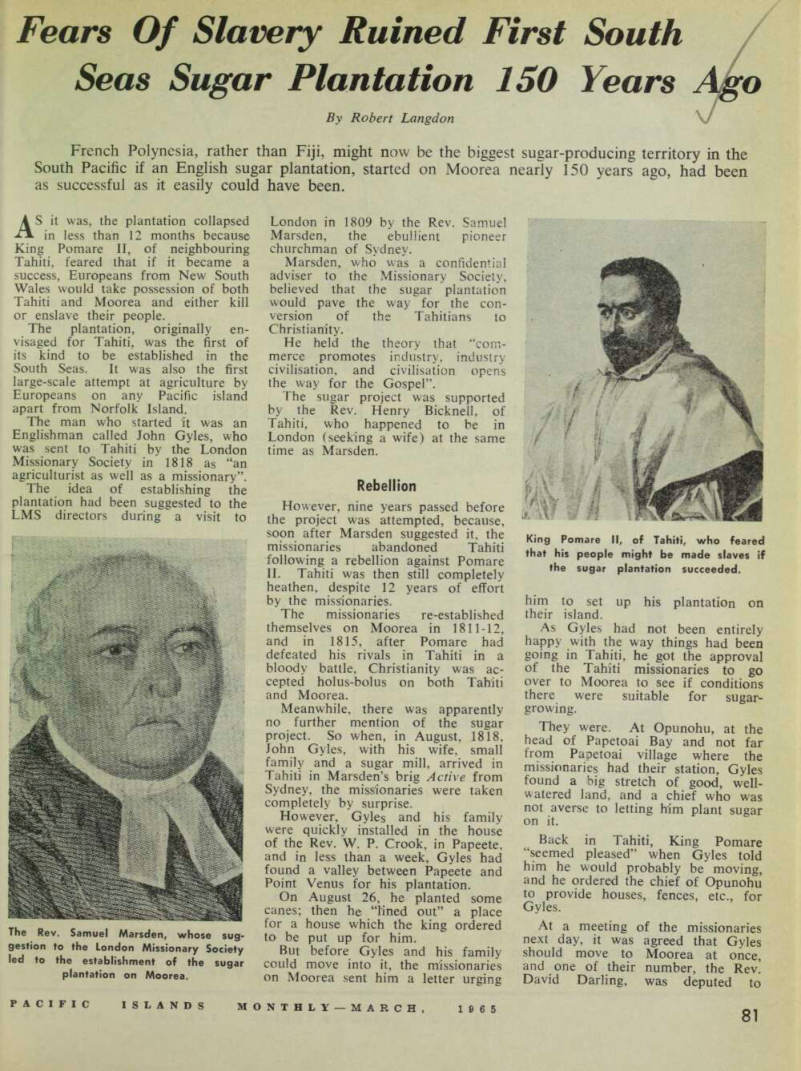
The Rev. Samuel Marsden, whose sug gestion to the London Missionary Society led to the establishment of the sugar plantation on Moorea.
King Pomare 11, of Tahiti, who feared that his people might be made slaves if the sugar plantation succeeded.
follow him with the sugar mill when the missionary ship Haweis came in.
Meanwhile, an assistant for Gyles, Isaac Shepherd, had arrived from New South Wales, and before long he and Gyles were in the throes of getting the site for the plantation cleared and fenced, and houses erected.
Many Troubles
The natives were fairly co operative during the first week, but after that Gyles never got much help from them. He also had other troubles—as is shown by a journal he kept, the original of which is now in the LMS archives in London, while a microfilm copy is preserved in Sydney’s Mitchell Library, Writing ruefully on October 5, 1818, Gyles said: “The natives want about 30 fathoms of cloth for felling the wood on the land intended for the canes”.
A few days later he complained he had hurt his hand and was wearing it in a sling, that his children were sick, that the “muskettoes” and rats were trouble some, and that all his native workers had left him because he would “not give them cloth before it is due”.
Meanwhile, Darling had come over from Tahiti with the sugar mill, and another missionary, John Platt, had moved up to Opunohu from Papetoai to help put it up.
The mill, whose equipment in cluded a water wheel, was installed by the end of January, 1819, after which Gyles and Shepherd “lined out cane holes” preparatory to planting.
First Sugar
However, Gyles did not wait for his first crop to make his first sugar.
This was made in mid-March, 1819, with wild cane bought from the natives.
As the natives would not help to turn the mill. Gyles engaged six deserters from the ship King George, which had recently arrived in Tahiti. With the deserters’ help, 50 lb of sugar and molasses were produced.
This success, it seems, excited the curiosity of the natives, for a few days later. Darling engaged a few natives to turn the mill—on payment of a hymn book each.
But the arrangement was not a success, for the natives again wanted to be paid before they had done their work, and when they didn’t get it, one of them set fire to the mill.
This incident, which may have been engineered by Pomare, him self, was the beginning of the end for the plantation.
Gyles went at once to Papetoai to ask the Rev. William Henry what he should do, and Henry agreed that the king should be told about the fire and that “some exemplary punishment” should be inflicted on the offender.
Tour Of Tahiti So Gyles and Darling went over to Tahiti to tell the king. But Gyles’ sense of urgency apparently soon wore off, for before seeking out the king, he made a leisurely tour round Tahiti. In the course of this, he climbed into the mountains to visit Lake Vaihiria, which few Europeans had then seen.
At Matavai a couple of weeks later, Gyles called on a friendly chief who had previously helped him, and this chief now promised to move his machinery and possessions back to Tahiti and to build houses for a new plantation —without charge.
Gyles then told the missionaries that he intended to bring up this proposal at the annual meeting of the Missionary Society in Papeete in about a month’s time.
Back on Moorea, Gyles filled in
the time until the meeting “making a fence to keep out Mr. G. Bick nell’s cattle”, walking round the island with a chief, and making a little more sugar.
But when he proposed moving back to Tahiti at the Missionary Society meeting in mid-May, 1819,
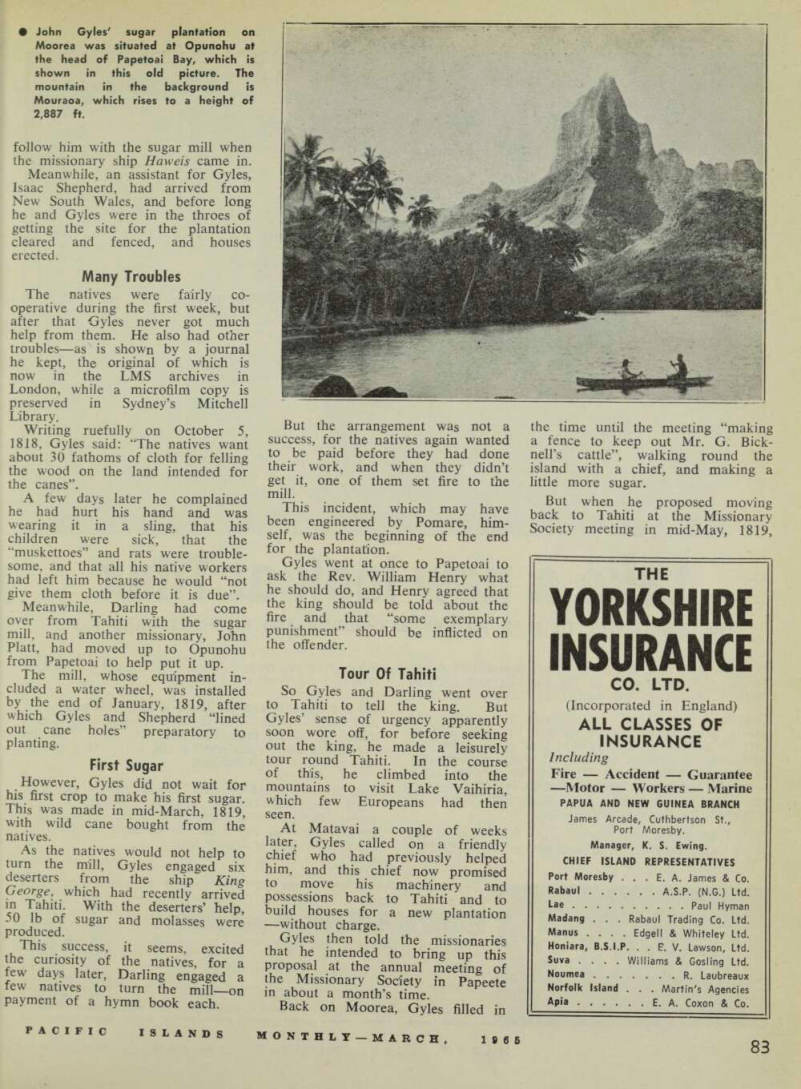
• John Gyles' sugar plantation on Moorea was situated at Opunohu at the head of Papetoai Bay, which is shown in this old picture. The mountain in the background is Mouraoa, which rises to a height of 2,887 ft.
he found that the missionaries would not hear of it.
He also found that King Pomare had also become decidedly anti sugar project, and when he asked why, Pomare said that the captain of an American ship had told him that if the sugar plantation succeeded, the rich people of New South Wales would come and take possession of his islands and either kill or enslave his people.
Pomare added that as far as he was concerned the sugar mill could remain on Moorea and rot.
Back To Sydney Faced with this attitude, Gyles went back to Moorea and prepared at once to return to Sydney to seek new instructions from Marsden.
However, it was not until mid- August, 1819, that he actually sailed, and when he did, his ship called at Raiatea and Huahine, where the missionaries strongly urged him to stay and try his luck again.
Gyles was not prepared to do this without consulting Marsden, but he did promise to return if Marsden was agreeable. Meanwhile, he gave the missionaries a few lessons on the art of sugar-making.
Subsequently, although Gyles never returned to the Islands, the Raiatea and Huahine missionaries were able—thanks to his instruction —to make sugar with some “spare machinery and boilers” sent out by the Missionary Society.
One of the Huahine missionaries, the Rev, William Ellis, recorded in his book Polynesian Researches, published in 1829, that the natives were so “delighted and astonished” at the success of their sugar-making efforts that they began to cultivate sugar for their own use and for bartering with ships.
“The mill we had erected,” Ellis said, “became a kind of public machine to which they brought their produce; and although in some in stances we failed in procuring good sugar, in time the people were so well acquainted with the process as to be able to boil it themselves.
Partial Success “The missionaries in Raiatea also erected a mill more efficient than the one we had constructed in Huahine, cultivated a quantity of cane, made sugar themselves, and taught the inhabitants of the island to do the same. . . .
“In this respect, although the attempt of the [LMS] directors to introduce extensively its cultivation has failed in the first instance, the
natives nevertheless, acquired from Mr. Gyles residence among them an acquaintance with the »w. CeS JV°f m ? nUfactLlr,ng thla . y al “" able article of commerce, which, it is presumed, will prove to the nation an important and permanent advantage.”
Meanwhile, although Gyles’ plantation fell into ruins on Moorea, George Bicknell, a nephew of the missionary, Henry Bicknell, took the most valuable parts of his machinery to Tahiti where he succeeded in producing enough sugar for the missionaries’ tables.
Eventually, also, sugar was again produced on Moorea—in the same area where Gyles had produced In 1839, when Commodore Wilkes of the US Exploring Expedition visited Moorea, he found that the Rev. Alexander Simpson, of Papetoai, was running a plantation at Opunohu with an Irishman as overseer.
Twenty-seven years later, when a couple of English yachtsman, anchored in Papetoai Bay—the first of the many yachtsmen who now criss-cross the Pacific—the Opunohu plantation was m the hands of Simpsons son-in-law, Louis Valles, and a cheery Italian doctor”, Dr.
Michelh.
Another sugar plantation had been started at Opunohu in 1865 bv Alfred Hort, a Jewish merchant* whose young wife Dora later wrote a couple of books on Tahiti T . ... , . J. slands of French Polynesia ln f act > eventually become more tf Jf n self-sufficient in sugar. But f n ner ,? ® Panama Canal was opened n 1 . ’ ]t . was found more fu° n 2 miCa u import sugar from the French Wes * Indies,
Captain Bliqh
, . own back for^th got itS J! s " „own W f,‘ Indle ,? ca ? e
cJe ?™Ca£aS Bligh’Sok m'.he
following;, l792 ’ the voyage in . Nowadays, the only mill produc in& , su B ar in French Polynesia is dndl . n tFe d * st rict of Atimaono on Tahiti, whose product is mainly used in making the local rum.
Atimaono, incidentally, was the site of a huge cotton plantation during the American Civil War a century ago, but the first man to foresee its agricultural possibilities was French Polynesia’s first agri culturist, John Gyles, during his trip round Tahiti in 1819. P