Internal Self-Government
pp. 75-77 · Read in the full issue
Niueans Won't Be Hurried Into Internal Self-Government
From a Correspondent on Niue Island Secretary of the New Zealand Department of Island Terri tories, Mr. J. M. McEwen, and Professor C. C. Aikman, dean of the law faculty at Victoria University, Wellington, have been visiting Niue Island for talks about the future political
development here.
AT the Assembly meetings and the public meetings held during their visit it was obvious that the people of Niue were not unanimous that Niue should have self-govern ment.
One member of the Niue Island Assembly said Niue was like a little child and was not yet ready for self-government. Professor Aikman replied that the only way to learn to govern was to do it, and Niue was far more ready than many other newly self-governing nations —in Africa, for instance.
The main concern of the members of the Assembly was that with in ternal self-government New Zealand might withdraw her annual finan cial grant, which last year amounted to £285,000, and also technical and other aid.
Mr. McEwen reassured the As sembly on this point, saying that in talks shortly before he left for Niue the New Zealand Prime Minister, Mr. Holyoake, had said any change in the form of govern ment would mean no change in the help New Zealand gave. Mr. Mc- Ewen pointed out that since Western Samoa had become independent New Zealand financial and other aid had increased.
Mr. McEwen said the Minister of Island Territories, Mr. Hanan, asked him to tell the Assembly that the Niue constitution should be as far as possible what the people wanted and the speed at which it was implemented should as far as possible be what the people wanted.
When formal talks on internal self-government ended on the last day of the visit Professor Aikman said that there was no need to draw up an elaborate draft programme showing a specific timetable.
His major proposal was that the previous target of internal self government in 1966 be dropped. He
will also make proposals about the present executive committee, which functions as a cabinet. This will involve the Resident Commissioner remaining as the president of the Assembly and executive committee, and setting out more precisely the functions of the committee.
Professor Aikman added that New Zealand was not “tired” of Niue—as had been suggested—and she didn’t want to get rid of her.
As a result of this visit there is now a general feeling of relief among the Assembly and the people that internal self-government is going to proceed more slowly.
General view until now has been that the New Zealand Government was forcing Niue into self-govern ment.
Address To Public Servants During the visit, Mr. McEwen addressed a meeting of the Niue Public Service, in which he said that future good government of the island by Niueans would depend on public servants, and a stable Public Service was the best guarantee that internal self-government would suceed. He said the confusion in
certain African States since their independence was due to lack of a good Public Service. Mr. McEwen also advised public servants to have nothing to do with party politics.
During the week the Assembly was in session for these important talks the complete proceedings were recorded and then broadcast in the evenings over 2ZN Radio Niue.
This station used a communications transmitter of the Radio Depart ment on a frequency in the broad cast band, but it is seldom operated because there is at present no established broadcasting service on the island.
The broadcasts were well received in all the villages on the island and played a valuable part in telling the Niueans what was happening con cerning constitutional development and land legislation.
The land legislation was also dis cussed at length with Mr. McEwen during his January visit.
Land Legislation
In 1964 the Niue Island Assembly put forward the rather revolutionary proposal that owners of land on Niue who stayed from the island for more than 20 years should lose the rights to their land.
One third of the Niueans live away from the island, mostly in New Zealand, and consequently a lot of good land lies idle.
Niue has an agricultural economy, depending on the export of bananas,
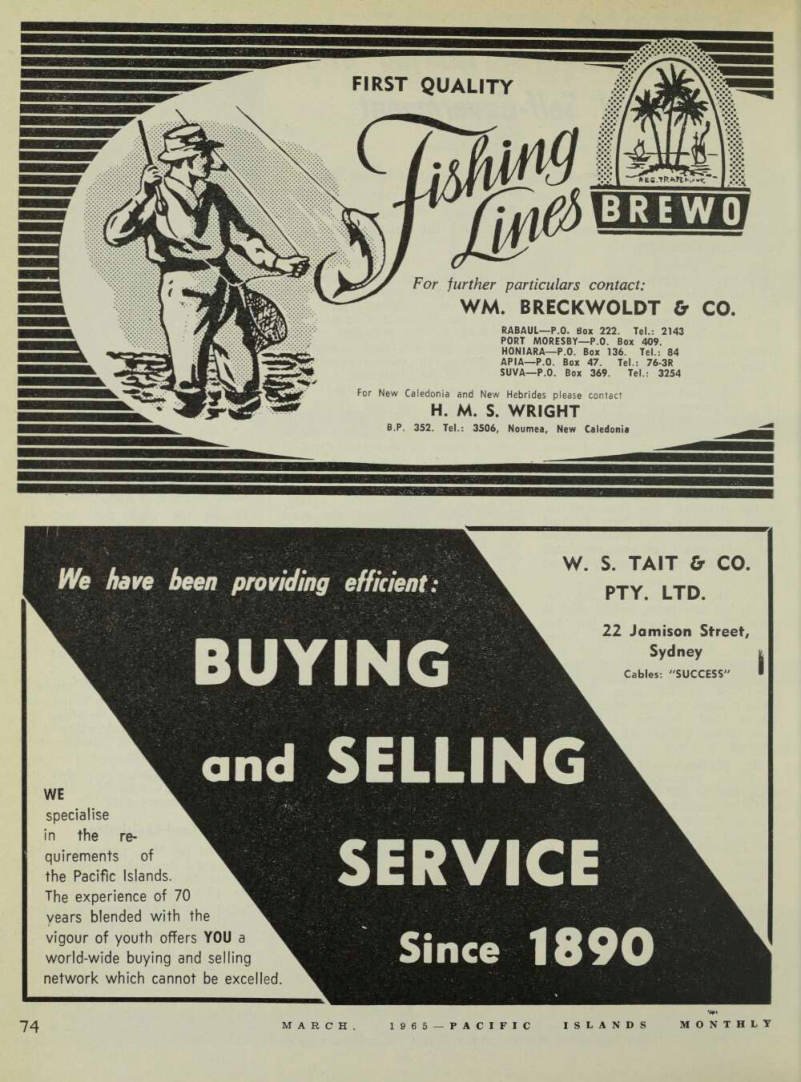
Mr. J. M. McEwen
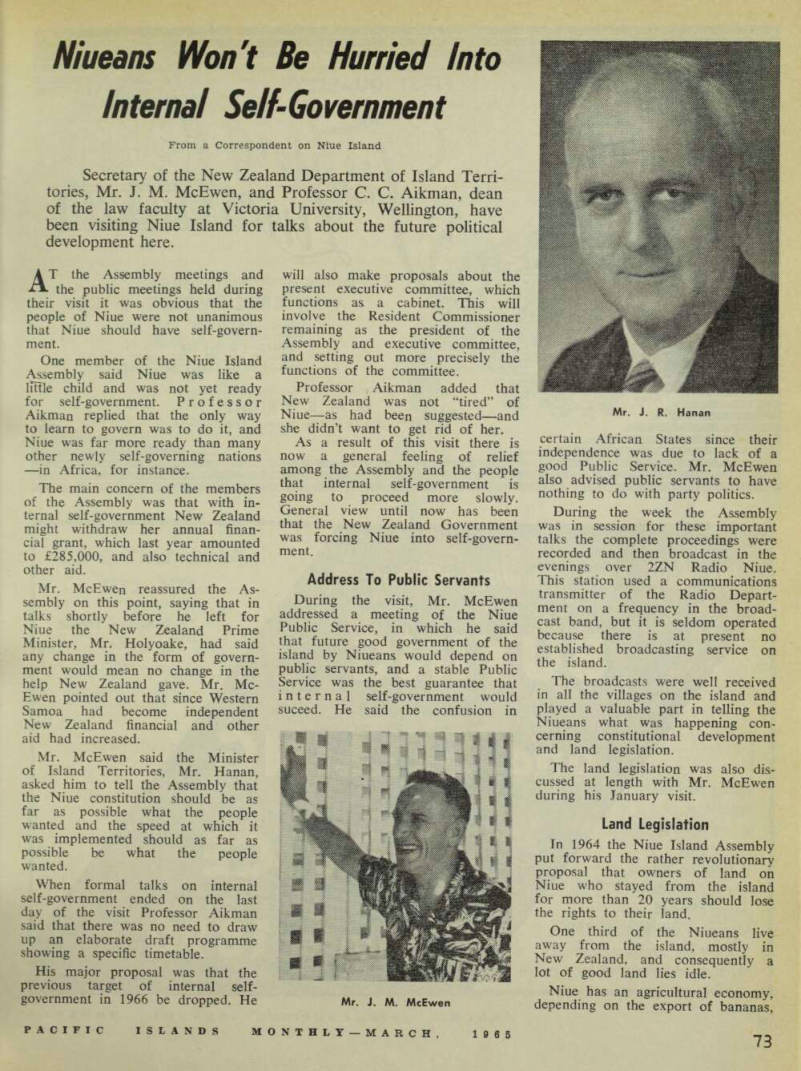
Mr. J. R. Hanan
copra and kumeras for its income, and the amount of land on the island is limited. In addition the Agriculture Department is encourag in the cultivation of larger tracts of land by mechanical means instead of by laborious hand methods, and quite often it has not been able to proceed because an absentee owner with a piece of land in the midst of a tract suitable for mechanical culti vation has refused to let it be used.
The Niue Island Assembly feels that more should be done to in crease production and so ease the burden on the New Zealand tax payers who support the island.
The proposal for loss of rights to land after 20 years was put into draft land legislation. The legislation included provision for setting aside land for parks and reserves, but the most controversial clause in it was the 20-year one.
Violent Opposition
It has been violently opposed by Niueans living in New Zealand. They held indignation meetings in Wel lington and Auckland (where most of them live) and one result was the formation of a Niue Society in New Zealand.
The members there engaged a lawyer and in December two re presentatives of the society, Lagaua and Mokoniu, travelled to Niue to put forward the views of the society.
Three more representatives of the Niue Society, Mrs. McQuoid, L.
Tuhega and L. Sipeli, also arrived at the same time as Mr. McEwen in January.
The proposal has merit, for idle land under absentee ownership should be utilised. And the person who does cultivate land owned by absentees must have some form of security for the money and time he puts into it.
"Very Unhappy"
Some people think the 20-year proposal is not as revolutionary as it first seemed. If the owner comes back after 20 years he is able to go to his brother, or whoever is the head of the family, and ask for a piece of family land again. And normally he would, by custom, be welcomed back and given land for a house and for planting of crops.
And provided he stayed on Niue for five years he would have re gained full rights to the land again.
Mr. McEwen told the Assembly that he had, 10 years ago, proposed that land titles be lost after 30 years, and the Assembly had reduced it to
20 years. But he had been in creasingly unhappy about the pro posal because to dispossess a man of land in his lifetime was a bad thing.
He said that the Minister of Island Territories, Mr. Hanan, was glad that the Niue Assembly had tackled this problem of land use, whereas the Cook Islands had not.
But the Minister was not happy
with this 20-year absentee owner clause and he would like to see the Assembly find the answer to the problem in some other way.
It appears that some system of leasehold for the land of absentee owners will be the alternative, for in the face of the disapproval of both the Minister and Secretary, the Assembly will probably not go ahead with the legislation.