Fiji Battles For Bigger Share
pp. 69-71 · Read in the full issue

Bigger Share Of Australian Trade
From a Suva Correspondent
Fiji-Australia trade is virtually
one way—in favour of Aus tralia. If Fiji ever had a favour able balance it was probably back in the days of the sandal wood traders, before Cession.
NO one is likely to quibble at the fact that Fiji buys much more from Australia than she can ever hope to sell in return. What irritates people in Fiji is the bar which Aus tralia puts so often on small items which can mean so much to a small businessman in the Islands.
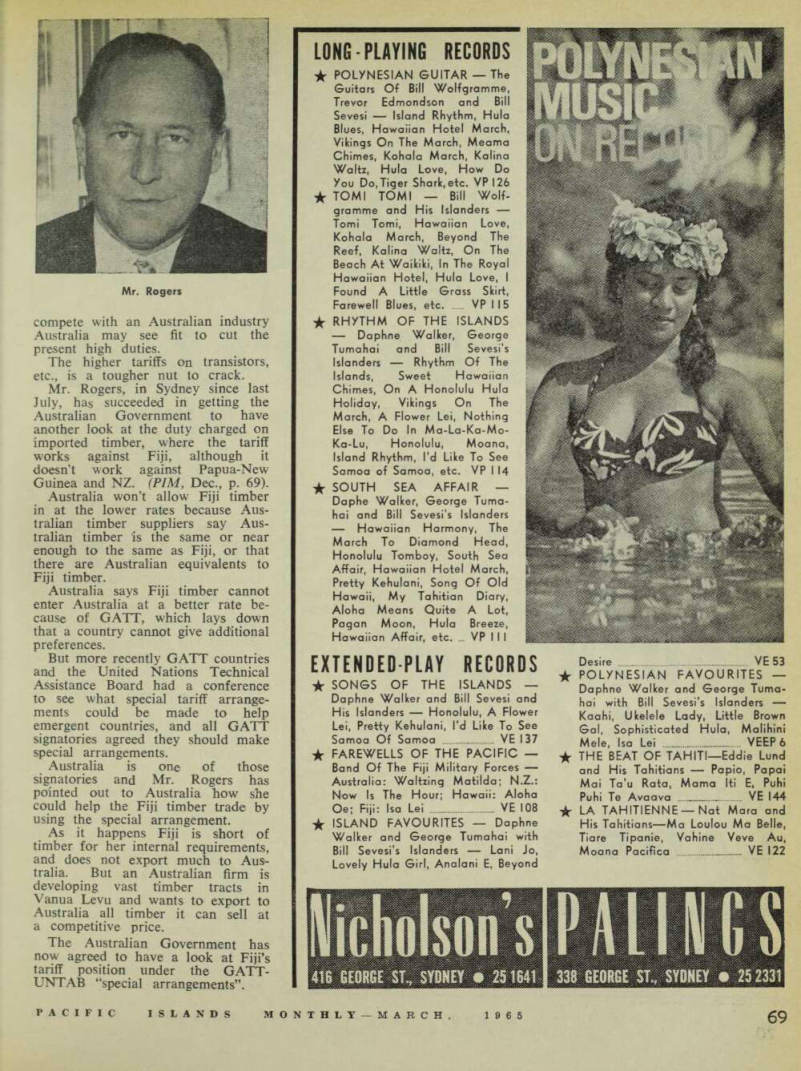
The Fiji representative in Aus tralia, Mr. W. B. Rogers, has run into a number of tariff problems in his efforts to do something for the small Fiji exporter ( PIM, Dec., p. 67).
Now he has in his lap the problem of trying to prevent Fiji’s rapidly growing trade in duty-free luxury goods being undermined by prohibitive tariffs in Australia.
New Australian Customs regula tions, which came into force on January 1, radically changed the picture about the import into Aus tralia of such things as transistor radios, television sets, watches, cameras, binoculars, etc. ( PIM, Dec., p. 12).
Best Buyers
Suva shopkeepers consider that Australian visitors are the best buyers of these goods. But they don’t expect this will continue.
As an example, an Australian who made a Pacific cruise in a luxury liner in January bought at Suva a TV set for £F4O, and a transistor radio for £FB. The Aus tralian Customs hit him on his re turn for £AS7/6/9 duty on the TV set and £A9 on the transistor.
Even though the cost, plus duty of those items, was still well below Australian retail prices, the 100 per cent, increase is going to make a prospective buyer think twice.
Australia no doubt put up this new tariff wall to protect her own secondary industries, and was probably unmindful of the effect her action could have on the restricted economy of a small colony.
The loss or gain to the Australian
revenue is likely to be infinitesimal; but sales of luxury goods mean a /ot to Fiji, for high sales mean greater profits and more for the Treasury in the way of income tax, more money in circulation, and more employment.
In January when the Australian Prime Minister, Sir Robert Menzies, was on a Pacific cruise he stopped off for a day at Suva and had a look at the Suva markets, where local handicrafts are sold.
An official of the Suva Market Curio Vendors’ Association recog nised Sir Robert and was quick to tell him how Australia could help Fiji’s small handicrafts industry. Sir
Robert, experienced politician that he is, was non-committal.
But there could be a break through, for the Australian Govern ment intends to have a survey made of the import of handicrafts, and will then refer the matter to the Tariff Board.
Australia’s tariff works against the Fiji handicraft industry; for example, women’s scuffs, valued at 2/9 attract a duty in Australia of 7/6 plus 25 per cent., while beach hats worth 3/9 each carry a duty of £2/5/- a dozen.
As it is unlikely that Australia would ever be flooded with Fiji handicrafts or that they will
compete with an Australian industry Australia may see fit to cut the present high duties.
The higher tariffs on transistors, etc., is a tougher nut to crack.
Mr. Rogers, in Sydney since last July, has succeeded in getting the Australian Government to have another look at the duty charged on imported timber, where the tariff works against Fiji, although it doesn’t work against Papua-New Guinea and NZ. (PIM, Dec., p. 69).
Australia won’t allow Fiji timber in at the lower rates because Aus tralian timber suppliers say Aus tralian timber is the same or near enough to the same as Fiji, or that there are Australian equivalents to Fiji timber.
Australia says Fiji timber cannot enter Australia at a better rate be cause of GATT, which lays down that a country cannot give additional preferences.
But more recently GATT countries and the United Nations Technical Assistance Board had a conference to see what special tariff arrange ments could be made to help emergent countries, and all GATT signatories agreed they should make special arrangements.
Australia is one of those signatories and Mr. Rogers has pointed out to Australia how she could help the Fiji timber trade by using the special arrangement.
As it happens Fiji is short of timber for her internal requirements, and does not export much to Aus tralia. But an Australian firm is developing vast timber tracts in Vanua Levu and wants to export to Australia all timber it can sell at a competitive price.
The Australian Government has now agreed to have a look at Fiji’s tariff position under the GATT UNTAB “special arrangements”.
Mr. Rogers