In Fiji’s Hurricane
pp. 47-57 · Read in the full issue

Out, Under And About In Fiji’s Hurricane
By R. W. Robson
Although I have been in and around the Pacific Islands for 50 years, I never have experienced a hurricane. But in early February I sat on the edge of one, and observed. I have no wish to be closer.
1 ARRIVED at Nadi as The Thing appeared in the faraway north.
I got out five days later, while it went bellowing off into the south, to scare the daylights out of Auck land.
Saturday morning, February 6, in serene weather, I breakfasted with Mrs. Marie Hardwick, Fiji’s most conscientious hostess-manager, in the luxurious Mocambo Hotel, overlook ing Nadi Airport.
I learned that although this was the “dead season” for tourists, the traffic hadn’t slackened, and that, as they had 180-200 guests packed in under the Mocambo’s wide-spread roof, I was lucky to have a room.
Tony Wilkinson, with his Fiji Times car, carried me over a dry road, to Sigatoka, Korolevu Beach
and Suva. “Bit of cloud away up around Wallis Island,” he reported.
“Might be a hurricane in the making.”
I looked out over the pleasant, sunny country. Such talk seemed absurd.
Ruminating, I told him that they called them cyclones in Australia, and how the previous week Cyclone Judy had sneaked out of the Gulf of Carpentaria and beaten up the Queensland coast before disappear ing somewhere beyond New Cale don.ia. “Perhaps this is it—you could call it Hurricane Judy,” I said, brightly.
Tony indicated, grumpily, that he had another, and unprintable, name for it. Four days later, I thought of him, and also of Marie Hardwick at the Mocambo, while scores of people in the Lautoka-Nadi area sat atop their houses in the scream ing gale, hammering in nails and putting ropes across their ridge poles.
Suva Battens Down As we approached Suva on Sunday morning, February 7, the ranges between Navua and Suva were swathed in swirling mists.
Tony, weather-wise, said that the “bloody hurricane” might be coming along, and he’d better get back to Lautoka PDQ (which he did, wisely).
We found Suva under a lowering sky, and bothered by a noon radio announcement that a hurricane definitely was building up, north of the Northern Yasawas.
As I went in to lunch I noticed a square-built, bearded man per forming urgently on the telephone.
He was the commander of the beautiful cable-laying ship Mercury , then lying at the docks, and he was calling in all men on shore leave, to take the ship quickly out to sea.
“The wider and the deeper the sea, the better we like it, when these damned things get going,” he said.
Years had passed since Viti Levu had had a visitation, and the meterological law of averages says
that Fiji may expect a real beating up every half-decade. Suva thought this could be it.
By mid-afternoon the black flags (“final warning of hurricane”) were flying on the official flagpoles, and Suva’s Sunday lethargy was gone.
Shopkeepers and anxious land lords came swarming into the main streets, and I saw an interesting display.
Hundreds of numbered planks were hurriedly dug out of dusty sheds and basements behind the shops, and dumped in clattering heaps along the footpaths. Every one—lndians, Fijians, Chinese, and Europeans—whether on the stores’ staffs or not, gave a hand.
They all seemed to know what to do. Each numbered plank or shutter was fitted into corresponding slots above and beneath the glass windows.
I thought all this meant that the unprotected glass could be blown in; but they said the real danger was from debris carried on a 100 m.p.h. wind. This could break the glass, and when a hurricane comes whirling in through a broken window or open door, things really happen.
Helping Hands
Elsewhere, in the little city, men and women—most of them still in their Sunday lounging dress—were climbing over their houses with ropes and shutters, and casting speculative glances at nearby trees, which were tossing wildly in gusty winds of growing strength.
People helped each other. I saw a shapely lady arrive in haste at her corner frock-shop, with two car-loads of briefly-clad girls obviously summoned from some bathing-pool—and begin to drag out planks and shutters.
By now, the Club Hotel was shuttered and fastened, so manager Oscar Betham gallantly led his team
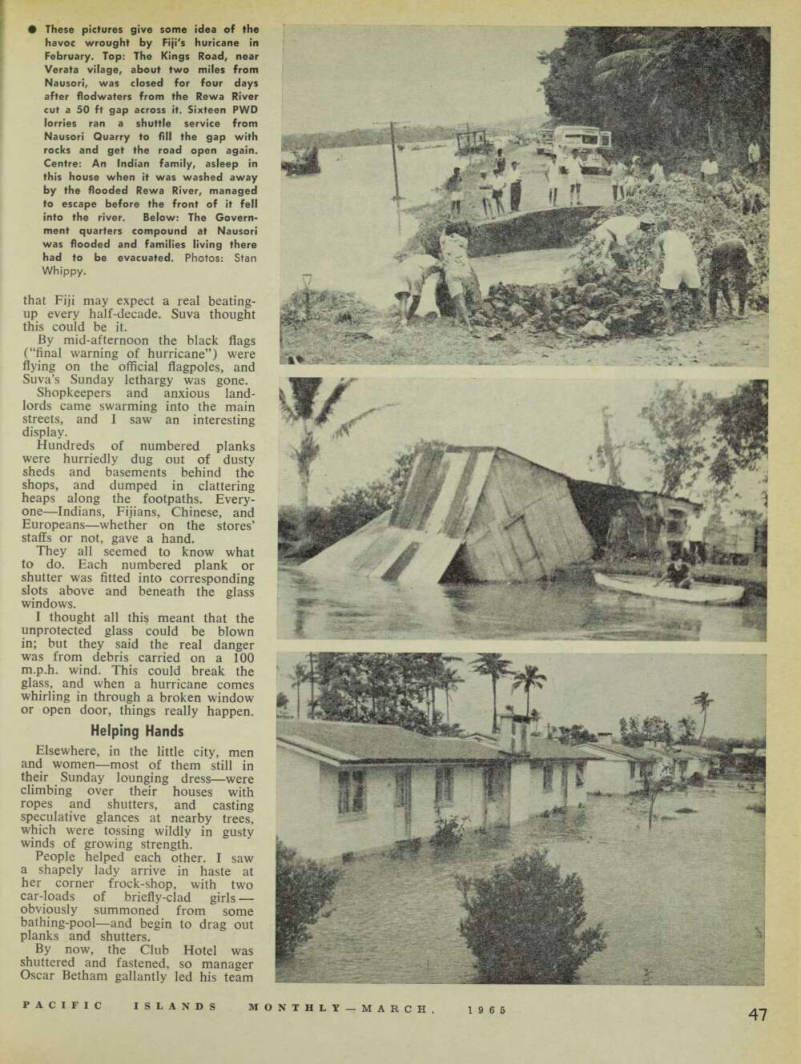
• These pictures give some idea of the havoc wrought by Fiji's huricane in February. Top: The Kings Road, near Verata vilage, about two miles from Nausori, was closed for four days after flodwaters from the Rewa River cut a 50 ft gap across it. Sixteen PWD lorries ran a shuttle service from Nausori Quarry to fill the gap with rocks and get the road open again.
Centre: An Indian family, asleep in this house when it was washed away by the flooded Rewa River, managed to escape before the front of it fell into the river. Below: The Govern ment quarters compound at Nausori was flooded and families living there had to be evacuated. Photos: Stan
Whippy.
of Indian helpers to assist the frock shop girls in a difficult, unac customed task.
By dusk, Suva was shuttered, silent and waiting, under a dark, lowering sky. Most people kept their ears glued to transistors.
The Fiji Broadcasting Corporation did a fine job then, and in the tense days to follow, in constantly reporting on the movement and effects of The Thing.
Unpredictable!
All Sunday night, Fiji waited, grim and ready. But the hurricane remained almost stationary, whirling in the same spot, about 100 miles north by a little west of Suva. We knew it soon must move; but even the weatherwise could not predict its course.
Suva on Monday, February 8, really was a remarkable spectacle.
There was no real hurricane—only heavy, swirling rain (to which the city is well accustomed) and strong gusty winds. There was no reason why there should not be business as usual.
But there was no work in the work force—in fact, many employers and managers reported, with adequate curses, that most of their staffs were missing.
The big stores opened their food sections for an hour, and then closed for the day. The banks did not open —and some traders, with money for deposit—and especially those who wanted to draw cash urgently—• became almost hysterical in their comments.
But under the general anxiety, there was a sort of holiday spirit.
The Fijians enjoyed it no end— they gathered in laughing groups, and splashed happily through the vast, accumulating pools of rain-water.
Deluge
This extraordinary practice—the disappearance of the working folk— has been seen before. It seems to be a survival from the days before radio communication. Then, there was only a limited warning of a hurricane’s approach. It could come within an hour or two of the ap pearance of the black flags, and the people were allowed to grab any transport available and get home and put up their shutters and tie down everything movable.
But now, as we saw on Sunday and Monday, the warning could be issued long before the phenomenon had shaped itself and set its course, and there was not any need for the immediate closure of shops and offices.
Unpredictably, the hurricane stayed
where it was all Monday; but it sent down over Viti Levu and Vanua Levu an almost indescribable deluge of rain. It soon was apparent that, whether hurricane-force winds de veloped over the main centres or not, there would be a major flood disaster in the two main islands.
During Monday night, the hur ricane’s centre began to move very slowly south-west, above the Yasawa chain, and it appeared that North west Viti Levu would really catch it.
By Tuesday morning, radio was the only means of communication
still functioning, as: • All roads had been cut by massive flood-waters pouring down from the central mountains of both Viti Levu and Vanua Levu. • All cross-country telephone lines were out, broken mostly by falling trees. © Phenomenal rain in the centre had lifted the level of the Rewa River above its banks, and the flat country around Nausori, Navua and the Rewa Delta was deeply under water. © Most of Fiji Airways’ Herons had been caught by flash floods on
Nausori airfield (where they had been grounded on Sunday) and were completely immobilised. So all in ternal air services and services to the Solomons, Samoa, Tonga and Gilbert Islands, were cancelled in definitely. • The various international air lines which customarily call at Nadi were over-flying Fiji until further notice.
Bits and pieces of radio messages coming in from officials at various points told us that the Labasa, Ba, Lautoka and Nadi areas, on the edge of the drifting hurricane, were being battered by gale-force winds and lashed by torrential rain.
The Administration did wonders in bridging the innumerable gaps in the communications systems; but anxious Suva could only guess at the over-all picture—and there cer tainly was some panicky guessing.
It was known definitely by Tuesday, however, that there was real disaster in the Rewa area. The surging rise of the river waters not only flooded all the flat country thereabouts, doing incalculable damage to crops and buildings, it also trapped many Fijian villages along the banks. More than 100 persons were reported missing. But the death toll proved to be only about a dozen.
That day, the hurricane’s centre continued to move slowly south west, and out to sea, so that the North-west towns were not shattered.
But it was near enough to ham mer them with 60 to 70 m.p.h. winds, and nearly drown them with rain.
Losses were severe, and general dislocation terrific.
About 3 a.m. on the Tuesday, the gale lifted the roof off the newest blocks of the big Mocambo Hotel, —which was accommodating about 180 guests—and a tremendous task fell upon the management. From then until Thursday (when the in ternational airlines began calling at Nadi again) the half-wrecked Mocambo tried to feed and house the hapless travellers, mostly
tourists, whose bookings had been completely dislocated by the col lapse of all transport, Then the hotel had to close down for reorganisation and repairs, thus further dislocating Fiji’s closely integrated tourist traffic, However, it got back into business in a surprisingly short time, although its bookings had to be drastically reduced, pending the fixing of a new roof.
Other organisations catering for
NOT THIS TIME: Road engineers made sure there was no repetition this time of the damage last March to the bridge across the River Sigatoka at Sigatoka.
On that occasion, as can be seen in this photo by Rob Wright, two sections of the bridge were swept away by floating debris. This time, the engineers had men at every pier of the long bridge fending off floating trees with grappling irons.
Fiji’s tourists also suffered cruel losses in the hurricane, which was at its worst in the 24 hours from midnight on the Monday.
The four big organisations suffer ing the worst dislocation and loss were the Government (roads, bridges, telephone and telegraph lines), the South Pacific Sugar Mills (roads, railways, buildings and damage to the sugar crops), Fiji Airways (complete dislocation of services and damage to property and plant at its Nausori headquarters) and Emperor Mines (destruction of the huge smoke-stack and damage to plant and buildings at Vatukoula).
Smaller concerns suffered heavily.
The Suva City Council staff worked day and night, maintaining services and clearing streets of debris. Fiji Times & Herald Ltd. did wonders in maintaining publication of its morning paper; but the paralysis of all air and road services prevented Fiji-wide distribution of its daily and weekly publications for four or five days. All small shipping services, of course, were completely dislocated.
Mails piled up.
Sun Comes Out On Wednesday morning, February 10, the rain had ceased, winds were down, the turbulent clouds charac teristic of the hurricane had with drawn to the mountain-tops, and the sun appeared shyly.
Streets were strewn with branches and leaves. Water and mud were everywhere. Men were running around restoring services. A police man stood at a respectful distance, warning people about a huge ferro concrete pole which, carrying a mass of power and other lines, at the junction of Gordon and Joske Streets, had cracked at the base and leaned dangerously.
Suva surveyed the scene, and seemed little perturbed. Once more, it had escaped the actual hurricane.
But Suva then still had no idea of what was happening around the Colony. All telephones were still out.
My friend David Ragg, head of Northern Hotels, became impatient.
He had half a dozen hotels out in the unknown—one or two undergoing alterations and additions—and he wanted to know how things' were.
He called for his muscular Fijian driver, Lui. He put new tyres on the back wheels of his trusty Holden. He took along his anxious wife, Maureen, who wanted to know what happened to her newly-married daughter who had been staying at the Mocambo Hotel, awaiting a plane, when the roof came off.
I W3S allowed in the party on ' d,dnt howl lf 1 wet an “ mudd y.
That was :ai drive, that was We left Suva at 10.30 a.m. on Wednesday, via Queens Road; and at 3 a.m. on Thursday I was decanted at Nadi Airport, unshaven and the bearer of much river mud, but well content to DC mere.
There was little traffic on the Queens Road-and not a vehicle identifiable as coming from Nadi.
Landslides and fallen trees on the road to Navua but nothing serious.
The jungle had taken a lashingsmashed trees everywhere. Signs indicated there had been much water over the road at Navua Plains, but we found a depth of only six inches. .. x ,_. . , , ,
Sigatoka Bridge Defended
Thence for 60 miles there were only slips and trees and smashed telephone lines to bother us.
There was much broken vegetation around Korolevu Beach, but the famous hotel was bathed in sunshine. “Place empty, I suppose— they can't get in?” I said. Bill Clarke smiled broadly. “Full—they can’t get out,” and he waved his hand towards crowded lounge and dining-rooms. The trapped tourists looked anything but miserable!
There was no sign of tempest along the Korotogo coast. In a
weather sense, this is Fiji’s choicest area. But we found real trouble as we neared Sigatoka.
That long river had shared the interior mountain deluge with the Rewa, and couldn’t take it and floods had spread deeply across the fertile Sigatoka Valley to damage tobacco, passionfruit and food crops From Korotogo village to the Siga toka bridge, we crlwled carefully through much axle-high water, but we made it; and found the bridge over the t rjver d functioning The road engineers-with bitter memories of last March, when jungle de bris smashed the structure at two places—had men at every pier of the long bridge, with grappling iVons and pole fendi off f he flood b ™ne trees as th c me a i ong on he racing currents e when the t ; ees jammed a t£am with an Metrical saw clambered down the piers an(J D b£ men acing trunks. It was risky work but the bridg£ harmed (The floodi just before we a e °: v£d> had been close to the deck).
We camped despondently at the Sigatoka Hotel, and watched Fijians wading up to their necks in water which covered the highway beyond a hank-up from the lower Siga *, a ’ which now was meeting a high tide. No vehicle had come through from the direction of Nadi, David Ragg and his driver returned an . inspection of the railway bridge with long faces. No dice!
A Boat Meets Us We refreshed while we ud . the tide , 0 , Hours Tater the water fell with astonishi^ ter s ’
and the Holden snorted and sniffed as Lui guided it slowly through the debris-filled mud-holes.
Cuvu was next. We were assured that only a strong swimmer could cross a section there. Lui, with tender care, pushed on into it. The Holden took it merrily, and at last we were out upon the low, cane clad hills—Loma-this and Loma that. I was told that Loma meant love, or good luck, or something.
It seemed appropriate.
Nothing moved on that highway, except the innumerable cows and horses of the Indian farmers—they must turn them out to graze there after dark. I’ve mounted horses often in my youth: this time, several times, I thought I was going to mount one in a Holden. But Lui is a nippy driver.
We saw the headlights of an ap proaching car. “Gripes!” I shouted, “the road’s open!” It pulled up for a word with us. It was a Northern Hotels lorry.
Planner Ragg, before leaving Suva, had left word to tell Lautoka that he was coming. The message eventu ally got through. Lautoka waited; no Ragg; so Lautoka sent the lorry to look for us, with a small boat in the back!
Trouble Ahead The capable young Indian in charge warned us of real trouble ahead, and led us on through the tempest-torn hills (the hurricane really had done its stuff here) into the Nadi Plain. Closely following the lorry we somehow got through the vast pools of shallow water right to the edge of Nadi town.
But the Nadi River had taken charge of the highway between the town and the airport—no crossing there. We turned away inland through a maze of canefields and little roads. The water was deeper and deeper, and somewhere in the middle of it the wetness reached a vital part, and the lorry conked out.
No ignition, no lights. Our Holden settled down comfortably in the water and the mud—but with engine running—and sneered.
The lorry driver gave Lui some directions, and we tackled it alone.
It was dark and exceedingly wet, with splatters of rain. I thought fondly of that boat. The water was so deep that it entered the car and the back seat reoorted four soaking Ragg feet. The Holden went steadily on.
Ten minutes later, the lorry over took us, and led us on through the worst patch of all. and then abruptly up on to a narrow-gauge railway, devoted to sugar.
For a long time, we bumped
slowly along over the sleepers. The water now was over the railway.
Now and again, one of the lorry’s crew got out and waded, to show us what was what. We could not have got through without that lorry.
We turned off the railway towards the now dry highway. This looked like the happy ending. It nearly was, minus the happy part.
The Holden fell, with a fearful crash, into a flood-burrowed hole between rocks. But Lui manoeuvred it out, on to the bitumen. He moved it gently onwards, while we all waited for something to fall to pieces. But we went on at 30 mph.
Maureen Ragg lit her 61st cigarette and said she really had enjoyed her 16-hours’ drive —it had been packed with incident, and now we knew what happened to Fiji travellers in hurricane weather.
I said my thanks and farewells. I took off my hat to that Australian built car. I always have liked Holdens.
Two hours later I was in a Pan American liner—the first in after the blow. The skipper went to Sydney via New Caledonia. The hurricane was now away South west, and the pilot gave it a wide berth.