Over High Living Costs
pp. 41-43 · Read in the full issue

Samoan Marchers Protest Over High Living Costs
From R. F. Rankin in Apia About 500 people marched through Apia to Western Samoa’s Fono (Parliament House) at Mulinu’u on February 2 to protest to the Government against the high cost of living.
SOME marchers carried hurriedly painted banners and placards calling for higher wages, the re introduction of the banana bonus, and the remission of recent heavy increases in Customs duty. One banner said simply: “We want to eat”.
The march had been proposed two nights earlier at a meeting at the store of Emile Fabricius. The meeting was called by Messrs. R.
Keil and V. MacKenzie, Jr., to dis cuss the cost of living.
More than 70 people turned up, including three Members of Parlia ment, Afoafouvale Misimoa, Amitu anai V. and Galuvao F.
Fonoti loane, a former director of the Bank of Western Somoa and an unsuccessful opponent against Prime Minister Mataafa at the last elec tion, was elected chairman of the meeting. Mr. R. Keil was made secretary.
The meeting resolved unanimously to: • Express dissatisfaction to the Government over the high cost of living caused by the duty increases without any adjustments to the wage structure or any assistance to planters. • To urge the Government to stop work on the Asau wharf until the Apia wharf was completed.
• To ask the Government for the reintroduction of the annual bonus for banana growers.
A proposal by Mr. Keil to hold a demonstration march was enthusiastically received; and another meeting, attended by about 150 people, was held the following night at Fonoti’s home to complete arrangements for the march.
Workers Join In The parade began at 9 a.m. next morning at Keil’s store at Taufusi with a couple of hundred marchers, and grew bigger as it went along.
As the marchers passed various business houses, many workers downed tools and joined in. The first word that many of them had had of the demonstration was over Radio Australia an hour earlier.
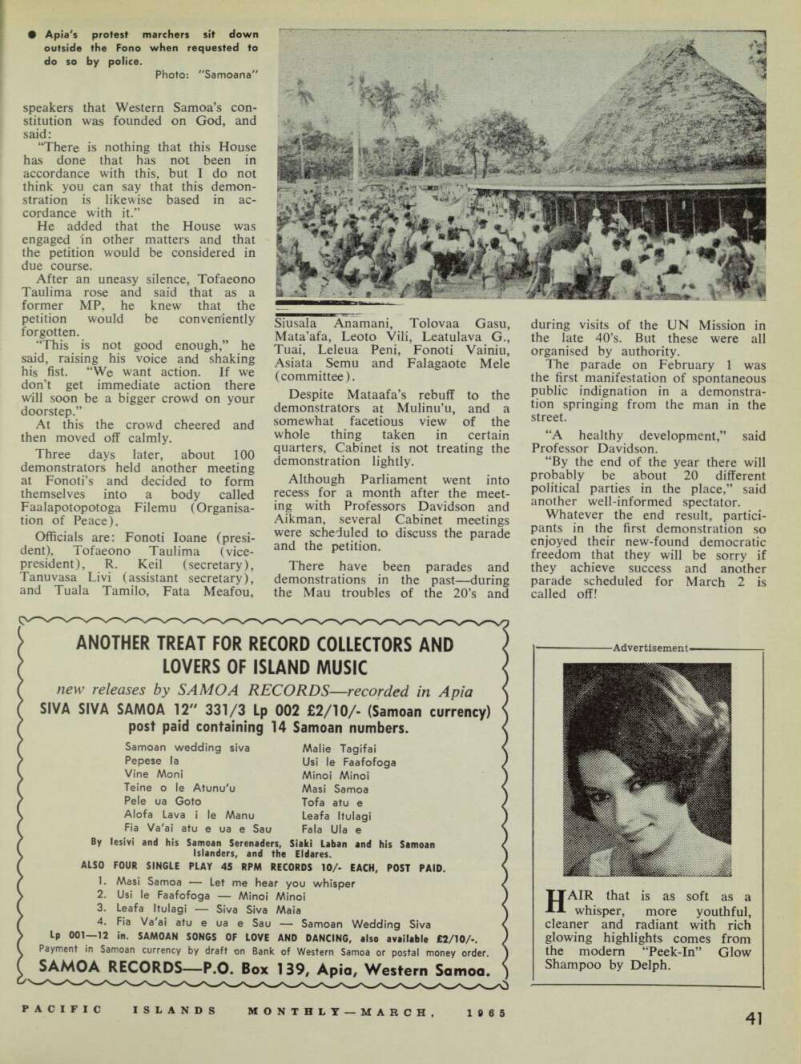
More than 20 cars were following the procession by the time it reached the Fonr at Mulinu’u. There, in obedience to orders from police, the demonstrators sat quietly in a semi-circle in front of the building.
Parliament was not in session, but its members were there discussing proposed constitutional changes with Professors Jim Davidson and Colin Aikman. This business was sus pended to let the demonstrators voice their complaints.
Fonoti loane summed up com plaints of the public at the lack of governmental activity to alleviate the difficult living conditions caused by rising costs. He was followed by an elderly orator from Afega, Fata Matua, who urged Parliament to regard the demonstration as a legitimate expression of public concern.
Another spokesman, Tofaeono Taulima, then handed a petition to the Clerk of Assembly on behalf of the marchers.
Tofaeono is a former MP and a master builder with long experience in New Zealand. [According to some reports, members of the Fono then debated whether Prime Minister Mataafa should reply to the marchers, and the general feeling was that he should not. However, Mataafa decided to do so and walked out into the sun.] Mataafa agreed with one of the
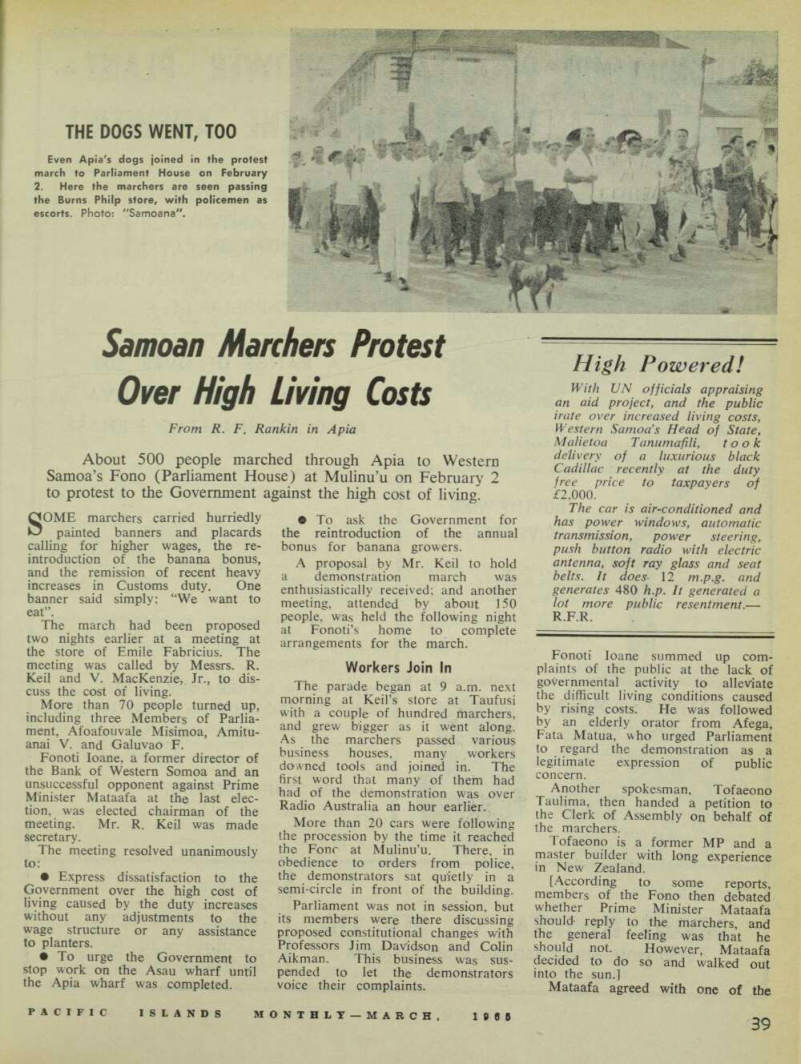
The Dogs Went, Too
Even Apia's dogs joined in the protest march to Parliament House on February 2. Here the marchers are seen passing the Burns Philp store, with policemen as escorts. Photo: "Samoana".
speakers that Western Samoa’s con stitution was founded on God, and said: “There is nothing that this House has done that has not been in accordance with this, but I do not think you can say that this demon stration is likewise based in ac cordance with it.”
He added that the House was engaged in other matters and that the petition would be considered in due course.
After an uneasy silence, Tofaeono Taulima rose and said that as a former MP, he knew that the petition would be conveniently forgotten.
“This is not good enough,” he said, raising his voice and shaking his fist. “We want action. If we don’t get immediate action there will soon be a bigger crowd on your doorstep.”
At this the crowd cheered and then moved off calmly.
Three days later, about 100 demonstrators held another meeting at Fonoti’s and decided to form themselves into a body called Faalapotopotoga Filemu (Organisa tion of Peace).
Officials are: Fonoti loane (presi dent), Tofaeono Taulima (vice president), R. Keil (secretary), Tanuvasa Livi (assistant secretary), and Tuala Tamilo, Fata Meafou,
Siusala Anamani, Tolovaa Gasu, Mata’afa, Leoto Vili, Leatulava G., Tuai, Leleua Peni, Fonoti Vainiu, Asiata Semu and Falagaote Mele (committee).
Despite Mataafa’s rebuff to the demonstrators at Mulinu’u, and a somewhat facetious view of the whole thing taken in certain quarters, Cabinet is not treating the demonstration lightly.
Although Parliament went into recess for a month after the meet ing with Professors Davidson and Aikman, several Cabinet meetings were scheduled to discuss the parade and the petition.
There have been parades and demonstrations in the past—during the Mau troubles of the 20’s and
during visits of the UN Mission in the late 40’s. But these were all organised by authority.
The parade on February 1 was the first manifestation of spontaneous public indignation in a demonstra tion springing from the man in the street.
“A healthy development,” said Professor Davidson.
“By the end of the year there will probably be about 20 different political parties in the place,” said another well-informed spectator.
Whatever the end result, partici pants in the first demonstration so enjoyed their new-found democratic freedom that they will be sorry if they achieve success and another parade scheduled for March 2 is called off!
• Apia's protest marchers sit down outside the Fono when requested to do so by police.
Photo: "Samoana"