Outpost
pp. 31-39 · Read in the full issue
A PIM Special Review
Life With A Giant On A Mid-Pacific Outpost
By a Staff Writer who was recently in Nauru
Whether or not the visit in March of a United Nations Mission to Nauru will help resolve the general air of frustration and deadlock that surrounds the island and its affairs remains to be seen. But it will focus atten tion once more on this extraordinary 8i square mile heap of phosphate where less than 3,000 indigenous people are trying to live with an industrial giant (in the shape of the British Phosphate Commission), and ex tract tribute from it; and where an Australian adminis tration is trying to see fair play—sometimes, perhaps, not very successfully.
THERE was nothing extra ordinary about Nauru—which was discovered by Europeans in 1798, became the resort of Pacific whalers in the early 19th century, and was annexed by Germany in 1888 as part of the Marshall Islands Protectorate until phosphate was accidentally found there by an Aus tralasian company at the end of the 19th century.
To this extent, the Nauruans can be said to be victims of geology as well as history. Had there been no phosphate, or had it not been discovered until a much later date, Nauru would no doubt have been taken over by Japan along with the former German territories of the Marshalls, Marianas and Carolines at the end of World War I; and, after World War 11, would have become part of the US Trusteeship Territory of the Pacific Islands.
However, the Pacific Phosphate Company which discovered the Nauru deposits was able to make a trading deal with the German administrators, and between 1906 and the outbreak of World War I the phosphate workings were firmly established, and frequent ships carried the pulverised rock off to Australia and New Zealand where it was manufactured into super phosphate. [Phosphatic rock, straight from Nauru, is useless for agri culture until it is treated with
sulphuric acid; in some cases trace elements are also added.] When war broke out in 1914, there was a scramble among Allied nations to occupy German Pacific colonies. New Zealand occupied Western Samoa; Japan occupied the Marshalls, Caroline and Mariana Islands; and Australia took over the former German territory of New Guinea.
Isolated Nauru was a second thought, but because of its associa tion through the phosphate company it was natural that Australia should be interested. In November, 1914, three months after the outbreak of war, it was occupied without resistance by 66 Australian soldiers from the Rabaul garrison, under the command of Major-General W.
Holmes.
Shortly after the Australians had
established themselves, a Japanese battleship and troop carrier arrived, also with the idea of taking possession of the island. As Japan was one of the Allies in that war, they withdrew without incident, leaving the Australians in command.
Nauru became a C class mandate in 1920, held jointly by Australia, New Zealand and the United Kingdom, but for convenience ad ministered by Australia. In 1919, the three Governments bought out the interests of the Pacific Phosphate Company which worked the deposits on Nauru and on Ocean Island, 160 miles to the east, and part of the British Gilbert and Ellice Islands Colony. The price paid was £3,500,000, which was contributed by Australia, New Zealand and the UK in the proportions of 42, 42 and 16. (over)
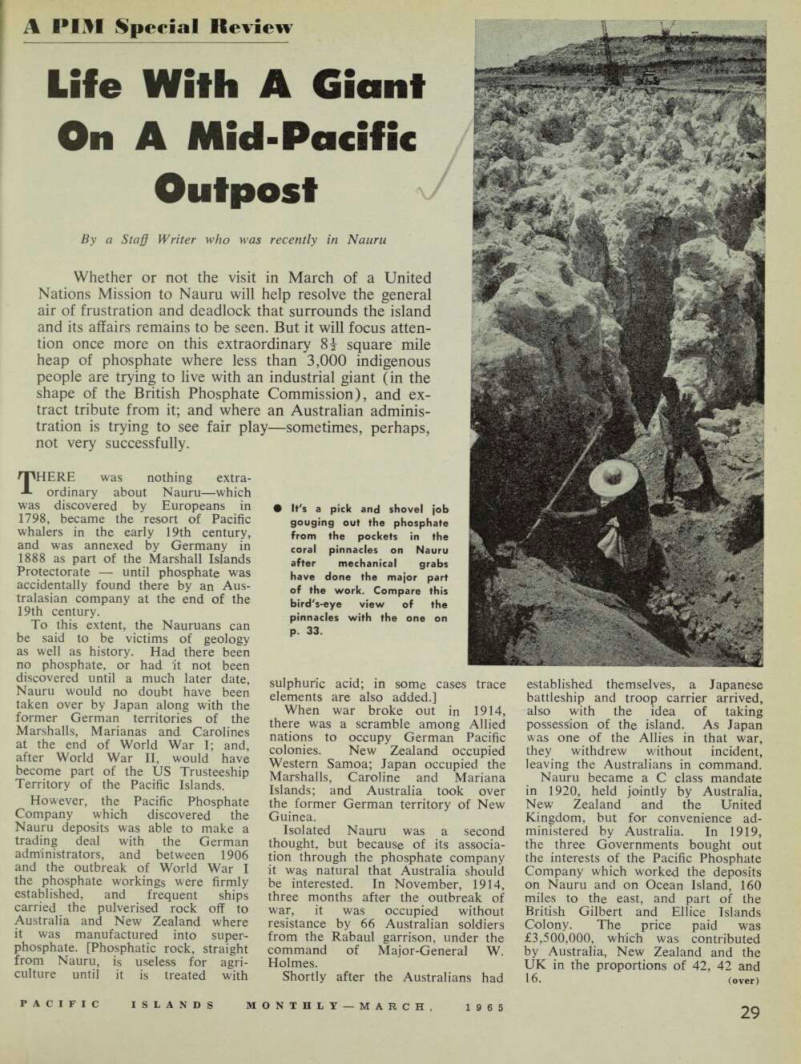
• It's a pick and shovel job gouging out the phosphate from the pockets in the coral pinnacles on Nauru after mechanical grabs have done the major part of the work. Compare this bird's-eye view of the pinnacles with the one on p. 33.
The agreement between the gov ernments provided for the establish ment of the British Phosphate Com mission of three members, one appointed by each government; the Commission was to be a non-profit making organisation selling its out put at cost of production for the benefit of member countries and each country received a proportion of the output in ratio to the money invested—that is, 42 per cent, each for Australia and New Zealand and 16 per cent, to the United Kingdom.
In practice, however, Australia and New Zealand received the total output until 1954 when the UK exercised its rights due to more accessible North African phosphate becoming too expensive.
The rights of the indigenous Nauruans and Ocean Islanders were safe-guarded by a system of royalties paid on phosphatic rock exported, but the method of calculating this now differs widely in the two islands. And this is one of the basic causes of Nauruan dissatisfaction with the cut they are getting from their sole commercial asset—phos phate worked and exported by the
Bpc.
In the case of Ocean Island, the indigenous people, called Banabans, were re-established on Rabi, one of the Fiji islands, after the war. The BPC has continued to pay royalties on phosphate exported from Ocean, at a flat rate (in 1964) of 25/8 per ton. Of this amount, only 2/8 a ton is paid to the Banabans, and the rest simply goes into GEIC revenue for the benefit of the other 50,000 people in the Colony.
The Nauruan Claims Payments by the BPC for Nauru phosphate exported is calculated in much more complicated fashion.
Payment is made for the land itself, direct to the landowner, and royalties are paid into various funds including a Long-Term Investment Fund (which, in effect, is the Nauruans’ resettlement fund). In addition, the BPC pays the difference between the internal revenue of the Administration and the actual cost of administration which, in 1963, amounted to £530,525.
The rate of royalty and other pay ments were fixed by agreement be tween the Nauruans and the BPC in 1947 for a 20-year term; how ever, various adjustments have been made since. Excluding land pur chases and BPC payments on behalf of the Administration, the Nauruans were getting 3/8 a ton royalty on phosphate exported in mid-1964.
In 1964, the Nauruans, through
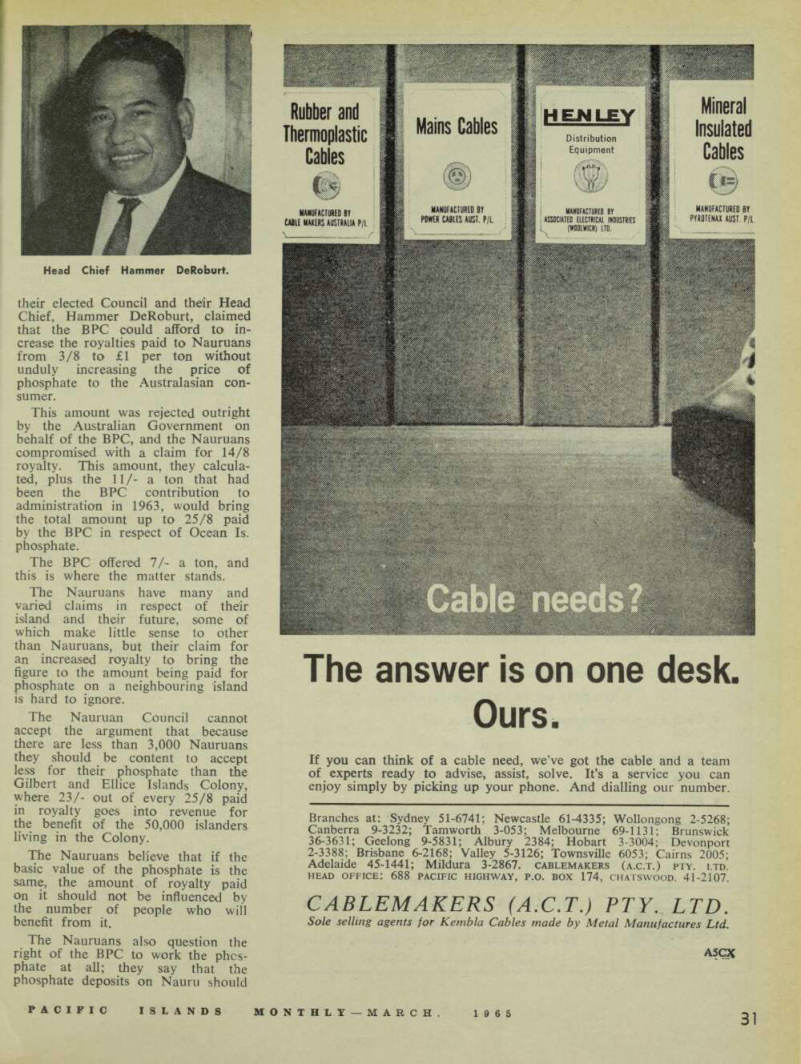
their elected Council and their Head Chief, Hammer Deßoburt, claimed that the BPC could afford to in crease the royalties paid to Nauruans from 3/8 to £1 per ton without unduly increasing the price of phosphate to the Australasian con sumer.
This amount was rejected outright by the Australian Government on behalf of the BPC, and the Nauruans compromised with a claim for 14/8 royalty. This amount, they calcula ted, plus the 11/- a ton that had been the BPC contribution to administration in 1963, would bring the total amount up to 25/8 paid by the BPC in respect of Ocean Is. phosphate.
The BPC offered 7/- a ton, and this is where the matter stands.
The Nauruans have many and varied claims in respect of their island and their future, some of which make little sense to other than Nauruans, but their claim for an increased royalty to bring the figure to the amount being paid for phosphate on a neighbouring island is hard to ignore.
The Nauruan Council cannot accept the argument that because there are less than 3,000 Nauruans they should be content to accept less for their phosphate than the Gilbert and Ellice Islands Colony, where 23/- out of every 25/8 paid in royalty goes into revenue for the benefit of the 50,000 islanders living in the Colony.
The Nauruans believe that if the basic value of the phosphate is the same, the amount of royalty paid on it should not be influenced by the number of people who will benefit from it.
The Nauruans also question the right of the BPC to work the phos phate at all; they say that the phosphate deposits on Nauru should
Head Chief Hammer DeRoburt.
revert to the ownership of the Nauruan people.
They believe that the German Administration granted the rights to the Pacific Islands Phosphate Co. without consulting the Nauruans, and that in 1919 the Phosphate Company’s rights were acquired by the BPC also without consulting the Nauruans.
Failing the transfer of the deposits back to the Nauruans, they would like the extraction of phos phate slowed down, so that they might benefit from a phosphate income longer.
At the present rate of extraction, the deposits will likely last about 35 years; but if the BPC carries out its plan for faster extraction they might last only 25 years. The BPC has made an agreement with the GEIC to extract no more than 310,000 tons a year from Ocean Island. Exports from Nauru in 1962-63 were over 1,600,000 tons.
The Nauruans believe that their wishes are ignored by the BPC, which, they say, “refuses to negotiate with them on a proper basis” and which will not produce documents to show either them or the United Nations any cost figures.
They believe, also, that Nauruan phosphate is the best in the world, sold cheapest in the world, to Aus tralasian farmers and that, in effect, they have been subsidising Aus tralian and New Zealand agriculture for years. In view of this, they think Australia should now be pre pared to make any necessary sacrifice in giving the Nauruans the resettlement terms that they want.
Resettlement As they have, for the time being, turned down the idea of resettling elsewhere on Australia’s terms, they believe that the “land that has been denuded of its natural soil for phosphate mining should be re claimed”. They do not think it would be “difficult to obtain volcanic soil from sources most convenient to back-load to the island” in the phosphate ships.
Although resettlement of the Nauruans when the phosphate has run out has been a long-term plan for a long time, it became a live issue only in 1961. Citizenship and resettlement in their own countries was offered by Australia, New Zealand and the UK but for reasons of association and climate it was considered that Australia offered the best prospects.
The three governments would contribute to the cost of resettle-
ment, however, which was calcula ted to be not less than £lO million.
Choice of a resettlement area finally boiled down to two islands off the north Queensland coast — Curtis Island off Gladstone, and Fraser Island off Maryborough.
Members of the Nauru Council told this PIM representative in January that the Nauruans, in fact, preferred Fraser Island, but that this was not offered them. Fraser supports a large timber industry and Queensland interests are apparently reluctant to give this up.
The Nauruans consider that such has been their contribution to Aus tralian welfare that the Common wealth Government should be prepared to buy off those interests, whatever the cost, and offer Fraser to the Nauruans.
Turned Down Curtis Island was offered but the Nauruans turned it down. There were a number of reasons for this but the chief one was the matter of sovereignty. The Nauruans main tain that they want to remain Nauruans and not lose their identity; that they don’t want to be Australian citizens or be absorbed into the Australian community where they would be—or think they would be—second class citizens open to racial discrimination.
As both Curtis and Fraser are so close to the Australian coast as virtually to be part of the mainland this matter of sovereignty is some thing about which the Common wealth and Queensland Governments are equally adamant.
The Nauruans, however quite genuinely—seem unable to under stand this natural attitude and feel that Australia should be willing to
give a piece of itself away in return for a Treaty of Friendship with New Nauru, ex-Curtis Island, and other safeguards.
When matters had reached this stage in 1964, the Nauruan leaders called off any further resettlement plans, and for the time being, at any rate, stated that they would now prefer to remain on Nauru and they would like an elected Legisla tive Council with a Nauruan majority in 1965 and independence by 1967.
The Other Side of the Picture Before the Pacific War, the Nauruans were regarded as the “luckiest islanders in the Pacific” because they had an independent income from their phosphate with out having to do a thing about it, they had an Australian administra tion to look after them, and a huge commercial enterprise like the BPC to work the valuable phosphate, in the most efficient way. Doubtless, no one asked the Nauruans if they felt the luckiest; this was simply the conclusion of the disinterested observer—although the Nauruan be tween the wars was probably happy enough.
The pendulum has now, however.
These are coral pinnacles of a worked out area of Nauru. Mr, J. C. E. Taylor, the BPC manager on Nauru, (left) is seen with a field engineer.
swung right over and the attitude is growing among the Nauruans that they are very hard done by indeed; that the BPC, far from being an efficient producer of phosphate on their behalf, is an exploiter that is tearing up their island and shipping it away to Australia and New Zealand where it is turned into superphosphate and virtually given away to farmers.
The truth probably lies in neither of these extremes. No very up-to date figures of the comparable costs of superphosphate in other countries is available, but according to those published in 1962 (see panel), the cost of superphosphate to Australian consumers is not phenomenally cheaper than elsewhere and dearer than in some places. However, no Australian could spend more than five minutes with a Nauruan leader without hearing the inference that Australian agricultural prosperity has been largely at the expense of the Nauruans.
This attitude is reinforced by that of the BPC, which refuses to explain itself to anyone. It could well be that the Commission is working the phosphate deposits in the most economical and efficient way in the world but as it makes no atempt to prove that it does, critics — particularly the Nauruans—distrust everything it does.
A similar fog surrounds the destruction of the island itself.
Nauru consists of a narrow belt of flat land around the perimeter, a small depression in the south-west corner containing Buada lagoon, and an interior plateau going up several hundred feet which consists of coral
pinnacles up to 30 feet high, between which is packed the phosphatic rock.
When the phosphate is taken out what remain are these pinnacles— acres and acres of them, like a vast graveyard covered with tall tomb stones.
The Nauruans now speak as though all of their island were fertile before the phosphate was taken away but the still untouched part of the plateau hardly bears this out. Little overburden exists over the phosphate, and what there is supports nothing more than a covering of stunted scrub and twisted vines. Coconuts and other food crops are grown around the coastal flat and around Buada lagoon, the areas, where the Nauruans themselves live.
Before the advent of the Phosphate Company the Nauruans necessarily had the same sort of subsistance economy as atoll dwellers and a diet that consisted of little more than fish and coconuts. But it is at least 50 years since the Nauruans had to make do with anything like that; today their food comes out of a shop.
But so far as we know, no in dependent expert has ever pro nounced on what the Nauru plateau might have produced if it hadn’t produced phosphate, and it might be a good idea if someone did and laid this ghost once and for all.
Similarly, it would be interesting to hear an expert on the idea of rehabilitating the island—first sug gested by a Russian member of the United Nations a dozen years ago and now taken up by the Nauruans with more enthusiasm than expertise.
Importation Of Soil It might be possible to import soil to fill the areas between the coral pinnacles, although to a non-technical observer it looks a task of such magnitude as to be impossible. In 1964 the Nauruans suggested that someone from the CSIRO look it over and calculate the cost of rehabilitation. PIM understands that such a report has already been made and that the scheme is not feasible because the soil would work its way through the porous rock, but if this is so it is bad public relations for the BPC not to have announced it.
Finally, there are the Nauruans themselves. Socially charming, with a vast capacity for enjoyment, kindly, they are at the same time stubborn and touchy to a point that no other Islands community has yet been able to afford to be. Moreover, they have a tremendous sense of identity and believe that they are
quite special and unique. And this, of course, is true.
No one knows quite where they came from and whether they are Polynesian with an admixture of Micronesian and Melanesian; or Micronesian with an admixture of Polynesian and Melanesian.
They have a language that no one else speaks and have used it and preserved it to such an extent that although there are less than 3,000 of them and they have been in con tact with the British for over 60 years, there is still an English problem in the schools.
But what really makes them uniquest of all is that they own a valuable property—and own it in a period when the omnipotent eye of the anti-colonialists is not likely to let anyone forget it.
The Nauruans have been shrewd enough to exploit this to the full but whether they have the elasticity of mind of true negotiators is not so obvious. Up to date, the Nauruans seem more prone towards hypnotising themselves into taking up an attitude, and then refusing to budge from it.