Tropicalities
pp. 23-25 · Read in the full issue
We happened to be in Port Moresby the other day when the giant Melbourne Herald publishing group announced it had purchased control of the South Pacific Post group, so we can report that the local reaction was “favourable”. Most people were hoping out loud that the takeover would mean a better news coverage by the local papers and a more intelligent interest in Territory developments.
THE South Pacific Post particularly has never enjoyed a reputation in the Territory as a comprehensive newspaper. Over the years, in the hands of various editors, it has fluctuated between the sensational and the dull, and current criticism of it is that it is frequently filled with Administration handouts, and that its editorials seldom discuss local matters with any real depth.
The Post’s younger sister, the New Guinea Times-Courier, in Lae, has in recent years been a much brighter paper and has made a more successful attempt at covering local news. But, it expresses no editorial opinions and carries no leader column.
Journalists who have worked for the papers under the Yaffa owner ship have more often than not been a colourful crowd; some have lasted only for brief but hectic spells before moving on, complaining loudly of low wages, long hours of work, and insufficient staff for the job on hand.
The Melbourne Herald group has a fine reputation within the Austra lian newspaper industry for main taining good working conditions and a high standard of production, and editorial changes will obviously take place in time. The position of Mr.
H. G. Cooke, on the managerial side, is not expected to change.
Three of the Herald group directors were in Port Moresby when the deal was announced—Mr. Keith Macpherson (finance), Mr. John Carter (production) and Mr. Brian Donaldson (legal). Mr. Macpherson was in charge of negotiations. He said there would be no changes.
In late February Mr. Cooke flew to Melbourne for discussions. For a report on the financial side of the takeover, which results in young David Yaffa (aged 31) getting him self a fortune, see our commercial pages.
Rarotonga Nails
Its Problem
A MECHANICAL genius in the Cook Islands Public Works Department seems finally to have solved the problem of Rarotonga’s nail-studded roads—the roads that gave a visiting PIM team in October eight punctures in seven days {PIM, Dec., p. 20). It’s the best news for Rarotongan motorists since the advent of the Model A Ford.
The solution to the puncture problem is a device, made by the Public Works Department, which is fitted with 30 powerful (over)
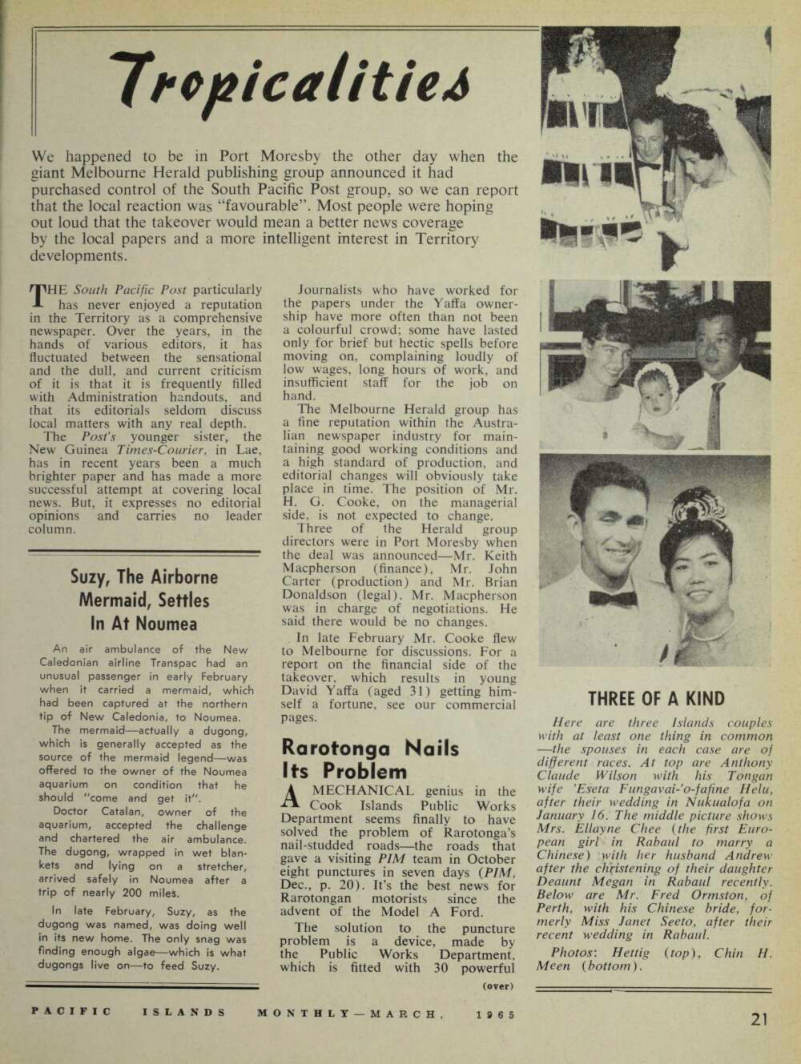
Three Of A Kind
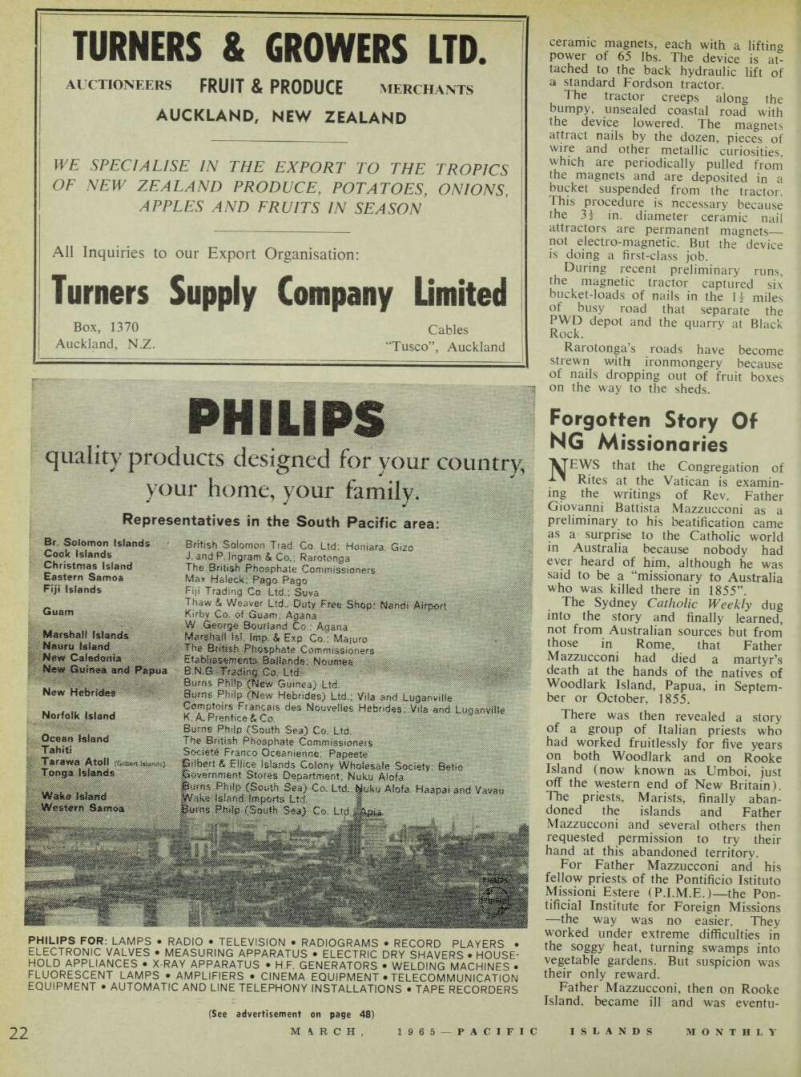
Here are three Islands couples with at least one thing in common —the spouses in each case are of different races. At top are Anthony Claude Wilson with his Tongan wife 'Eseta Fungavai'-o-fafne Helu, after their wedding in Nukualofa on January 16. The middle picture shows Mrs. Ellayne Chee (the first Euro pean girl in Rabaul to marry a Chinese) with her husband Andrew after the christening of their daughter Deaunt Megan in Rabaul recently.
Below are Mr. Fred Ormston, of Perth, with his Chinese bride, for merly Miss Janet Seeto, after their recent wedding in Rabaul.
Photos'. Hettig {top). Chin H.
Meen {bottom).
ceramic magnets, each with a lifting power of 65 lbs. The device is at tached to the back hydraulic lift of a standard Fordson tractor.
The tractor creeps along the bumpy, unsealed coastal road with the device lowered. The magnets attract nails by the dozen, pieces of wire and other metallic curiosities, which are periodically pulled from the magnets and are deposited in a bucket suspended from the tractor.
This procedure is necessary because the 3i in. diameter ceramic nail attractors are permanent magnets— not electro-magnetic. But the device is doing a first-class job.
During recent preliminary runs, the magnetic tractor captured six bucket-loads of nails in the U miles of busy road that separate the PWD depot and the quarry at Black Rock.
Rarotonga’s roads have become strewn with ironmongery because of nails dropping out of fruit boxes on the way to the sheds.
Forgotten Story Of
NG Missionaries
VTEWS that the Congregation of . Rites at the Vatican is examin ing the writings of Rev. Father Giovanni Battista Mazzucconi as a preliminary to his beatification came as a surprise to the Catholic world in Australia because nobody had ever heard of him, although he was said to be a “missionary to Australia who was killed there in 1855”.
The Sydney Catholic Weekly dug into the story and finally learned, not from Australian sources but from those in Rome, that Father Mazzucconi had died a martyr’s death at the hands of the natives of Woodlark Island, Papua, in Septem ber or October, 1855.
There was then revealed a story of a group of Italian priests who had worked fruitlessly for five years on both Woodlark and on Rooke Island (now known as Umboi, just off the western end of New Britain).
The priests, Marists, finally aban doned the islands and Father Mazzucconi and several others then requested permission to try their hand at this abandoned territory.
For Father Mazzucconi and his fellow priests of the Pontificio Istituto Mission! Estere (P.I.M.E.) —the Pon tificial Institute for Foreign Missions —the way was no easier. They worked under extreme difficulties in the soggy heat, turning swamps into vegetable gardens. But suspicion was their only reward.
Father Mazzucconi, then on Rooke Island, became ill and was eventu
ally sent to Sydney to recuperate. In August, 1855, he sailed back to New Guinea, in the Gazelle. The Gazelle struck one of the reefs near Wood lark and started to ship water. The village elders decided to kill all on board and despite the strenuous opposition of one native who had been a follower of the Catholic religion, Mazzucconi was killed by a hatchet in the middle of the skull, and so was everybody else aboard the Gazelle. Mazzucconi was 29.
According to the Rome story, that same day at his lakeside home in Italy the dead man’s mother saw a shadowy form waving as it passed.
She recognised it as her missionary son and noted the time and date in her diary.
Father Mazzucconi’s fellow priests, back in Australia, organised a search party, found the wreck of the Gazelle, but sailed away after learn ing the natives intended slaughtering them too. With them they took the faithful native Puarer, who had been against the killing of the priest.
The Colonial Government in NSW proposed to send a punitive ex pedition to Woodlark but one of the missionaries opposed the move. He thought it more to the point that Masses be offered in Sydney to Mazzucconi, the martyred priest, who may become a South Seas saint.
Eggs For Breakfast
Dinner And Tea
TF you should hear rumours of an egg shortage in Lae and that the patients at the Aneau Memorial Hospital are so healthy that there
is talk of reducing the staff, then they could be right. It’s all due to the fact that there are eggs and eggs—thousands of cooked eggs— at the Red Cross kiosk in Lae.
The sale of cooked eggs at the hospital kiosk started as an experi ment, but now almost 100 dozen cooked eggs a week go over the counter. New Guinea children, in the Lae area at least, demand a cooked egg in the same way Euro pean children demand sweets.
But the sale of eggs is not only for children—everybody buys them, Doctors at the hospital are both amazed and happy about the egg business, and the doctors them selves—and the nursing sisters— can often be seen buying the cooked eggs as gifts for patients in the wards, particularly the children.
The kiosk was opened last August and it has developed into both a first class business and first class meeting place.
Both visitors and sick make for the kiosk during the day and sit down for a chat on the verandah.
In charge is Mrs. Dewberry, who
took over recently from Miss Pat Robertson, who has now “gone South” to a permanent house in Brisbane, after more than 12 years in Port Moresby and Lae.
Only difficulty about egg sales is the pile of egg shells accumulating, and maybe the time will come when the hospital will have to move out to Mr. Purnell’s chook farm and he will move to the hospital site where he can produce even bigger eggs by raising healthier chooks on the mounds of shellgrit!
“Too Many"
Taxis in Fiji
rpHERE are now 1,100 taxis in Fiji to serve a population of less than 500,000 and that is too many, ac cording to the Colony’s Department of Transport and Civil Aviation.
Visitors, however, may not agree, for Fiji is certainly the best served by taxis of any Pacific island.
Most of Fiji’s taxis are on Viti Levu, the main island, which has a population of about 300,000.
The department in 1963 made an effort to control the number of taxis (there were then 750) when the Controller. Mr. George Smith, intro duced a bill into the Legislative Council to limit the number.
But the combined efforts of a few Fijian members and some Indian members, who were most vehement in their opposition, were too much for the Government, which allowed a free vote, and the bill was over
whelmingly rejected.
The department’s latest annual re port comments: “In their efforts to earn a living, taxis are now poaching bus traffic on a large scale and there is a real danger that some scheduled bus services will, in due course, be come uneconomic”.
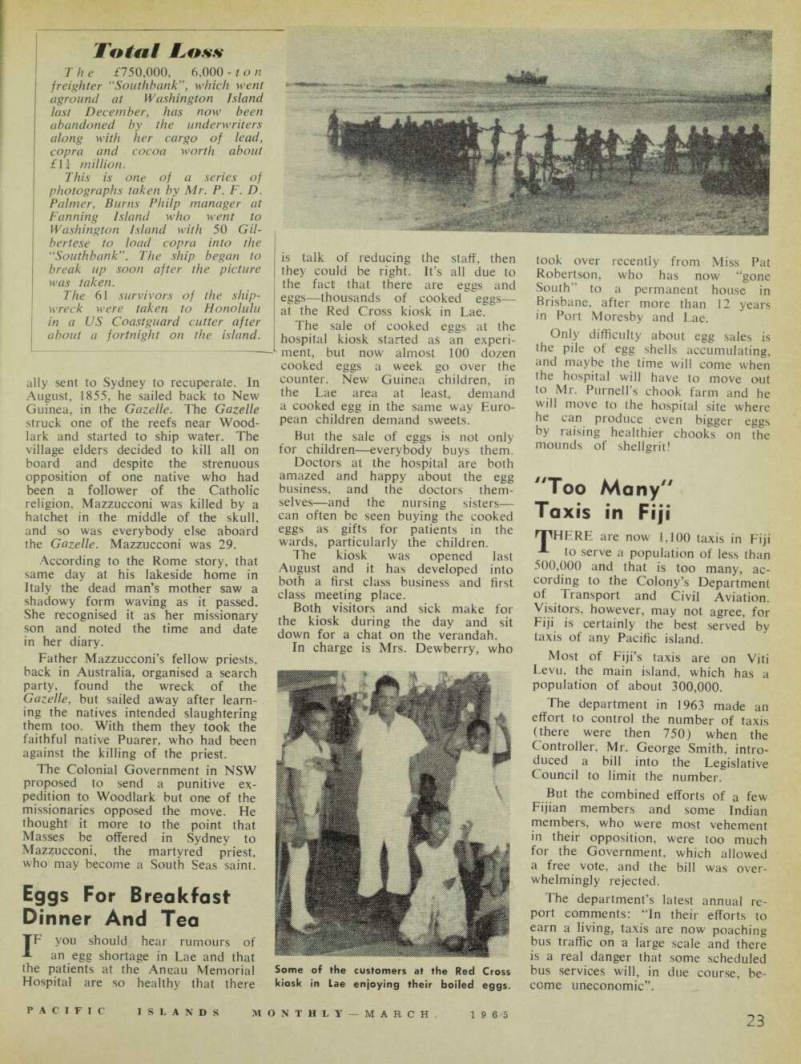
Some of the customers at the Red Cross kiosk in Lae enjoying their boiled eggs.