Parliamentary Government
pp. 9-10 · Read in the full issue
The Fight Opens For Parliamentary Government In Papua-New Guinea
From Stuart Inder, in Port Moresby Here in February the first shots were fired in the fight for parliamentary government for Papua-New Guinea. And first casualties were—as always in a developing colonial situation— the expatriate public servants, 5,000 of whom currently con trol the administrative machinery in this big territory of two million people.
IT wasn’t a bitter fight—although there were occasional signs of temper. It was a fight fought with words, solid arguments, some emotion, tactics and with not a little heart burning, “These people may be wrong but they are terribly sincere and what they are doing, because of their sincerity, must end up being for the general good,” planter lan Downs told the 64-member House of Assembly.
And dour miner Bill Bloomfield said: “We are forced to pass this bill because the Administration has not recognised the political progress, aspirations and the importance of these people.”
Theoretical Command “These people” were the 54 mem bers of the House elected by one million voters on the Territory’s first common roll last year, and now, in theory, in command of the Territory’s Parliament except for financial matters.
“The bill” was an amendment to the Public Service Ordinance, intro duced by the elected members in an effort to take most of the control of the Public Service away from Can berra and put it into the hands of a local Public Service Board.
The amendment was bulldozed through despite the protests of the official members who, in the years when they were in the majority, had bulldozed through many a bill them selves.
It is now up to the Australian Minister for Territories to veto it, or —if he is wiser—send it back with a few suggested amendments to tidy it up. For its details do need tidying up, although its principle is sound and simple.
Its principle is: The time has come for Australia to ease up on the reins;
to practice what it has been paternalistically preaching these last few years.
It has been clear to me in a fascinating week of moves and counter moves that P-NG has now reached the stage that many now-independent British colonies reached after the war; Politictl machinery has been established that cannot be controlled with any certainty by metropolitan interests.
There can be no guarantees now.
Good sense and compromise must prevail.
The particular issue which has now come to a head has been warmly simmering since last year, when the Administration announced two salary scales for the Public Service—a lower one for local recruits, based on the Territory’s future ability to pay.
Such a move was overdue, but the difference in payments between the locals and the staff recruited from Australia was such as to bring the obvious query, “Can we afford to bring up Australians and their wives and families?”
Quiet Resentment The query fell on fertile ground, for New Guineans have for some time been quietly resenting well-paid Australian clerks and bottle-washers who live in large, well-furnished houses at 18/- a week while they hold down jobs that the locals claim they could learn to do if they were given the chance.
And they have resented, too, many of the expatriate wives with their petty prejudices and suburban minds, and even their pouting children.
It’s been the haves and the have nots, with one vital difference: The New Guineans have not been resentful to the point where they are blind to the value of expatriate officers and want to rid the country of them.
They know they can’t do without them and that to attract them here Australia has to bait the hook.
But they do believe that the Terri tory can do without some of them, and that a larger say in Public Service recruitment and salary conditions might help them adjust the position in time.
Mr. Downs gave notice in January that he would move at the February meeting the amendments to the Public Service Ordinance and thus attempt to move another step forward on the road to self-government.
A statement issued by the Minister following this notice seemed to in dicate that Mr. Barnes would be ready to consider the proposal.
But a shock awaited Mr, Downs and his fellow elected members of the Administrator’s Council when they met in February on the eve of Mr. Downs’ presenting his amend ments to the House.
In a “secret communication”, Mr.
Barnes made it clear that he had no intention of allowing any part of the proposed measure to become law.
The elected members of the Council, stung by the Minister’s re fusal to leave them even a loophole for compromise, were now in a dilemma. With a bill about to be in troduced that would have the majority support of the House, how could the House be warned that it would cer tainly be vetoed in Canberra?
This dilemma was resolved by the unprecedented step of calling to gether the elected members of the House at a closed meeting and reading
the Minister’s uncompromising letter to them.
Reaction of the European and many of the elected New Guinean members was of anger at the Minister’s stand.
From most of the native members there was no reaction, simply because the peculiar wording of the Min ister’s letter made it almost impossible to translate it intelligently into Pidgin.
For the next day or two there was constant activity in the corridors and the members’ rooms, as in the House the session droned on with nothing of special interest to break the monotony. A visitor could be for given for feeling that this session was dull, dull, dull—for the trouble that was brewing was all behind scenes.
"Lesson In Compromise"
The difficult question for the elected members to solve was the method of rephrasing the proposed bill so that a collision with the Minister could be avoided. Despite Mr. Barnes’ uncompromising at titude the members appeared de termined to turn the other cheek and prove that sincerity, and not political expediency, was their motivating force.
As Mr. John Stuntz commented: “If the elected members wanted to play politics all they would have to do would be to complain to their electorate that big, bad Canberra wouldn’t let them do the right thing.
But for Canberra’s sake we’ll try to work on Canberra, not the elec torate.”
This view was all the more note worthy considering that the Public Service Association was now irritat ing the elected members by taking a narrow we’ll-fight-to-keep-what we’ve-got stand, and the Administra tion had further inflamed them by introducing economic rentals for expatriate officers, but at the same time announcing payment of “rental allowances” to bring the rents back
to the old figure of 18/5 a week.
These allowances weren’t payable to local officers!
“If every clerk in the place wants to pack up and go home to Aus tralia then good riddance!” said one irate member.
The amending bill was passed after a day-long debate marked on the elected side of the House by speeches appealing to Canberra to please, please intelligently consider what the aim of the bill was; and on the official side by urgent requests to the elected members not to bull doze, not to collide head-on with Canberra but to put the whole thing over to June, when a more considered bill could be introduced.
The House took the view that Canberra could do the considering, especially as one or two new amendments should now make it even more palatable to Mr. Barnes.
Although the loyalty of the official members was beyond question, observers of this week’s activities would have been left with the im pression that the Port Moresby Administration had a sneaking regard for the attitude of the elected members. Said one official: “Hasluck
wouldn’t have dug in his toes the way Barnes did. Barnes has been wrongly advised.”
Certainly if Canberra officials had been present during the week they would have seen for themselves that the repeated cry of the elected members that they “have to take action on the bill because the elec torate wants it” was not a hollow one.
On a dozen other different matters during the week the elected members showed that their electorates were demanding action and that they were going to have to give them action or take the risk of being kicked out.
The situation was illustrated by an outburst from Gaudi Mirau, an intelligent, if choleric Papuan, who protested that he was now bringing up the subject of a Bundi road for the fourth time in four meetings, and that his words were still ignored.
“My people at the elections wanted me to speak about this matter of a road through bush and I cannot stop talking about this because this road must go through . . he shouted.
This, surely, was parliamentary government on the move.
The roads, and the bridges, and the parish pumps all over the Ter ritory will have to be seriously con sidered by 1968, or the next House of Assembly will be packed with men not as sincere, as forgiving, as reasonable, nor as compromising as this parliament has been in its bid to grasp the reins that Canberra boasts it has already handed to them.
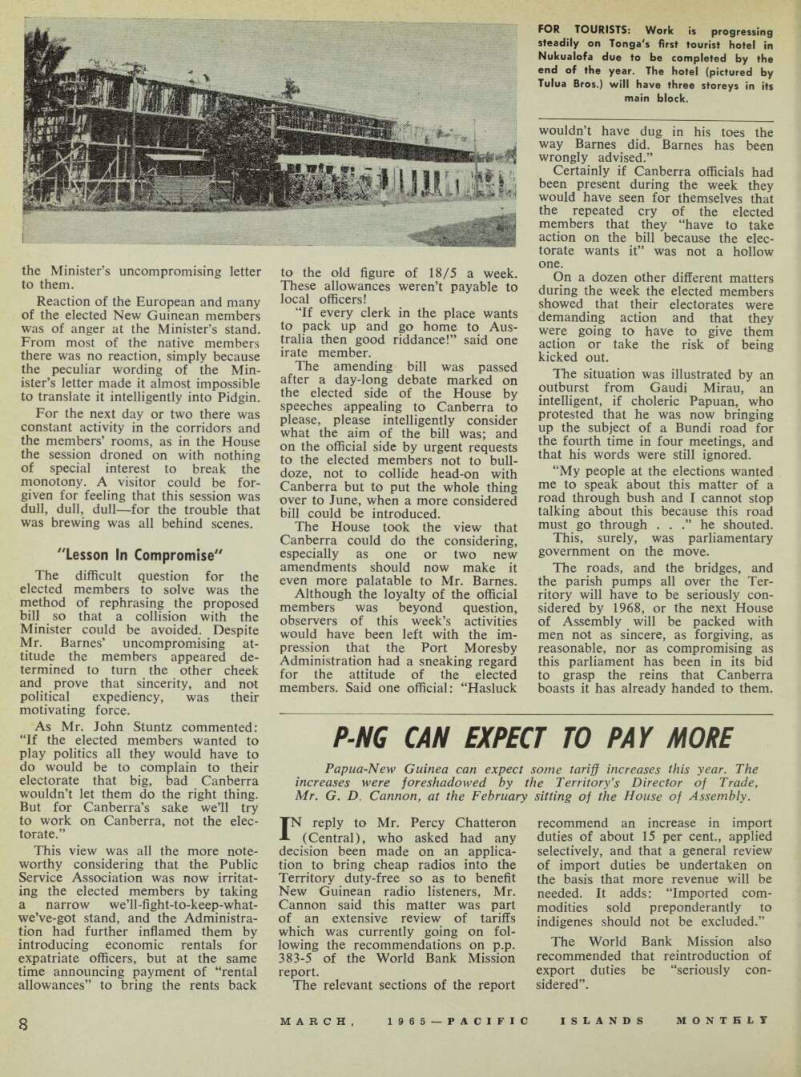
FOR TOURISTS: Work is progressing steadily on Tonga's first tourist hotel in Nukualofa due to be completed by the end of the year. The hotel (pictured by Tulua Bros.) will have three storeys in its main block.