Noted Missionary's
pp. 89-91 · Read in the full issue

Tahitians Angry Over Damage To Noted Missionary's Grave
From a Papeete Correspondent The bulldozing of some of Tahiti’s finest coconut and other trees to make way for Army barracks and such like has been a source of intense resentment among the Tahitians since the first troops and technicians for the atomic testing project at Mururoa arrived in Tahiti about 18 months ago.
RECENTLY, this resentment reached a new pitch when a bulldozer, clearing ground in the district of Arue, knocked down a coconut tree which damaged the tomb of the pioneer LMS mis sionary, Henry Nott.
Nott is a revered personage among the Tahitians because of his translation of the complete Bible into their language. This translation established Tahitian as the classic tongue of Central Polynesia and brought with it the majesty of style of the English Bible.
Nott’s grave is on private land at Outu Aiai, near the tomb of King Pomare 11, who was the main collaborator in his translation work.
Consignment Of Pipes
A school of 15 to 20 classrooms is to be built on this land, which, meanwhile, is being used as a depot for a consignment of long pipes, re quired for some purpose connected with the atomic testing project.
The pipes are stacked right up against Nott’s grave, making it almost impossible for anyone to approach it.
The profanation of this grave has come hard on the heels of a decision by the Eglise Evangelique de Polynesie (Polynesian Protestant Church) to build a magnificient tomb for Nott in the old Polynesian style.
Now, it seems, some of the money for this project will have to be used to restore the present one, which is marked by a simple head stone of a type commonly seen in British cemeteries.
The stone bears the inscription: “Sacred to the memory of the Rev.
Henry Nott, Missionary, who departed from this life of sin and sorrow and entered into his rest on the 2nd day of May, 1844, after having endured a great fight of afflictions. He had been, for 48 years, the faithful servant of the London Missionary Society, having been sent out by them to this island in the ship Duff, commanded by Captain James Wilson, in the year 1796. He was translator of the Sacred Scriptures into the Tahitian language. . . .”
A stately ceremony was held at Nott’s graveside on May 2, 1944, to mark the centenary of his death.
On that occasion, the late Mr. W.
W. Bolton, an English historian who lived for many years in Tahiti, said in an oration: “Nott is not famous in Christian circles as are John Williams, of Ra’iatea, Chalmers, of New Guinea, or Baton, of the New Hebrides; but we who know his worth and work rank him amongst the greatest mis sionaries who ever landed on the islands of the Great South Sea”.
A bricklayer by trade, Nott arrived in Tahiti as a single man at the age of 22—one of the youngest in the Duff company.
He proved to be a born linguist.
He was the first missionary to master the Tahitian language and the first to address the Tahitians publicly in their own tongue. This was in 1801.
After the disastrous wars, involv ing King Pomare 11, which induced
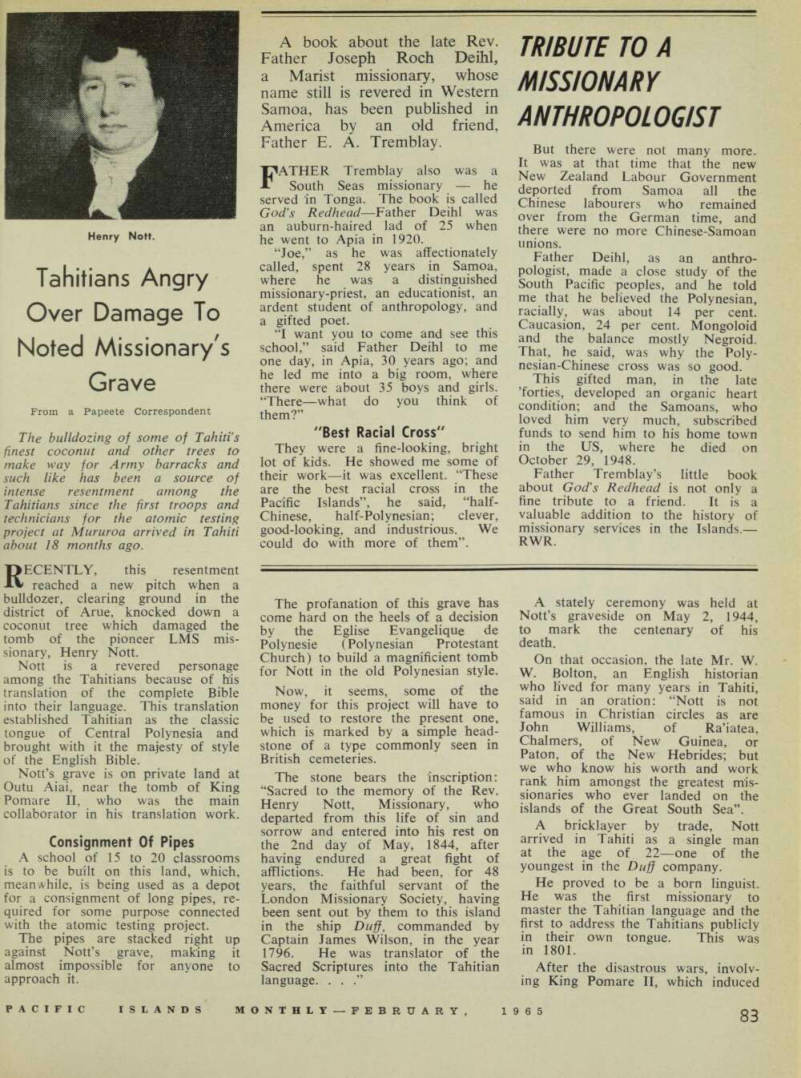
Henry Nott.
Nott’s colleagues to abandon Tahiti in 1808 and sail for Sydney, Nott moved to Moorea and continued his missionary labours there—alone.
When the missionaries began dribbling back from Sydney in 1812, Nott made a quick trip to New South Wales to marry “a godly young woman” from London who, with three others, had been sent out by the London Missionary Society to become the wife for a Tahiti missionary.
Returning to Moorea, Nott trans lated the Gospel of St. Luke into Tahitian, and in 1818 this became the third book to be published by the Mission Press on Moorea—the pioneer printing establishment in the South Seas.
After 12 months on Huahine in 1818-19, Nott returned to Tahiti where he lived the rest of his life, except for a single visit to England.
Nott’s translation of the Bible was completed in December, 1835, after 20 years’ labour, and he left for England two months later tx> see it through the press. The Bible was printed to the expense of the British and Foreign Bible Society, and Nott personally presented a specially bound copy of it to Queen Victoria.
He returned to Tahiti in Septem ber, 1840, taking the Bibles with him, and retired from active mis sionary service soon afterwards.
At the time of his death in 1844 at the age of 70, Tahiti had been i French protectorate for two years.
Forgotten
Thereafter, the French gradually )usted the English LMS missionaries, ind the graves of those who had lied in Tahiti became neglected and 'orgotten.
For some reason, the Tahitians wentually moved the headstone Torn Nott’s grave, and one from the icarby grave of the Rev. T. S. tfcKean, to the grass outside the loor of the church at Outu Aiai.
There their significance un mown, because no one could read he inscriptions on them—the two ombstones lay until about 1918 /hen the late Mr. A. C. Rowland, n American long resident in Tahiti, hanced to see them.
With the help of an English riend and some elderly Tahitians f Arue, Mr. Rowland succeeded in the graves of Nott and IcKean, and the headstones were to their original sites.
That is where they stand today— lott’s damaged and profaned by lose who care nothing and know othing of Tahiti of the old times.