Pickings For Divers
pp. 83-86 · Read in the full issue
Wreck Off Privateer In Tonga Should Provide Good Pickings For Divers
By Robert Langdon
The development of the aqualung since World War II has resulted in skindivers dis covering many old wrecks on the seabed in various parts of the world, some of which have contained relics of great historical and archaeological value (see p. 88) or treasure worth hundreds of thousands of pounds.
SO far, however, there have been few discoveries of this sort in the South Pacific, except at Vani koro (see panel below), mainly
because skindiving has not reached the South Pacific in a big way yet.
When it does, there is at least one wreck—which should not be difficult to find—that will almost certainly yield a worthwhile treasure of old Spanish coins and other valuable items.
This wreck is that of the well armed, 500-ton British privateer Port au Prince, which the Tongans cut off and burned to the water line at Lifuka, in the Ha’apai Group, in 1806.
The Governor of Ha’apai, the Hon. Vaea, told me in Sydney re cently that a diver could probably locate the wreck in a few hours, as the water where the Port au Prince went down was only a few fathoms deep.
Traditions He said the people of Lifuka had several traditions about the exact location of the wreck, but all sites were in a small area off the north western point of the island.
The Hon. Vaea added that the Tongans, themselves, had never searched for the wreck because there was no aqualung equipment in Tonga.
Details of the valuables on board the Port au Prince and the story of how and where these were obtained were set down a century and a half ago in one of the most notable books on the South Seas.
The book, commonly known as Mariner’s Tonga is the story of
William Mariner, one of the crew of the Port au Prince who survived the massacre when the ship was taken. His book was first published in London in 1817, and although it is well known by reputation, few people these days have read it, as it has not been reprinted since 1827.
Mariner was only 13 years old when he joined the Port au Prince in London as clerk to her com mander, Captain Duck. The Port au Prince had a twofold commission: to cruise for prizes among enemy shipping and to search for whales in the Pacific.
Haul Of $4,000 The ship rounded Cape Horn in June, 1805, and put into Coquimbo, Chile, disguised as an American, a month later. There, Captain Duck had his first success as a privateers man when three Spaniards mistook his ship for a smuggler and came on board expecting to find contra band goods.
The officers of the Port au Prince did not disillusion them and told them to bring money on board the following night to make purchases.
The Spaniards came back with $4,000 in cash. This sum was taken from them after they had been
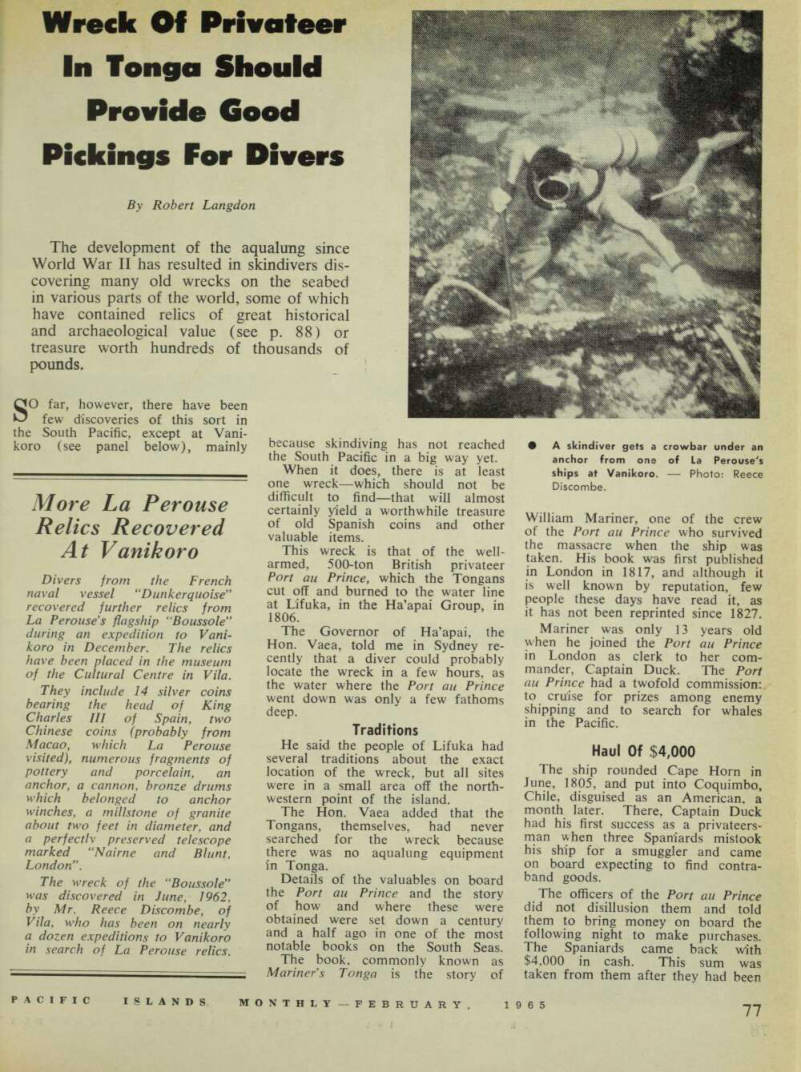
A skindiver gets a crowbar under an anchor from one of La Perouse's ships at Vanikoro. Photo: Reece Discombe.
Captain Died At Cocos Island
entertained until the early hours of the morning and then told they were prisoners of war.
Next day, two other Spaniards came on board with $4OO to buy smuggled goods, and they and their money were separated in the same way as before. Later, four armed boats from the Port au Prince went ashore and plundered several ware houses of 52 hides of tallow, 800 gallons of wine and four pigs of copper; and two of the prisoners were ransomed for $3OO.
Gold, Silver Ore When the Port au Prince put into Caldera, a port to the northward, a few days later, Captain Duck got no loot, but he did get a present of gold and silver ore from the Governor.
On leaving Caldera, the Port au Prince captured three Spanish brigs, one of which, the Begonio, was found to be carrying $l,OOO and plate worth $3OO to $4OO.
The Port au Prince’s next success was in the Peruvian town of Ho, where the church was pillaged of silver candlesticks, chalices, incense pans, crucifixes and several images of silver. All the silver plate that could be found in the town was also taken before the town was set on fire.
On September 22, 1805, the men of the Port au Prince, with those from another British privateer, the Lucy, plundered the town of Chinca.
After an engagement with Spanish warships off Paita, in which the Port au Prince was slightly damaged and suffered several casualties, Captain Duck headed for the Galapagos Islands in company with the Lucy. There all the plate and dollars, which had been taken by the two ships in concert, were equally divided between them.
The two privateers then parted company, the Port au Prince soon afterwards turning her attention to whaling. But while still seeking her first whale, she sighted a Spanish brig, Santa Rosa del Carmo, which was captured and manned as a prize.
At Cocos Island In mid-February, 1806, the Port au Prince put in to Cocos Island, west of Panama, for wooding, water ing and painting. Then she resumed her whaling cruise, but did not sight a single whale in two or three weeks.
At the end of March, off Acapulco, one of the officers of the Port au Prince was given command of the Santa Rosa del Carmo and ordered to sail her to Sydney and sell her and her cargo.
The Port au Prince then resumed her whaling cruise, took several whales, and captured another Spanish ship which yielded $ll7, plus some beef, pumpkin and a couple of bullocks.
In August, 1806, while paying another visit to Cocos Island for repairs, Captain Duck died and the command passed to Mr. Brown, the whaling master. Things went badly for the Port au Prince from then on.
Mr. Brown’s views on privateering did not coincide with those of Captain Duck, and he passed up a chance to capture a treasure-laden Spanish warship off the coast of California, much to the disgust of his crew.
Instead, he sailed to Hawaii for repairs, arriving at Oahu at the end of September, 1806, with his ship leaking badly.
As she had a sick man on board, the chief of the island would not let anyone land for fear that the disease might be transferred ashore; but the Port au Prince was able to take on board a supply of pigs,
fowls, fruit, and vegetables, plus eight Hawaiians who offered their services.
Headed For Tahiti Mr. Brown then headed for Tahiti to make repairs—the leak, meanwhile, increasing to the rate of 9i inches an hour.
To ease the ship, the carronades were removed from the quarterdeck and taken below; the whale oil try works were also taken down, and the bricks were thrown overboard.
By mid-November, it was necessary to work the pumps every hour, and as the ship could make no headway for Tahiti, a course was steered to the westward.
On November 29, 1806, the Port au Prince brought to in seven fathoms of water at the north-west point of Lifuka. This was the same spot that Captain Cook had anchored in 30 years previously.
The Tongans at first acted amicably, but before 24 hours were out it was evident—but not to Mr.
Brown, who seems to have been marvellously naive that the Tongans were up to no good.
On the morning of December 1, even though 300 Tongans had boarded the ship, Brown accepted an invitation to go ashore to view the country.
Soon afterwards, the Tongans
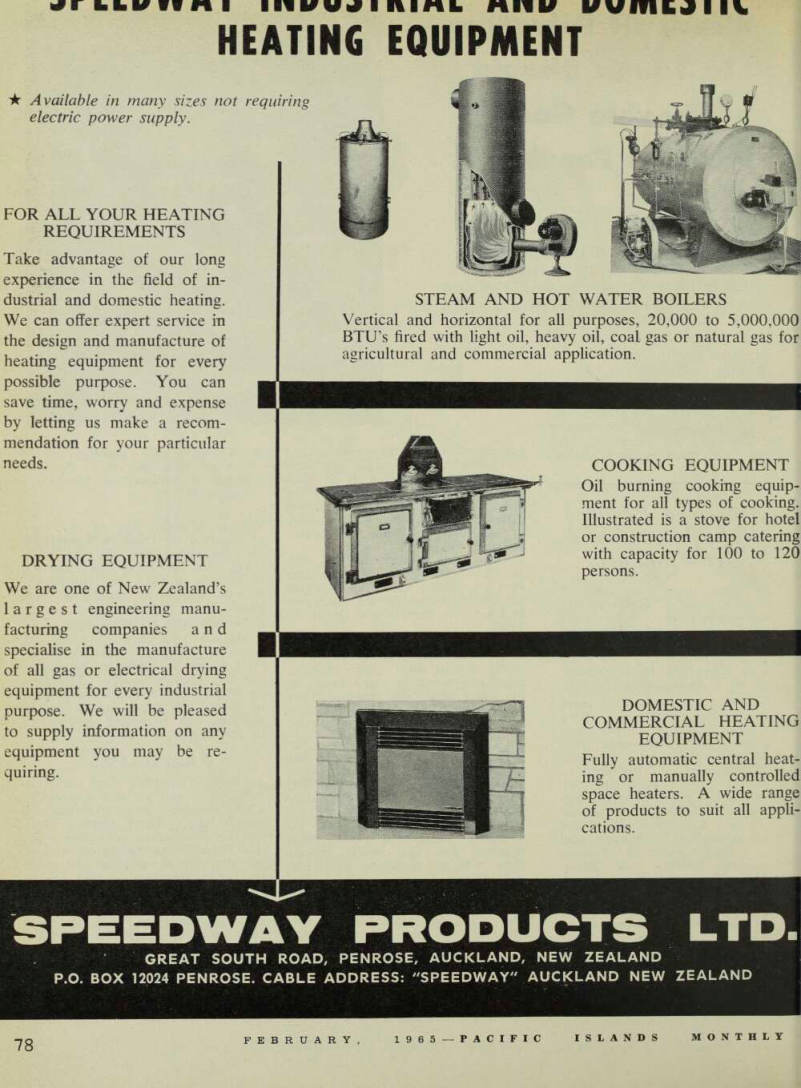
This map shows the three main islands in the northern part of the Ha'apai Group, the anchor indicating the spot where the "Port au Prince" was captured by the Tongans.
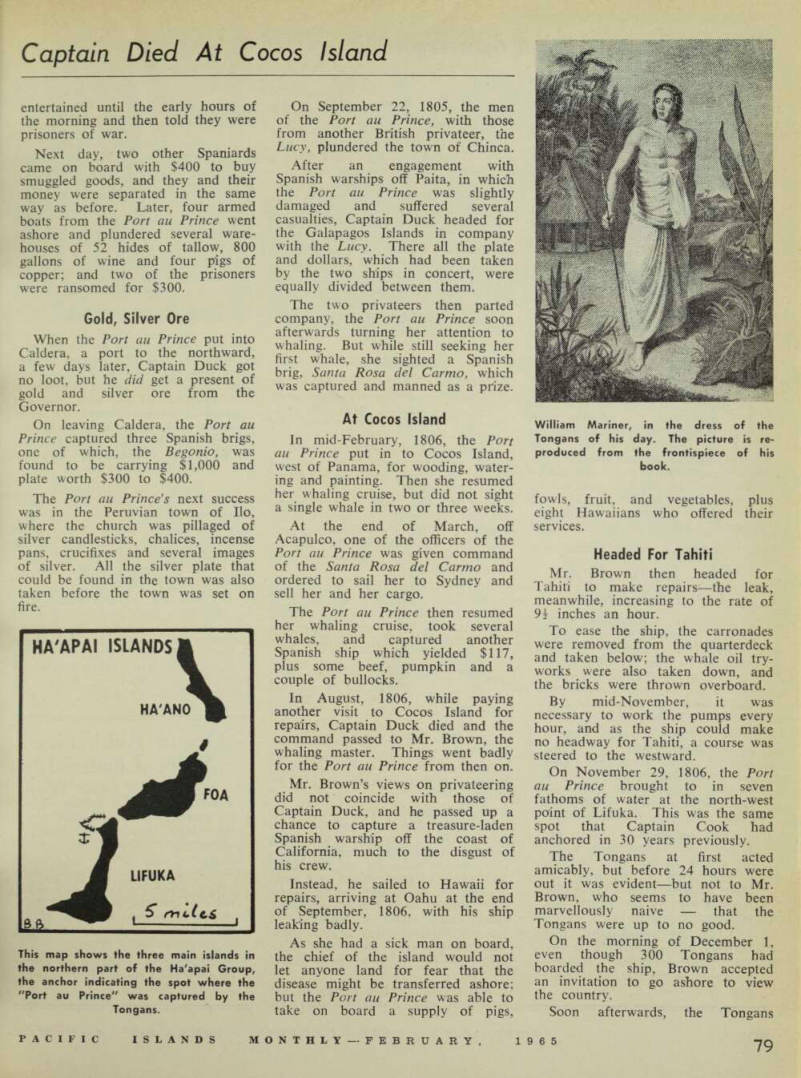
William Mariner, in the dress of the Tongans of his day. The picture is re produced from the frontispiece of his book.
Tongans Panicked When Guns Went Off
massacred 22 of his crew who were on deck. Brown himself, and several other men were murdered ashore.
Will Mariner escaped death through being below decks at the time of the massacre. Twenty-four of his shipmates also survived, although it is commonly stated that he was the only one, or only one of a handful, to do so.
Taken To Finau Soon after the massacre. Mariner was marched to the island of Foa, which is joined to Lifuka by a reef.
There, he was taken to see Finau, an important chief, who took an immediate liking to him.
During the next four years, Mariner was a leading member of Finau’s entourage, acting as his adviser in matters of warfare, etc.
The day after his meeting with Finau, Mariner went with him on board the Port au Prince. On Finau’s orders, he and several other members of the crew cut the cables and worked the ship “through a very narrow passage, so full of rocks and shoals as to appear almost un navigable”, to within half a cable’s
length of the shore (300 ft) where she was run aground.
During the next two or three days, the masts were struck and two of the carronades and eight barrels of gunpowder were taken ashore.
Meanwhile, the Tongans stripped the iron from the upper works and knocked the hoops off casks in the hold—iron being a most valauble commodity to them, and their main reason for cutting off the ship.
On December 9, it being spring (high) tide, the ship floated and was warped into low water mark.
That evening, the Tongans set fire to her so that they could get at the iron work more easily.
Guns Go Off The fire, however, produced an unexpected result—all the guns, which were loaded, went off, pro ducing a terrible panic among the Tongans.
Later, when the guns had stopped firing, Mariner went down to the beach and found the ship burnt to the water’s edge.
During the next four years, Mariner probably never learned precisely what the Tongans took from the ship and what they left on board when the exploding guns drove them off.
But it is clear from one passage in his book that they left some of the Spanish dollars behind. This passage concerns a conversation that Mariner had one day with Finau on the subject of money.
Finau expressed surprise that dollars were money, saying he had always taken them to be pa’anga (a kind of bean which the Tongans used in one of their games).
He was therefore exceedingly sorry that he had not taken all the dollars out of the Port au Prince before he had ordered her to be burnt.
“I had always thought,” he said, “that your ship belonged to some poor fellow, perhaps to King George’s cook, for Captain Cook’s ship, which belonged to the King, had plenty of beads, axes, and look ing glasses on board, whilst yours had nothing but iron hoops, oil, skins and 12,000 pa’anga, as I thought. But if every one of these was money, your ship must have belonged to a very great chief indeed.”
When Mariner left Tonga in the American brig Favourite after his
four-year stay, his only wealth comprised 50 or 60 Port au Prince dollars. Some of these had been given to him by a woman who had adopted him as her son, and some he obtained from a Lifuka woman in exchange for beads.
The mention of this small sum in Mariner’s book indicates that at least some of the Port au Prince's treasure was recovered. But there is little doubt that a good deal more —along with many other articles of interest—still await a finder off Lifuka’s north-west coast.
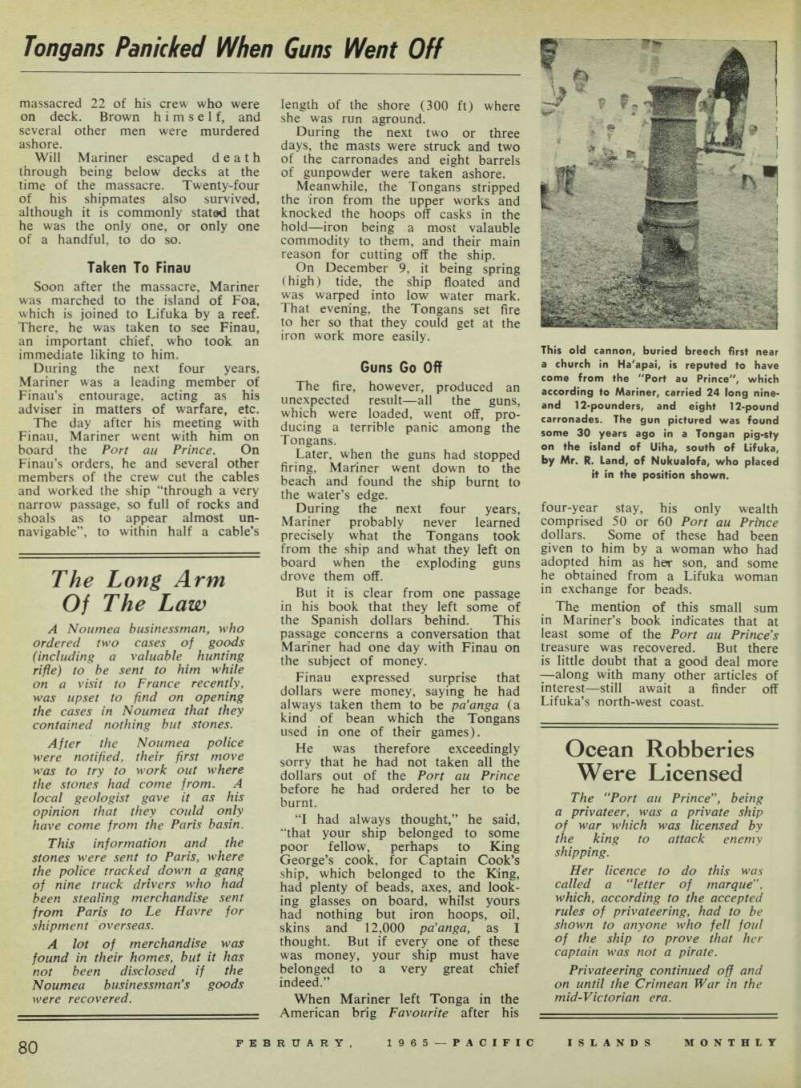
This old cannon, buried breech first near a church in Ha'apai, is reputed to have come from the "Port au Prince", which according to Mariner, carried 24 long nine and 12-pounders, and eight 12-pound carronades. The gun pictured was found some 30 years ago in a Tongan pig-sty on the island of Uiha, south of Lifuka, by Mr. R. Land, of Nukualofa, who placed it in the position shown.