Bure On
pp. 47-50 · Read in the full issue
Is The Fijian
The Way Out?
From a Suva Correspondent
Some time within the next five years visitors to a Fijian village in the north-west comer of the main Fiji island of Viti Leva will see a bure shining in isolated splendour, unoccupied. It will be a distinctive sight because it will be the only bure, or native type house, in the whole village. It will be surrounded by wooden-walled, iron-roofed houses, all occupied by Fijians.
AND this, in a coconut shell, is a hint of the shape of things to come in Fiji’s rural areas. The Fiji bure appears to be on the way out—to become a museum piece, The bure in this particular northwest village will in fact be built as a museum piece, to show visitors an example of Fijian handicraft, and as an object lesson to Fijians yet unborn. It will be built only after all the villagers are housed in European-type housing, and the new housing is already rising in this particular village.
The people in this village say that the traditional bure today costs too much to build and maintain. The bure may be picturesque and cool in summer and warm in winter, but more and more villages aim to replace it with ugly wooden structures.
And this is despite the views of
“Frustrated Islands Resident”, who wrote in PIM in December that not enough attention was being paid by Islands Administrations to tradi tional Islands skills, including the skills of cheap home building, Already, of course, the housing problem is becoming acute in the urban areas such as Suva, Lautoka and Labasa, and other growing centres of population, Rrinht linhtc Attrart Bn 9 nr L, 9 hT S Attract Attracted by the “bright lights”, hundreds are leaving their villages every week, the Fijians hastening the process of urbanisation through a desire to try town life on a weekly wage—if they’re lucky—instead of living communally in the way of their ancestors.
The Indians are moving in,
possibly like Pat of the Mountains of Mourne, with the dream of streets all paved with gold.
For several years now, the Fiji Government has attempted to tackle the housing problem through the Government-created Housing Authority which is, in turn, under the aegis of the Fiji Development Company, a subsidiary of the Commonwealth Development Cor poration.
The authority built its first workers’ house in 1959, a year after the authority was constituted, the idea—confined at first to Suva— being to provide houses for workers who must work in the city or town in which they are being housed and who must be earning not more than £l2 a week.
The plan was to provide the worker with a roof over his head at a price inside his financial com mitments, the ceiling being fixed at “not more than 25 per cent, of his income”.
The formula usually presented to the Fijian, who is less inclined than the Indian to worry about any financial situation, is: One month’s rent equals one week’s pay.
All Kinds Of Housing In that way he knows what he is letting himself in for, and the same formula has been adopted for those in the lower income bracket.
Several classes of workers have been provided with dwellings, par ticularly in Suva where the Housing Authority’s holdings now run into thousands of pounds.
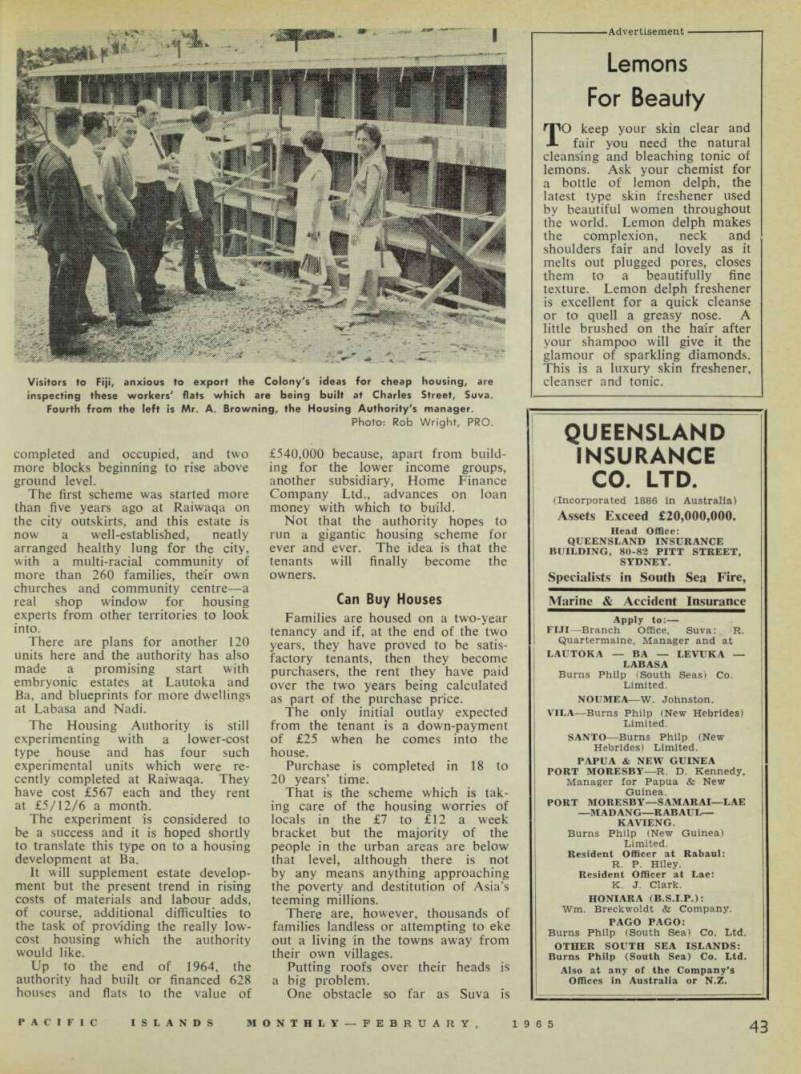
There is the duplex or semi detached house, single or double storey, terraced dwellings, usually in rows of six, and flats. Charles Street in Suva affords a good example of the last-named type with two blocks each of 24 flats recently
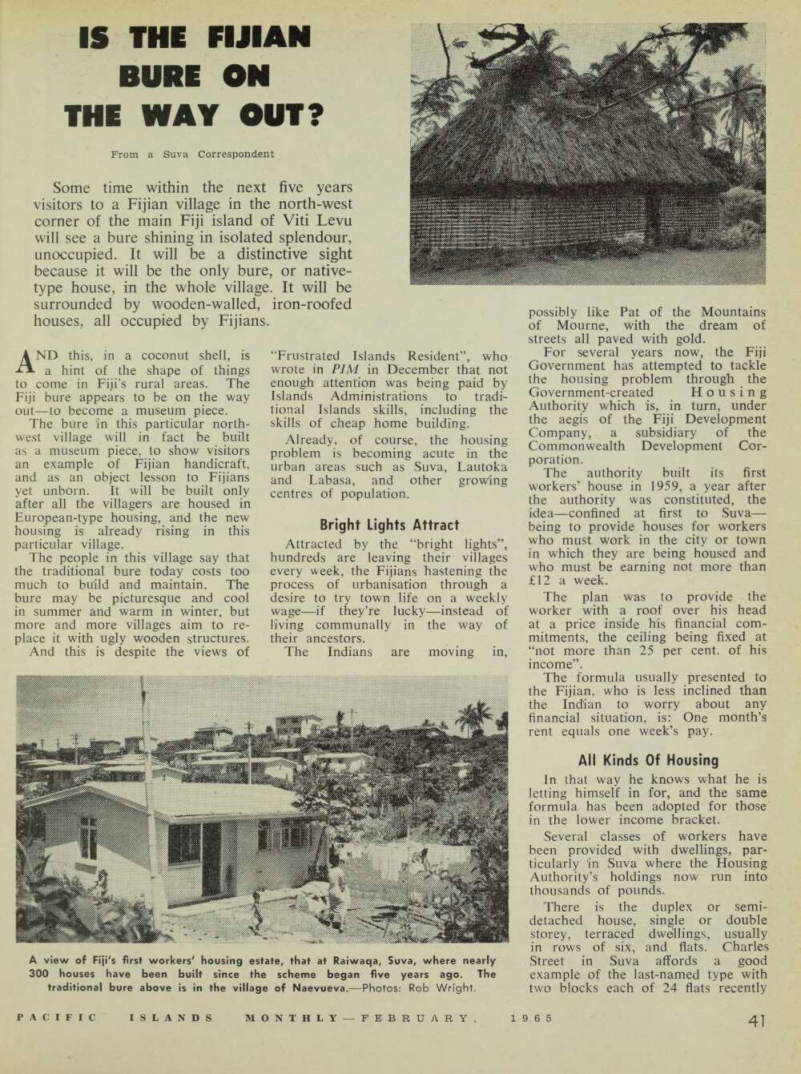
A view of Fiji's first workers' housing estate, that at Raiwaqa, Suva, where nearly 300 houses have been built since the scheme began five years ago. The traditional bure above is in the village of Naevueva.— Photos: Rob Wright.
completed and occupied, and two more blocks beginning to rise above ground level.
The first scheme was started more than five years ago at Raiwaqa on the city outskirts, and this estate is now a well-established, neatly arranged healthy lung for the city, with a multi-racial community of more than 260 families, their own churches and community centre—a real shop window for housing experts from other territories to look into.
There are plans for another 120 units here and the authority has also made a promising start with embryonic estates at Lautoka and Ba, and blueprints for more dwellings at Labasa and Nadi, The Housing Authority is still experimenting with a lower-cost type house and has four such experimental units which were re cently completed at Raiwaqa. They have cost £567 each and they rent at £5/12/6 a month.
The experiment is considered to be a success and it is hoped shortly to translate this type on to a housing development at Ba, It will supplement estate develop ment but the present trend in rising costs of materials and labour adds, of course, additional difficulties to the task of providing the really low cost housing which the authority would like.
Up to the end of 1964, the authority had built or financed 628 houses and flats to the value of
£540,000 because, apart from build ing for the lower income groups, another subsidiary, Home Finance Company Ltd., advances on loan money with which to build.
Not that the authority hopes to run a gigantic housing scheme for ever and ever. The idea is that the tenants will finally become the owners.
Can Buy Houses Families are housed on a two-year tenancy and if, at the end of the two years, they have proved to be satis factory tenants, then they become purchasers, the rent they have paid over the two years being calculated as part of the purchase price.
The only initial outlay expected from the tenant is a down-payment of £25 when he comes into the house.
Purchase is completed in 18 to 20 years’ time.
That is the scheme which is tak ing care of the housing worries of locals in the £7 to £l2 a week bracket but the majority of the people in the urban areas are below that level, although there is not by any means anything approaching the poverty and destitution of Asia’s teeming millions.
There are, however, thousands of families landless or attempting to eke out a living in the towns away from their own villages.
Putting roofs over their heads is a big problem.
One obstacle so far as Suva is
Visitors to Fiji, anxious to export the Colony's ideas for cheap housing, are inspecting these workers' flats which are being built at Charles Street, Suva.
Fourth from the left is Mr. A. Browning, the Housing Authority's manager.
Photo: Rob Wright, PRO.
concerned is that the City Council’s accepted standards for housing are pretty high.
The council has, however, agreed to a request from the Housing Authority to lower its standards slightly to allow the authority to build a cheaper house in certain specified areas.
But it is generally clinging tenaciously to standards and at the moment is fighting a grim battle with unscrupulous landowners who, dis pensing with the necessity for sub dividing land before building, are creating a black market in shanty towns.
Shacks and hovels made from odd bits of wood, petrol tins and rusty corrugated iron are being built, illegally of course, in their hundreds round Suva’s outskirts.
The builders, innocents abroad from the villages who want to live in the big city, are paying in most cases an exorbitant ground rent to the land-owning Shylocks.
All these shacks are illegal, breaking every land and housing law.
Council Has A Heart Not that the council has no heart.
Several times, Suva’s Mayor, Cr.
Charles Stinson, has expressed regret that legal action has to be taken against the squatters, but it is either that or the creation of filthy slums.
A Roman Catholic priest, Fr.
Hurley, who for years has been fighting to house the poor, has pro vided an idea for a cheap house which can grow and keep pace with its occupants’ fortunes.
This house has the support of the Housing Authority and the blessing of several other bodies. The first batch has been built at a settlement near Suva occupied by the Filafou community, who have now given their name to the type of house which, with Fr. Hurley’s plans, they have built.
The money has been advanced by the Housing Authority and the first of the Filafous are in being. Pro vided land can be acquired cheaply, these houses can be provided in rural and semi-rural areas for as little as £4 a month.
The Filafou house consists of a single room but with a wide verandah all round and the roof overhanging to a distance of several feet. The floor space of the one room house is 300 square feet, but construction is such that additional rooms can be added later, so that the occupant can, in the end, finish up with a house covering floor space of 500 square feet.
That to thousands in this Colony adds up to a palace.