Pacific Commerce and Produce
pp. 132-134 · Read in the full issue
"Not Enough Co-Operation"
Steamships' Chief Attacks P-NG Administration
The Papua-New Guinea Administration has not been co operating sufficiently in recent months with commercial enter prises in the Territory, according to the chairman of Steamships Trading Co. Ltd. (Mr. H. D. Underwood).
ADDRESSING shareholders at the company’s annual meeting in Port Moresby in December, Mr.
Underwood said: “There has been a slow but marked deterioration in relations with the sector [of the Administration] concerned with economic development.
“Since it became known that the draft report of the World Bank had reached Canberra, it seems that a curtain has been dropped between the economic sector of the Administration and commercial enterprises which have been long established in the Territory.
“On the day following the release of the World Bank Report, the Administration was unable to make available to your company a copy of the report, although copies had been given to various interested institutions and persons.”
Mr. Underwood said he had made a submission to the Minister for Territories, Mr. C. E. Barnes, which he hoped would lead to closer cooperation between private enterprise and the Administration on economic development.
"Faith Justified"
He went on: “I believe that Steamships’ continuing policy of faith in the Territory has been justified by consistently improving profitability, and that if the various recommendations of the World Bank ... are endorsed and supported by the Federal Government, the economic growth
of Papua and New Guinea during the next few decades will be rapid yet sound.”
Mr. Underwood said the consoh dated net profit of his company for the year was £408,136 compared with £348,993 last year. This represented an earning rate of 24.4 per cent, on average paid-up capital, an improve ment on the previous year’s rate of 22.9 per cent.
Complimenting his staff on this re suit, Mr. Underwood said: It be comes increasingly difficult and costly to obtain staff of suitable calibre for service in this Territory.”
Other points made by Mr. Under wood were that his company had; • Acquired 96 per cent, of the issued capital of Mount Hagen Hotel Ltd., owner of the licensed hotel at Mt. Hagen, and it was proposed to expand the hotel’s facilities consider ably, • Acquired an area of land at Lae, where it planned to build a modern hotel “to cater for an ever-increasing local demand in that developing centre, and to meet a forecasted in crease in the tourist industry” • Recently bought all the issued capital of Korfena Plantations (New Guinea) Ltd, which ran the largest coffee-producing plantation in the Territory.
Mr. Underwood added that his company had financed new invest ment in the Territory in excess of £1 million during the year ended June 30, 1964.
Australian Trade
Drive in SW Pacific
AN Australian trade ship will visit five South Seas territories in May and June, in a drive to arrest the decline in the percentage of Australia’s exports to the area.
Australian Export Promotions is arranging the promotion in con junction with Australian Department of Trade and Industry. Australian Export Promotions is a non-profit organisation set up by the Associated Chambers of Manufactures and the Associated Chambers of Commerce.
The trade ship, the 3,300 ton Sletholm, chartered from Karlander, New Guinea Line Ltd., will visit Papua-New Guinea, the British Solomons, the New Hebrides, Fiji and New Caledonia. Its ports of call will be Port Moresby (4 days), Lae (2 days), Madang (2 days), Rabaul (3 days), Honiara (2 days), Vila (1 day), Lautoka (1 day), Suva (3 days) and Noumea (3 days).
A total of 10,000 square feet of space on three decks will be devoted to displays of goods and products.
It is expected that the ship will be fitted out at the end of April and that it will leave Sydney in the first week of May.
Representatives of companies ex hibiting on the ship will fly to the ports of call to demonstrate and explain their products, and will not travel on the ship itself. Display space in the ship is at present being allocated.
The territories the “floating show case” will visit have a total popula tion of 2,750,000 and a total import bill of more than £75 million a year.
Australia’s income from the area has risen in recent years, but generally its share of the growing market has fallen steadily because of penetration by other exporting countries.
Australia’s share of the Papuan market fell from 68.8 per cent, in 1958-59 to 63.3 per cent, in 1962-63, and during the same period its share of the New Guinea market fell from 65.2 to 54.5 per cent.
The share of the British Solomons fell from 51.1 per cent, to 47 per cent, between 1957 and 1963.
Australian exports to the New Hebrides —49.8 per cent, of the ter ritory’s total imports in 1959—fe1l to 48,7 per cent, in 1963.
In New Caledonia, Australia’s share of the market fell from 25 per cent, in 1952 to 12.56 per cent, in 1962.
AEP officials say the purpose of the trade ship venture is, not only to increase Australia’s share of these
markets, but to demonstrate Aus tralia’s capacity to meet the increasing need for products in the expanding economies of the six territories.
Australian promoters have made good use of trade ships in SE Asia, but none has been sent to the South Seas before. New Zealand business men made a successful drive in the Tofua in July, 1962, visiting New Caledonia, New Hebrides, Fiji, Western and American Samoa, Tonga and Tahiti.
Pacific Island Mines
In New Venture
PACIFIC Island Mines Ltd., which has gold mine interests on Misima, Papua, will join a venture to search for tin and other metals on the Australian mainland. The operating company will be Austral Exploration Pty. Ltd., and the share holders will be Austral-Malay Tin Ltd., Straits Trading Co. Ltd., Singapore, Pacific Island Mines and a syndicate headed by Mr. Yeap
Hock Hoe, a prominent Malaysian banker. A private Canadian syndicate may also participate. Each group will subscribe equally.
Drilling operations begin near Tingha, northern NSW, in early 1965, Pacific Island Mines will finance the new venture by way of an issue to shareholders of one for four shares held on January 4. Applications close on February 12. The PIM 2/6 shares rose to more than 6/- on the Sydney stock exchange before the announcement.
BSIP Rice Future
"Looks Good"
A GOOD future for wet rice in the Solomons was predicted by the regional controller of the Com monwealth Development Corporation for Asia and the Pacific, Mr. W. A.
Belsham, when he visited Honiara in December. He said he was very much impressed with the Corpora tion’s rice scheme at Ilu, The rice was abviously growing well and quite clearly it was a crop that could be grown on the Guadalcanal plains.
According to an official Govern ment statement, Mr. Belsham said
a CDC irrigation expert would visit Honiara in February and subject to the experts’ views and the availability of technical and advisory services, “everything indicated there could be a viable scheme at Ilu”.
Mr. Belsham said he was thinking in terms of a scheme which would meet all the import needs of the Protectorate—about 2,500 tons a y ear — an d such a scheme would not necessarily stop at the domestic market. There was hope of con verting the Solomons into an ex porter of rice, as there was plenty of scope for marketing rice in other Pacific Islands.
Mr. Belsham added the CDC was also interested in future development of oil palms and other cash crops in the BSIP.
Higher Copra Prices
INURING December Philippine
fr, FM c °P ra prices reached their highest level—at £Stg.74/7/9—since mid-July. Short supply was doubt less the reason for this rise as over the past few months some fairly heavy losses of copra and coconut oil have occurred in shipment be tween their origins and Europe. In such cases, crushers are faced with either closing down their works temporarily or going on to the market which they usually do.
Whether the present level will carry on is “uncertain”, but with the recent typhoon weather in the Philippines it does look as though it will, in the view of the P-NG Copra Marketing Board.
Negotiations for the marketing of P-NG copra during 1965 have been completed on similar lines to last year. Disposal will be as follows: Unilever (UK)—4O,OOO tons, 10 per cent, more or less,
Australian Crushers—approximately
30,000 tons.
Coconut Products Ltd.—including the production of their own estate, 40,000 tons, 10 per cent, more or less, Japan—approximately 4,000 tons.
The Board’s financial year ended on December 31, 1964, and indica tions are that the final price distri bution for the year will be in the vicinity of £lO per ton. (Over)
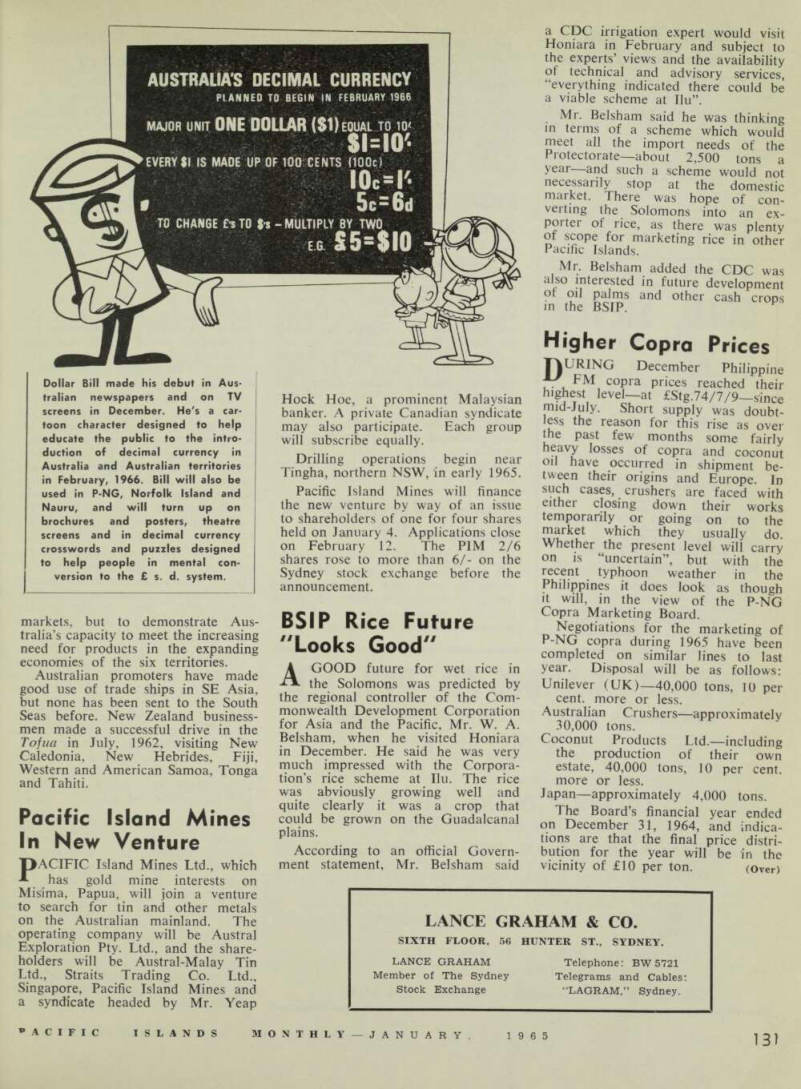
Dollar Bill made his debut in Aus tralian newspapers and on TV screens in December. He's a car toon character designed to help educate the public to the intro duction of decimal currency in Australia and Australian territories in February, 1966. Bill will also be used in P-NG, Norfolk Island and Nauru, and will turn up on brochures and posters, theatre screens and in decimal currency crosswords and puzzles designed to help people in mental con version to the £ s. d. system.
No More Tongan
Bananas For Japan
TONGA, which recently made two shipments of bananas to Japan and was due to make others ( PIM, Dec., p. 12), is unlikely to make any further shipments to that country until February or March this year.
This is because serious damage to Tonga’s banana plantations by gale force winds in mid-November is thought to have wiped out all surplus bananas for overseas markets.
Tonga has been selling bananas to
Japan since May, 1962, under an arrangement with New Zealand that this would only be done when New Zealand could not absorb the entire Tongan crop.
Now, with black leaf streak disease cutting banana production in Fiji and bunchy top doing the same in Western Samoa, New Zealand will probably be able to take all of Tonga’s wind battered crop for several months.
Pearl Experiments
Successful
Experiments to produce cul tured pearls in Fiji have been technically successful. The experi ments, begun early last year at Buresala on the island of Ovalau, were conducted by a Japanese specialist, Mr. Y. Tokito, on behalf of Pacific Holdings Ltd.
Mr. Tokito said recently that a new site would have to be found because muddy water from the Bureta River killed some of the oysters.
Mr. Tokito’s superiors in Japan are confident that, given the right conditions, there will be no difficulty in culturing large blister pearls.
Timber Potential On
Bougainville
A PRELIMINARY forest survey in the Empress Augusta Bay area along the west coast of Bougainville indicates that there may be more than 150 million super feet of com mercial timber in the legion.
Gold Price Depresses
Mining Industry
Criticism of the us gold price policy was made by Mr. J. F.
Wren, chairman of Fiji’s Emperor Mines Ltd., at the company’s annual meeting in December.
Mr. Price said the US Govern ment was “consistent in rejecting any proposals for an increase, apparently because it would be equivalent to depreciation of the US dollar”. (The gold price remains fixed at the 1934 price of 35 dollars an ounce.) Mr. Wren added; “In view of the fact that the pur chasing power of the dollar has declined considerably over the past 30 years it would appear that there is a refusal to admit that sub stantial depreciation has already occurred.
“So long as this policy is followed there is no question but that the gold mining industry all over the world will continue in a depressed state, as the time is approaching when improved mechanisation and research and increased production will not be able to contend with possible further rises in costs, the only solution seeming to be in the granting of government assistance.
“One of the harmful effects of the fixed price of gold is the tendency, and, in many cases, a real necessity to confine operations to mining of high grade ore, neglecting the normal practice of working to an average grade, the result being a reduction in life of a mine.
“Prospecting of any but the more promising areas will decline and the position might well be that there will be an acute shortage of gold, due to an insufficient supply, to support currency requirements.
Many governments, including Aus tralia, have recognised the dif ficulties mining companies are facing and are granting subsidies and concessions to maintain the in dustry.
“Insofar as our company is con cerned, in 1958, the Fiji Govern ment, recognising the importance of the gold mining industry to the economy of the country granted a subsidy of £2 per ounce for three years, the receipt of which enabled us to carry on the special develop ment and capital expenditure pro gramme to increase production.
Your directors are now considering the submission of further proposals for Government assistance and con cessions.”