Travel And Transport
pp. 115-117 · Read in the full issue
What's Happening In
The Central Pacific
By a Staff Writer
The 1964 slogan of the Pacific Area Travel Association that the “Pacific is Terrific” is borne out by the increasing num ber of people from Australasia and North America who are spending large sums of money to go and look at it.
WHILE some countries are cashing in on this boom, others have been slow to get off the mark, but there is money enough in it for all.
The following is a summary of what has been happening in three of the territories on or close to direct routes across the Pacific—Fiji, Western Samoa and American Samoa.
Fiji
Fiji has just completed a record tourist year—one in which the Colony profited by French mistakes in making Tahiti relatively in accessible; and one which showed that the available hotel accommoda tion is now inadequate in mid-year.
The biggest pressure on ac commodation is at Nadi, where almost everyone entering the Colony by air needs accommodation for at least two nights. In addition, Nadi has become a tourist centre in its own right, instead of just an airport on the edge of the sugar-cane as it was five years ago.
A new large hotel-motel, near the airport on a hill opposite the Mocambo, which is now being built by Reddy Construction Co., will do something to help the position. This will have two blocks of motel-type bedrooms, lounge and dining rooms, and a swimming pool. It will be in operation this year.
Resorts on the Korolevu-Korotoga
coast have had a busy year and the next big development here will probably be a new hotel on an island m the lagoon near Cuvu. This will not be until 1966 at the earliest.
Reef Lodge at Korotoga is now completing its first year. This hotel has a delightful location but is handi capped by the fact that it hasn’t sufficient bedrooms to support profit ably the rest of its amenities. There are plans to add more bedrooms and if Reef Lodge is to succeed, this should be before the 1965 winter season.
There has been no extra ac commodation built for tourists in Suva, which is fast reverting to the hotel bottle-neck it was up until the late 1950’5.
Duty Free Fiji
Fiji has also completed its first full year as a duty-free port for such goods as cameras, tape-recorders, transistor radios and watches. These shopping facilities are the number one attraction for cruise-ship Aus tralians who are Fiji’s biggest buyers.
Tourists who visit Fiji by air also carry off plenty of duty-free booty, although they don’t go at it in such a bull-headed fashion as cruise ship travellers, who are happy to forgo
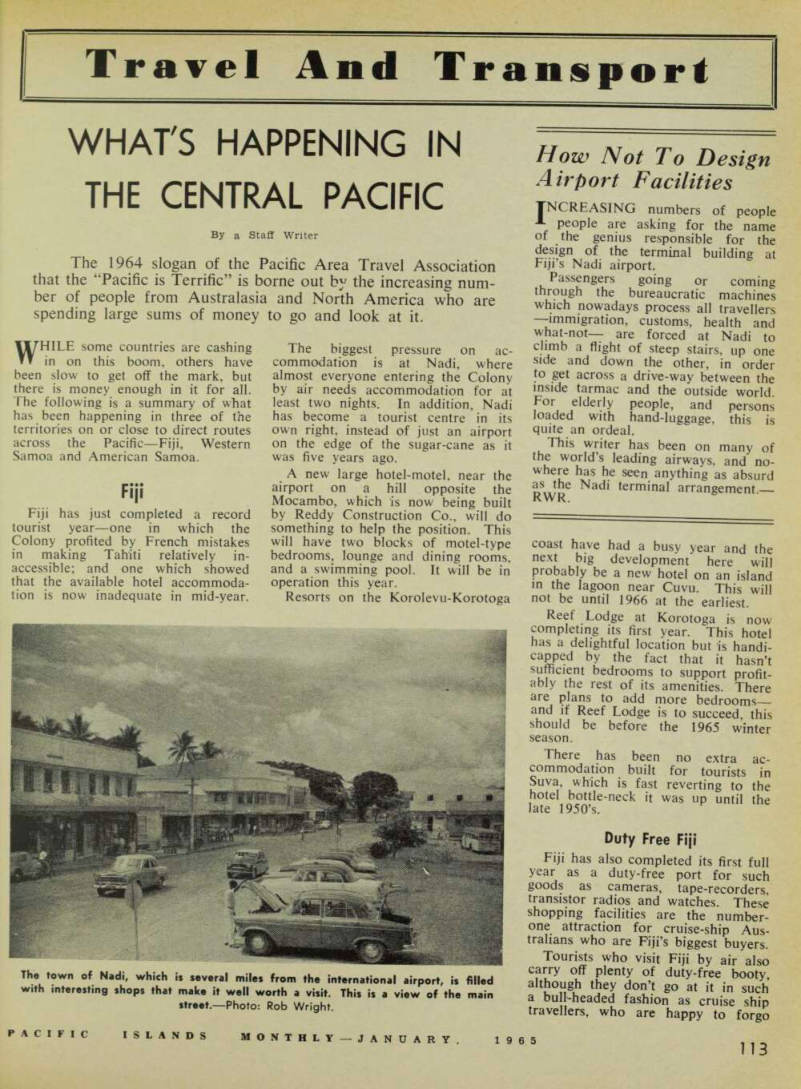
The town of Nadi, which is several miles from the international airport, is filled with interesting shops that make it well worth a visit. This is a view of the main street. Photo: Rob Wright.
all the other delights of Suva for the sake of shopping.
Western Samoa
Western Samoa, which two years ago had many of the same inhibitions about tourists as the Cook Islands, has relaxed a lot of its old rules and regulations.
One reason for this is the develop ment of the local air company, Poly nesian Airlines Ltd., which, since the acquistion of a DC3 aircraft under charter from NZ, has branched out with new routes.
Polynesian now has fortnightly services to Fiji and Tonga, a weekly service (on behalf of TEAL), to Aitutaki and Rarotonga, Cook Islands; and an almost daily service to American Samoa. All this has brought a breath of fresh air into the offices of Western Samoa bureau crats who formerly demanded per mission from the Prime Minister before travellers could set foot in the place and another permit before they could leave.
Passengers in transit now need none of these pieces of paper. Pas sengers to the Cook Is. from Fiji and points south spend one night in Apia on the forward journey and two nights and a whole day on the return from the Cooks to Fiji and Aus tralasia. All this transit accommoda tion is provided at Aggie Grey’s Hotel in Apia and is included in the price of the ticket.
Aggie has added a new block of motel-type bedrooms to her hotel.
All of the rooms are bright and modern, equipped with a refrigerator, have shower and toilet and fan.
Three of the units are air-conditioned.
The friendly, informal atmosphere, plus the patio bar, the swimming
pool and the modern bedroom blocks, have made Aggie’s something of an oasis for those who have to travel further afield in Polynesia.
Polynesian Airlines and Aggie’s have between them revolutionised Western Samoa for travellers in the last two years.
American Samoa
The major revolution that began in American Samoa when it was host for the South Pacific Conference in 1962 is continuing, and before it is through, this territory will have a tourist industry that will add greatly to the national economy.
People who have known American Samoa since the Navy days still find this hard to believe—but all the signs are now there.
A start has been made on the new hotel adjacent to the Goat Island Club which will eventually be demolished. This will be bungalow type, with central dining and lounge rooms. Units will be air-conditioned and be of concrete with shingle roofs -—a form of architecture that blends in well with the Samoan background and has become standard in Ameri can Samoa in recent years.
Ultimately there will be ac commodation for about 200 in the hotel, which is being built with local money plus a government grant and will be run by a Pan American hotel subsidiary.
American Samoa’s new educational TV is also going to pay dividends for the tourist industry. To get the transmitter on to the highest peak so that reception would be possible all over Tuituila, engineers have put a cable-car across Pago’s spectacular inner harbour. At present it is being used for utilitarian purposes
but later it will be used for tourist excursions.
Recently cruise ships have been getting a flowery farewell from the cable-car. As they pull out from the wharf, the cable-car starts out with a load of flowers and when the ship is directly underneath they are showered on the decks. It is a gimmick that probably only Ameri cans would think up—but the tourists love it.
American Samoa got its jet airstrip and its jet service two years ago and its beautiful new terminal build ing at Tafuna only this year. The jet service has proved rather an embarrassment touristwise, because none of the other facilities in Pago matched it. The only accommoda tion is at the Rainmaker Hotel which can be better described as a hostel.
Improved
The Rainmaker has improved con siderably under new management in the last year but it is nowhere near international tourist standard.
It will probably be late 1965 or 1966 before American Samoa gets into its tourist stride but all the signs are that, when the time comes, it will make adjacent tourist spots look to their laurels.
The Americans don’t see it as a place that will hold tourist interest for a long period—Tutuila is too small for that—but they do see it as a pleasant interlude in a Pacific tour. • Citizens of Australia, New Zealand, USA, Canada, Great Britain, Mexico, Japan and many other countries may now visit New Caledonia for up to 10 days without a visa. The only condition required is an onward ticket.
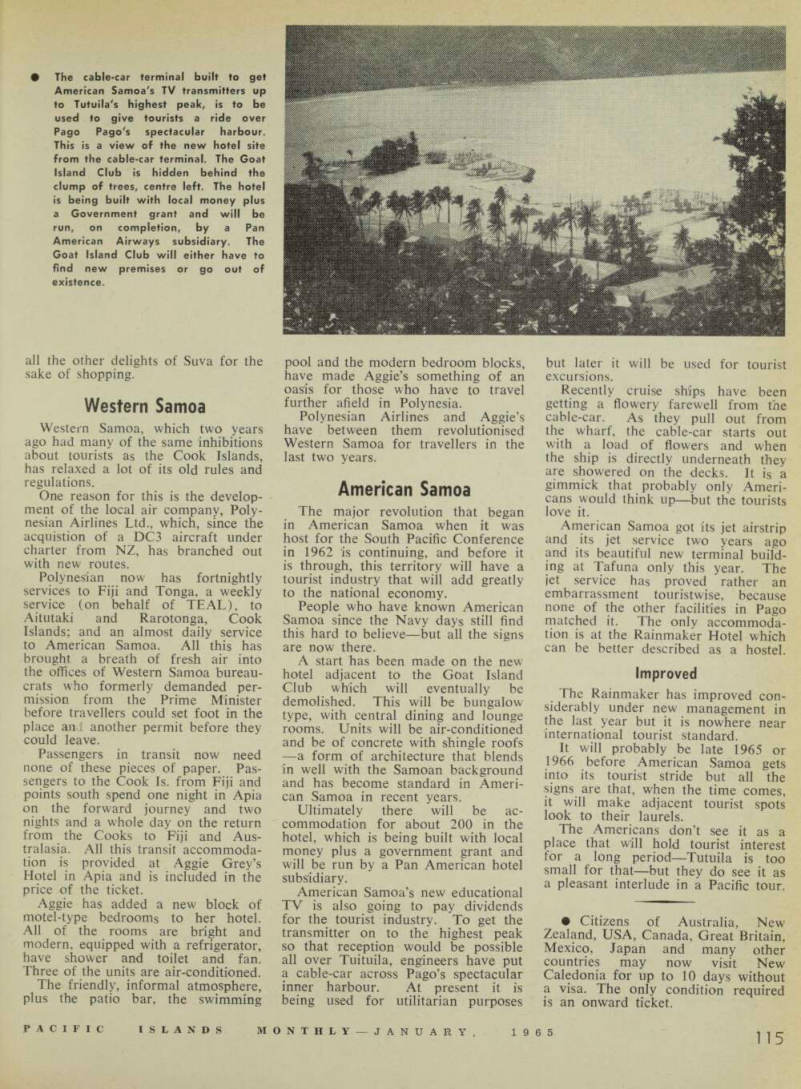
The cable-car terminal built to get American Samoa's TV transmitters up to Tutuila's highest peak, is to be used to give tourists a ride over Pago Pago's spectacular harbour.
This is a view of the new hotel site from the cable-car terminal. The Goat Island Club is hidden behind the clump of trees, centre left. The hotel is being built with local money plus a Government grant and will be run, on completion, by a Pan American Airways subsidiary. The Goat Island Club will either have to find new premises or go out of existence.