Territories TALK-TALK
pp. 109-113 · Read in the full issue
With Tolala
The 23 rd of January 23 years ago was undoubtedly the most eventful and tragic day for Rabaul and, eventually, for the whole of New Guinea. It was the day the Japs landed; the second time the town had been captured by an invading force.
THE military angle of that day has been well covered by official and other historians; but the civilian angle has, naturally, not received much publicity.
There were few left to tell the tale of the retreats to Refuge Gully on two occasions; of the message re ceived from military headquarters by the Chief Warden in the Gully on the morning following the first re treat: “Resume normal duties,” said Brass Hat, and that was on the 22nd with Jap troops on the door step and Zeros overhead; of the rather excited meeting in the Gully of the mixed gathering of Asians, Malays, natives, mixed races and whites on the night before the land ing to determine a plan of action.
Would they stay and face it out or get away over the hills “like hairy goats” (a popular term in those days). Many decided to take a chance, to “give it a go”. Yet either way was taking a chance. Some of those who departed around midnight reached safety after weeks of hard ship; for some of them it was cur tains.
Japanese Occupation: Then
early in the morning of the 23rd came our first civilian casualty. The Chief Warden’s dispatch rider—Rogers— came roaring up the hill on his motor bike, fell off at the entrance to the Gully and was brought in with shocking wounds from a machine gun burst and from which he died.
The continued strafing from the air made the Chief Warden (R. L.
“Nobby” Clark) apprehensive for the safety of the Asian, Malay and native women in the Gully, so it was decided that at daybreak a white-flag party
should enter the town and surrender.
This idea was put into effect by the Chief Warden, Hector Robinson (senior public servant in the Gully) and myself arming ourselves with large white flags and marching down Namanula Street to the intersection of Casuarina Avenue, where a fierce looking Jap machine-gun nest was set up.
It was not a happy time walking down there, wondering just what the Nip was going to do. We were greeted with rifle butts and not a burst from the gun, so it could have been worse.
Our surrender resulted in all occu pants of the Gully being escorted to the baseball oval (adjacent to the Pacific Hotel in those days) where we were “frisked” and kept standing about in the sun, with the “coloureds” occupying the grandstand in the shade.
An Unhappy Night: The Day
ended by everyone being herded into
the Kuomingtang Hall at sunset and a ration of rice was issued. The night was made less comfortable by the spasmodic bombing, by our planes, of buildings nearby contain ing army foodstuffs; the repeated crack of rifle fire bringing down native looters throughout Chinatown.
And here, parenthetically, let me say these looters shot by the Japs were usually buried where they fell, so little wonder skeletons and bones are being discovered periodically around the gardens of Rabaul.
According to Hoyle, or some old time edict. I believe victorious troops are given 24 hours in a captured
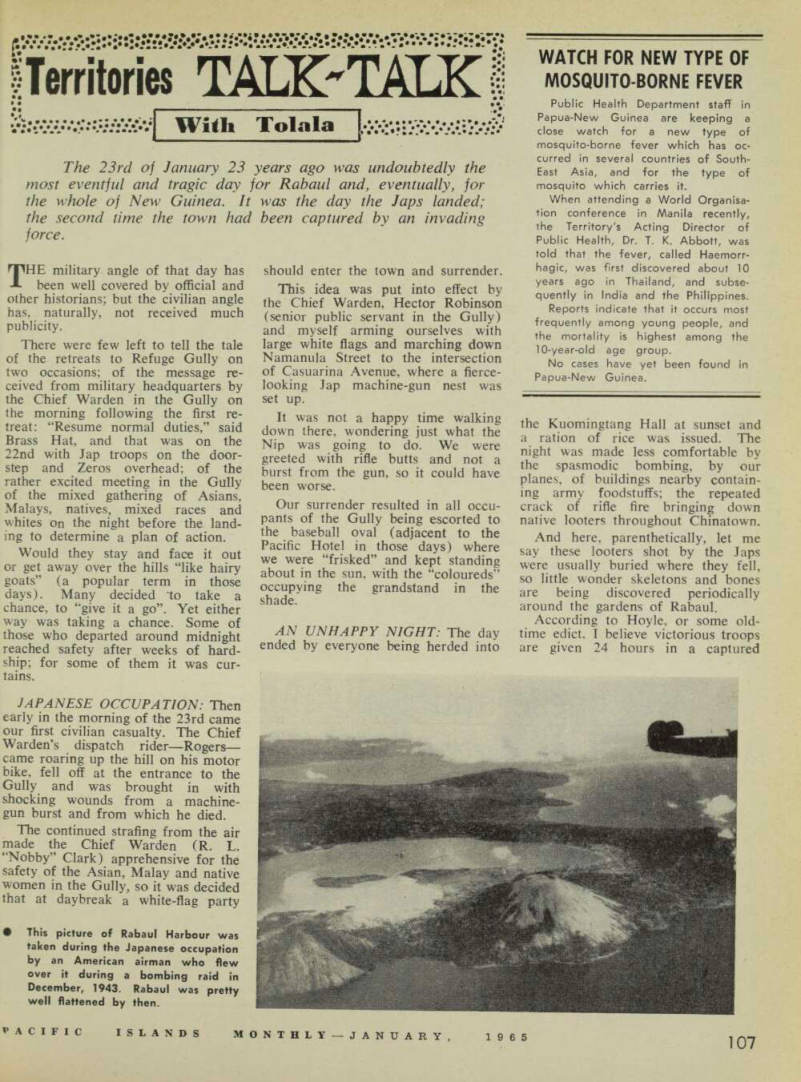
This picture of Rabaul Harbour was taken during the Japanese occupation by an American airman who flew over it during a bombing raid in December, 1943. Rabaul was pretty well flattened by then.
town as an “open go”. Well, Rabaul was given that treatment on that par ticular night. Homes were looted, local looters shot and. within the Kuomingtang Hall, females were gathered up and raped.
Anti-Rape Tactics: This I
will say: On the next day strictest discipline was enforced. All stores in Chinatown were sealed down and allotted to a certain Butai and I heard of no case of rape by the troops amongst the native women.
There was a strict order from High Command to refrain from interferring with women; it was hoped to estab lish good relations with the native people.
Only a few days after the landing some 3,000 professional ladies arrived under government contract in an attempt to allay any gender hunger amongst the Army, Navy or Air Force.
I believe the attempt was success ful from what one of these girls told me. Their daily tally was about 30, but they usually had a few extras on the side; they received a third of the gross takings. Unfortunately it didn’t allow them to lift the mortgage on the old farm, as the whole lot of them were in a ship which was tor pedoed off the New Hanover coast in 1944. Rabaul was then being closed down owing to the heavy air bombardments. I don’t think there were any survivors, I was sorry to hear of their fate.
I saw one lot depart in a lorry for the wharf for embarkation; they were laughing and singing and, incident ally, I recognised one of my good leather suitcases among their luggage.
The gift, presumably, of some big hearted Nip who had looted my home months before.
But their labours had not been in vain. Later I learned that inter ference with women by Jap service men was comparatively rare. I haven’t heard of any great number of Jap war babies; so I suppose the Little Ladies in the Kimonos did the Territory a good turn.
Export Promotion
When the bottom dropped out of the European Common Market for Britain, Australian exporters sat up, took notice and pushed the buzzer for their sales promotion managers, with the result that streamlining tactics were adopted. Chambers of Commerce, manufacturers and export promotion experts got cracking.
With all the latest gimmicks in the promotion world these Barons of
Export staged trade exhibitions and festivals; they held conferences, symposiums and attractive, floating displays of Australian goods throughout our Near North. And now, at long last, they have realised that the More Adjacent North and our Near East have been neglected.
To remedy this the Department of Trade and Australian Export Promotions Pty. are setting out in the good ship Sletholm round about May next, taking in Papua-New Guinea, BSIP, New Hebrides, Fiji and New Caledonia.
The Old Knights Of The
ROAD: Before World War 11, before trade ships and promotional gimmicks came on the market. New Guinea was quite well served by a handful of Australian commercial
travellers—a good team, too. Each one persona grata wherever he went throughout the Pacific. The doyen of these knights was Bill Chandler; he carried many lines from flour to frocks, journeying from Rabaul to Rarotonga and back again, with head quarters in Sydney. 1 met him first on the old Matunga in 1915, and he had been on the road for many years then. At that time he was having rather a slim time in the New Guinea area with. the military occupation.
In fact New Guinea, up until the Exproboard became less active in the late twenties, was not a good hunting ground for the commercials. They were more or less confined to dealing with the merchants in Rabaul’s China town; the Board had its own buying agency in Sydney—the New Guinea
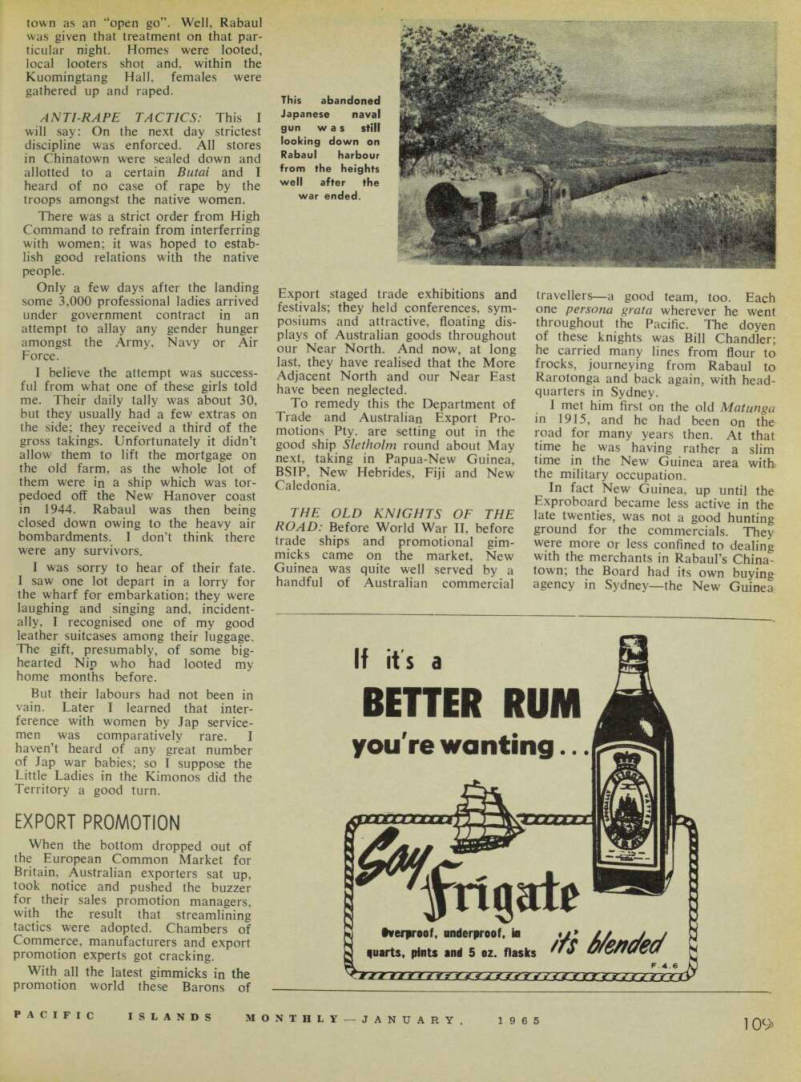
This abandoned Japanese naval gun was still looking down on Rabaul harbour from the heights well after the war ended.
Trade Agent, which supplied all goods required for Board plantations and retail stores in the usual un imaginative government manner.
As the Board influence waned, in dependent representatives of Aus tralian wholesalers had a better spin and as the 1920’s closed New Guinea had regular visits from Yin Smith and Jim Pym and Harold Cooper who won the hearts of Territorians and proved themselves worthy Aussies in extending Australia’s trade.
Some Trade Figures: These
emissaries of the exporters came, of course, with no blare of trumpets from public relations officers, nor armed with studied promotion tech niques; nevertheless they put up a remarkably good fight against the products of other countries coming into New Guinea, despite the fact that all signatories to the League of Nations were entitled to equal tariff status.
Here are a few trade figures which are interesting in view of Australia’s growing concern at her export trade to the Islands: • New Guinea (not including Papua) total imports 1938-39 £1.3 million, ex Australia £563,594. Total imports 1961-62 £16.7 million, ex Australia £8.7 million; maintaining the 50-50 ratio. • During the period of Civil Ad ministration in New Guinea (1920-21 to 1940-41) the trade balance was a favourable one, i.e., exports ex ceeding imports; however, from 1946-47 to 1961-62 the trade balance was an unfavourable one, with the exception of four years.
There could be a message here for some of these modern planners who have, as yet, not learned to curb their appetites.
All good luck to these chromium plated exhibitions. It’s the way it’s done now. Here’s hoping nothing eventuates before next May to inter fere with their promotion programme.
Old Time Church
Collections
It was in July Talk-Talk I com mented on the method of making their church offerings adopted by the somewhat primitive members of the congregation in the Duke of Yorks some 50-odd years ago.
I came across an interesting book let the other day, printed by the Methodist Mission at Rabaul (accord ing to the imprint, but I expect it was actually at Malakuna) in 1918.
It is in the Blanche Bay dialect and
entitled A Varveai ik are ra Papalum na Lotu ta ra Qunan Bismarck Arki pel (“A Short History of the Work of the Lotu in the area of Bismarck Archipelago”). It was written by Rev. H. Fellmann, chairman of the Mission Society (1902-1911).
It is a concise, comprehensive and valuable addition to the local history of the Mission from the days of Dr.
George Brown in 1875 to 1915.
An interesting table of figures is that detailing amounts obtained each year from the combined “native givings” or vartabars from the year 1868 to 1915.
Starting off in 1886, when the “converts” numbered 3,983, the sum of £4B/18/- was collected. Ten years later it amounted to £3Ol/14/8 and 10 years after that, in 1906, it had grown to £1,243/12/- and in 1915, when church members were 30,914 the amount collected was £1,390/1/3; not forgetting, of course, that World War I was on and conditions were a bit abnormal—even in New Guinea.
The best year’s collection was in 1913 with £3,066.
Those are figures for a time when there were only two competitors in the Vineyard. It would be interesting to know how the average works out now that there are some 50 different purveyors of salvation in the field.
The Old Diggers
CHRISTMAS, for some reason, re minded me of the men who re turned to Civvy Street in 1920-21, working as plantation staff for the Exproboard, which kept them in the Mess at Rabaul while it briefed them.
They were then sent out to the islands.
TROPIC NIGHTS: Many a night in the Mess there would be a number of the lads sitting beneath Tilley lamps, inundated by wogs and moths and flying insects. No electric light in those days, no wire screen rooms nor insect sprays.
In fact there was no street light ing, no taxis and only a very, very few private cars; no picture theatres and no private clubs except for the military; there were three hotels, but a pub-crawl meant negotiating long, dark pads through kunai fields.
The electric torch had not become the handy instrument it is today; even the use of the hurricane lantern (“lamp walk-about”) had as yet not been fully realised by these old soldiers in a new country.
But it was not long before they did find their feet and then they soon knew all the answers from
wangling honorary membership in the military clubs to playing fan tan in the back streets of China town, and accompanied invariably by their “monkey”, armed with the “lamp walk-about”.
The popularity of Rabaul’s night spots could be gauged by the size of the crowd of “house-boys”, with flickering lanterns, squatting outside the door awaiting the departure of their “masters”. And the “boys” often had a more enjoyable evening’s entertainment (at least they had no “hang-over” next day— not
in those years!).
They were a good crowd —for the most part—those Aussie Diggers in New Guinea in the Early 1920 s . . . They were solid types; their relationship with the native— of all classes—was good and there was tolerance and understanding on both sides.
To this good understanding, created by those Aussies, I attribute to a very large extent the laying of the foundation to the general friendly feeling between the two races at present.