£500,000 Wharf Plan For Vila, New Hebrides
pp. 97-103 · Read in the full issue
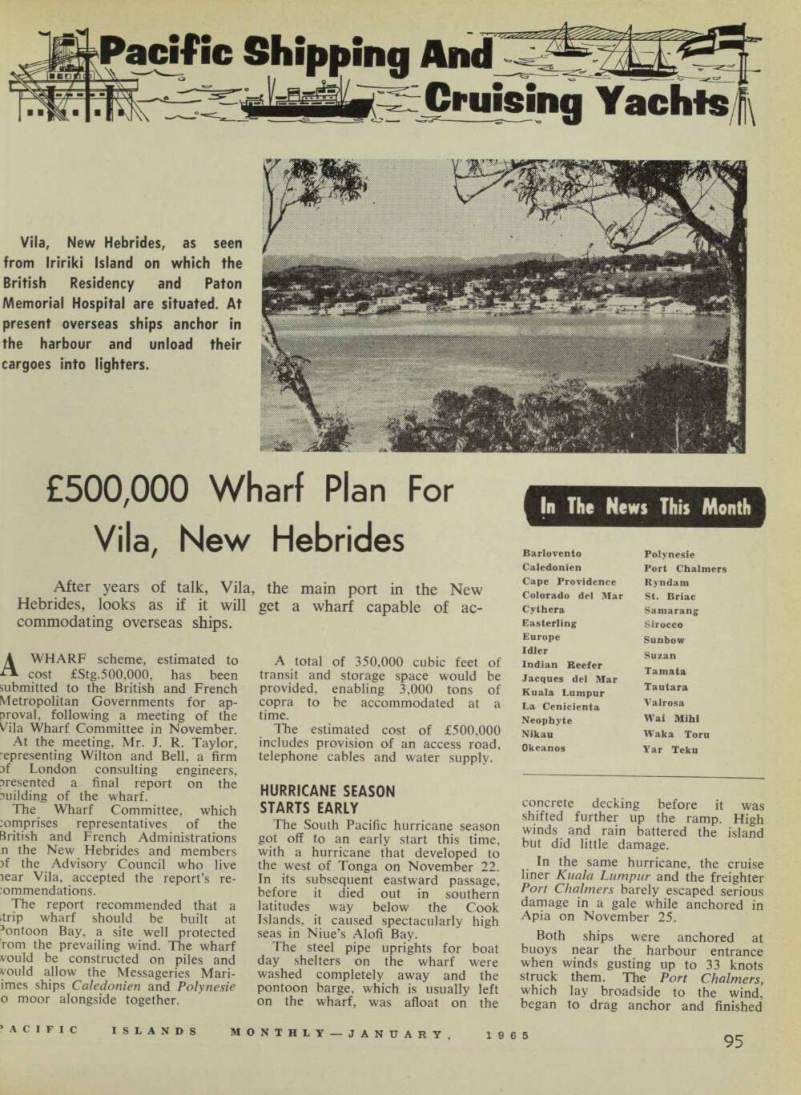
Vila, New Hebrides
After years of talk, Vila, the main port in the New Hebrides, looks as if it will get a wharf capable of ac commodating overseas ships.
A WHARF scheme, estimated to cost £Stg.soo,ooo, has been submitted to the British and French Metropolitan Governments for ap proval, following a meeting of the Vila Wharf Committee in November.
At the meeting, Mr. J. R. Taylor, epresenting Wilton and Bell, a firm jf London consulting engineers, a final report on the building of the wharf.
The Wharf Committee, which :omprises representatives of the British and French Administrations n the New Hebrides and members )f the Advisory Council who live iear Vila, accepted the report’s re :ommendations.
The report recommended that a itrip wharf should be built at 3 ontoon Bay, a site well protected ‘rom the prevailing wind. The wharf vould be constructed on piles and yould allow the Messageries Mari imes ships Caledonien and Polynesie o moor alongside together.
A total of 350,000 cubic feet of transit and storage space would be provided, enabling 3,000 tons of copra to be accommodated at a time.
The estimated cost of £500,000 includes provision of an access road, telephone cables and water supply.
Hurricane Season
Starts Early
The South Pacific hurricane season got off to an early start this time, with a hurricane that developed to the west of Tonga on November 22.
In its subsequent eastward passage, before it died out in southern latitudes way below the Cook Islands, it caused spectacularly high seas in Niue’s Alofi Bay.
The steel pipe uprights for boat day shelters on the wharf were washed completely away and the pontoon barge, which is usually left on the wharf, was afloat on the
concrete decking before it was shifted further up the ramp. High winds and rain battered the island but did little damage.
In the same hurricane, the cruise liner Kuala Lumpur and the freighter Port Chalmers barely escaped serious damage in a gale while anchored in Apia on November 25, Both ships were anchored at buoys near the harbour entrance when winds gusting up to 33 knots struck them. The Port Chalmers, which lay broadside to the wind, began to drag anchor and finished
close to the pile-driving machinery being used to construct the new wharf.
Later, the ship almost went aground in the mud at the mouth of the Vaisigano River; and it was not until seven hours had passed that she was able to back out of the harbour.
The Kuala Lumpur swung danger ously close to the reef at the harbour mouth when four stern lines snapped.
The 103 passengers and 69 crew members were ashore at the time, and they watched helplessly as the ship edged towards the harbour entrance. Finally, the anchors were hauled up and she was able to head for the safety of the open sea.
The stranded passengers and crew were put up for the night at Aggie’s Hotel, the Casino Hotel, the White Horse Inn and at many private homes.
The liner returned next morning to pick up the passengers and crew, and to continue her voyage to Suva.
Noumea-Wallis Island
Service Started
A regular shipping service between Noumea and Wallis Island, via the New Hebrides and Fiji, was recently started by the motor vessel Tamata, formerly the Colorado del Mar. De partures from Noumea will be every 35 days.
The service will facilitate com merce between New Caledonia and Wallis, which, hitherto, had no regular liaison with New Caledonia.
The calls en route will be made at Tanna, Vila, Santo and Suva.
American Samoa
Gets A "Navy"
Two decades ago, at the height of World War 11, 239,000 men of the United States Coast Guard manned a mighty fleet of almost 1,500 ships and boats. Coast Guardsmen par ticipated in every invasion in the Pacific from Guadalcanal to Okinawa.
Today, the Coast Guard is once more established in the South Pacific, but on a rather more modest scale and solely for the purposes of peace.
A young officer, 14 enlisted men, a 95-foot patrol boat and a solitary jeep have been assigned to American Samoa to help save life at sea and to perform the Coast Guard’s other humanitarian duties.
The patrol boat. Cape Providence, is skippered by Lieutenant William Sobeck, of San Antonio, Texas, who
recently brought the vessel south on its nine-day voyage from Kauai, Hawaii, where it was previously assigned.
He is American Samoa’s ranking military officer and is the first armed forces officer to be permanently assigned to the territory since the Navy relinquished administration of American Samoa in 1951.
Lieutenant Sobeck’s tiny command is the most isolated in the Coast Guard and it is also the first in the Southern Hemisphere. It was estab lished because American Samoa’s Governor H. Rex Lee felt it was badly needed in the vastness of the South Pacific, and also because American participation in the search for lost Tongan, Fijian, Western Samoan or Tahitian mariners would be deeply appreciated by other Islands governments and peoples.
The Cape Providence took part in an unsuccessful search in late November for two American school teachers, who disappeared while making a canoe trip from the village of Nua to Pago Pago, 10 miles away, on November 23 (see below).
New Round-The-World
Service
The 15,000-ton liner Ryndam arrived in Sydney on December 14 on her inaugural round-the-world voyage for the Holland-America Line. The ship arrived from Rotter dam, via Southampton, Port Said, Suez, Colombo, Fremantle and Melbourne. In Sydney she embarked passengers and continued her voyage via Wellington, Papeete, Los Angeles, Acapulco, Balboa, Cristobal, King ston (Jamaica), Lisbon and South ampton back to Rotterdam.
Ryndam was built in 1952 and can carry 879 passengers. She is fully air-conditioned and stabilised.
Searched Abandoned For
Missing Teachers
A search was abandoned on November 26 for two American schoolteachers who disappeared in an outrigger canoe off the coast of American Samoa on November 23.
The teachers, Dennis L. Hoff, 28, and his wife, Patricia, 22, left the village of Nua in a native canoe at 9 a.m. on November 23, for a trip to Pago Pago, 10 miles away. They were later seen off-shore about half way to Pago, but when they had not reached Pago by nightfall, friends reported them missing.
The Coast Guard cutter Cape Providence began a search for them at 2 o’clock next morning. She was later joined by Government of American Samoa motor vessels and
Japanese tuna fishing vessels based at Pago. Meanwhile, villagers searched the shore line.
The Hoffs began their trip in good weather but the weather changed rapidly during the early evening. By the time the search for them began, there were high seas, high winds and driving rain.
A Royal New Zealand Air Force flying boat from Laucala Bay, Fiji, joined in the search on November 25.
Hoff and his wife came to Pago Pago last September. Both were graduates of the University of Arizona.
Children Survive Week's
Drift In Punt
After eight days at sea in a 12 ft. open punt, three Fijian children from Vanua Vatu, in the Lau Group, reached Koro Island, about 80 miles away. Their punt capsized on a reef a mile from Koro, and they swam ashore.
The children are Mere Soko, 17, and Marika Nuku and Vili Vaka loloma, both 13.
They left Vanua Vatu on November 29, for a trip of about 30 miles. A widespread search for them, involv
The Coast Guard cutter "Cape Providence" alongside the main dock at Pago Page.
ing ships, aircraft and coastal search parties began three days later.
On Saturday, December 5, it was decided not to continue with the search, and little hope was given for the children’s survival. News that they had reached Koro was received at Suva next morning.
Bigger Vessels
For Nauru
A party of experts from the British Phosphate Commissioners, led by BPC Chief Engineer R. Nevile, was visiting Nauru in November, report edly to find a mooring system which would take ships bigger than the present Tri fleet which operates between Nauru and Melbourne with phosphate.
The present fleet ships are from 10,000 to 15,000 tons. Larger ships would, of course, allow quicker handing of the dwindling phosphate supplies on Nauru, but there has been no official announcement of just what ships are being planned.
The Nauru moorings are difficult because of the extreme depth of water around the island, which has no natural harbours.
The BPC experts planned to inspect the sea bed near the proposed mooring sites with the aid of an American closed-circuit underwater television camera, used normally to study marine life and the geology of the ocean floor in very deep water. They expected to operate it at depths up to 1,400 ft.
"Jacques Del Mar" To
Carry Tourists
The passenger-freighter Jacques del Mar ( ex-Waiben , ex-Morialta), which was recently sold to the Societe Maritime Vate, of Vila, by John Burke Ltd., of Brisbane (PIM, Dec. p. 99) is to carry a small number of tourists on her trips between Sydney, Lord Howe Island and Norfolk Island.
Norfolk News said recently: ‘Captain Savoie is anxious to further the tourist trade and hopes (depend ing on the availability of extra cater ing crew) to have a full complement of passengers (25) in about six weeks time. On his next visit, the captain expects to carry about 12 pas sengers”.
Captain Savoie used to operate the Colorado del Mar on the Sydney- Lord Howe-Norfolk Island run.
This ship was sold recently for a reported £30,000 and will trade in future as the Tamata between Noumea and Wallis Island (see above). As the Colorado del Mar, the ship made her last visit to Ix)rd
Howe and Norfolk early in November.
The Jacques del Mar was built in England in 1940 as a private yacht for King George VI, and was taken over by the Royal Navy as a messenger ship during World War 11.
After the war, as the Morialta, she cruised in South Australian waters between Adelaide and Spencer’s Gulf ports, and then, re named Waiben, plied between Bris bane, Thursday Island and inter mediate ports.
Norfolk News says: “The interior is luxuriously furnished with polished woodwork.” The newsletter adds: “The accommodation consists of 12 two-berth cabins, each with hot and cold water. There is a bar, sports deck, dining room and private lounge”.
Another Expedition
To Vanikoro
The French Navy patrol vessel Dunkerqoise left Noumea for Vanikoro in late November with a group of naval skin divers to retrieve as many relics as possible from the wreck of the Boussole, the flagship of the French explorer La Perouse, which was wrecked on a reef there in 1788.
The wreck was discovered in June, 1962, by Reece Discombe, a New Zealander, of Vila, New Hebrides.
Discombe has been on several French expeditions to Vanikoro to retrieve La Perouse relics, but this time he had to decline an invitation to go again because of pressure of business at his garage and electrical workshop in Vila.
Need For Slipway
at i rviJKA . , - ..
T urgerd n ?e d for a slipway at uka on the Fl J l lsland oi . ° valau has been stressed several times re ce™y. . .
Ratu Edward Cakobau raised the mader . in Legislative Council early m D f, eml ?, er L an 2 a ,f e Y uka shipowner. Mr. Robin Powell, later s “.P.P° r . ted h,m ln an interview with a re P°rter , Mr - Powel !, suggested that Draiba about two miles from Levuka, would be a suitable site for a slipway, . w ,n was needed both to cater for local , sh W and for those which supply fish to the Pacific Fishing C °l?P any T s freezm 8 factory, Japanese have 17 fishing ? hl P s at th , e mc ? ment and thl * number 18 expected to increase soon to about 30, and possibly to 100 in four or five y ears ’ time,” Mr. Powell said.
Nauru, at present, cannot accommodate ships much bigger than this one, the British Phosphate Commission's "Tri-Ellis", of 11,760 tons, but it may do better soon, if a suitable mooring system can be established.