Australia And
pp. 91-92 · Read in the full issue
Lost Treasures Of Australia And New Zealand
Australia and New Zealand are not particularly famous as the sites of lost and sunken treasures, but if you start collect ing the stories of such treasures that have been handed down the years, it is surprising how many you can find.
SYDNEY accountant Kenneth W.
Byron has collected some 50 or 60 for his book Lost Treasures in Australia and New Zealand.
The piece de resistance of this, it need scarcely be said, is a chapter on the treasure of the Dutch ship Batavia, which ran aground on a reef off the Western Australian coast in 1629 with 11 chests of silver coins, of which one was not recovered at the time.
Interest in the Batavia’s treasure was revived recently when the Aus tralian author Henrietta Drake- Brockman figured out from the records where the Batavia was wrecked and skin-divers followed up her discoveries by locating relics from the ship. One of these, the astro labe, has been valued by an Ameri can expert at $25,000.
Mr. Byron writes of several other treasures that have been found, either after deliberate searches or by accident. Two such discoveries, though not within the area covered by Mr. Byron’s title, were made at Suwarrow Island in the Northern Cook Group and at Woodlark Island, Papua.
The story of the Suwarrow treasure was told by this reviewer in PIM for September, 1962; but the Woodlark Island discovery has not previously been mentioned in PIM.
According to Mr. Byron, the Woodlark treasure was discovered in 1850 when the crew of an unnamed schooner noticed native girls there wearing necklaces of gold coins. The girls pointed to a nearby reef where they had found the coins, and on investigating, the seamen found the wreck of a ship from which they recovered about 500 silver dollars and a number of gold coins.
Mr. Byron adds: “The identity of the wrecked vessel, its exact location and other details remain a mystery”.
Many of Mr. Byron’s other
treasure stories are equally vague when it comes to essential details, and it is pretty safe to say that they are merely the product of someone’s over-vivid imagination.
Some of the stories, moreover, are based on nothing more substantial than a few newspaper stories, written years after the treasures in question are supposed to have been buried or lost.
An example of this is a chapter entitled “Queenscliff’s Loot of Lima”, which tells how a pirate called Benito Bonito is supposed to have buried some treasure, stolen from Lima, Peru, at Queenscliff, Victoria.
Mr. Byron’s authorities for this chapter are nine newspaper articles, the earliest of which appeared on July 13, 1935, whereas the treasure in question is supposed to have been stolen in the first half of the 19th century.
Mr. Byron apparently made no effort to find out if any treasure ever was looted from Lima during that period, but if he had done so, he would have found —as this reviewer did ( PIM, July, 1962, p. 87)—that it almost certainly was not.
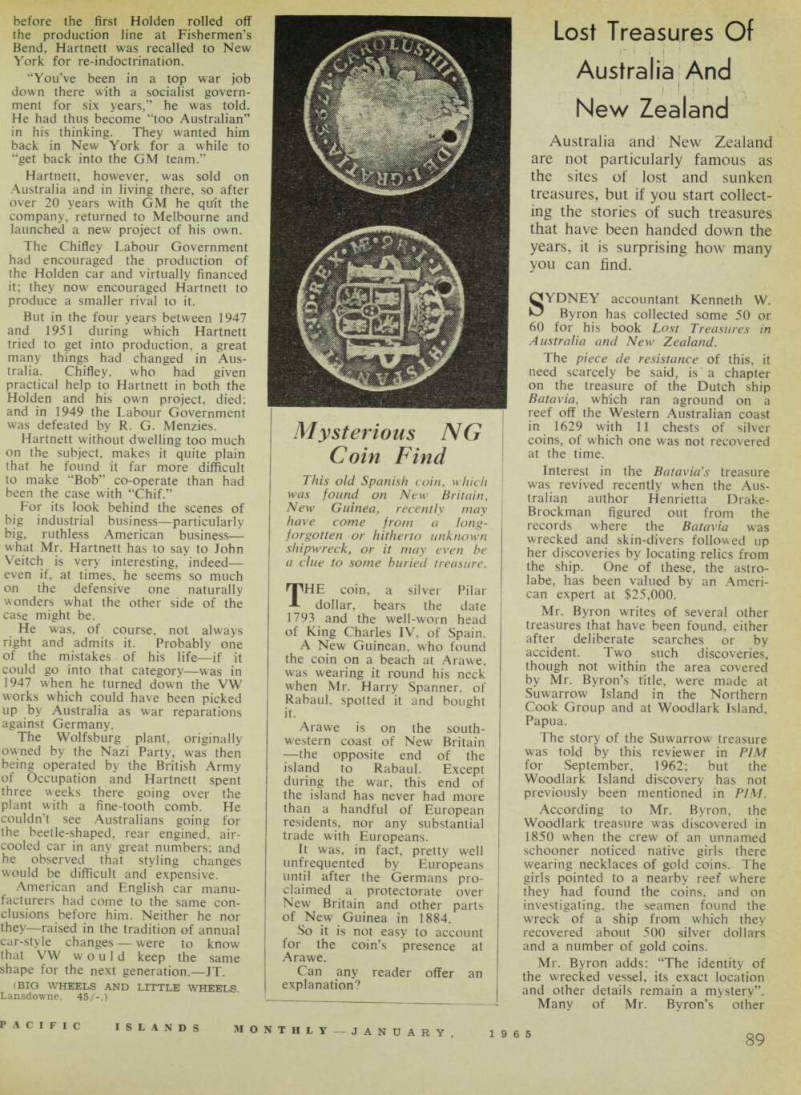
However, it must be said in fair ness that Mr. Byron is no blind believer in every treasure story he comes across. A number of those recorded in his book are finally dismissed as improbable, and it is pleasing to note that he does not conclude that a hoard of Spanish coins found on some reef or other, particularly in Torres Strait, must have come from a Spanish galleon.
In fact, on this subject he says: “At no time did the Man'ila-Acapulco galleons use Torres Strait as a sea lane to the Philippines . . . Nor does it seem likely that a galleon would be blown so far off her course that she would enter the Torres Strait area accidentally. As a matter of fact, although the galleon trade was carried on by more than a thousand ships from 1565 to 1815, only about 30 vessels were recorded as being lost — a very small percentage, even by modern standards”.
Mr. Byron adds that Spanish dollars were once widely used as international currency and that when English coins were scarce in 1797 Spanish dollars were officially issued for use as currency in England.—RL.
(Lost Treasures In Australia
AND NEW ZEALAND. Ure Smith, Sydney. 39/6.)