Pioneering With
p. 85 · Read in the full issue
The Pigs On NG's Air Trails
By J. M. Bourke.
Whenever I step into the flying “lounge room" which is the passen ger section of a modern aeroplane, my thoughts go back to those courageous men who pinned their faith in a few strips of three-ply, linen and glue, braced with wire, which made up the principal parts of the crazy kites in which they blazed the air trails of unmapped New Guinea.
IN February, 1927, Pard Mustar landed his DH9 at Wau. This tricky, one-way airstrip was situated on a grass-covered landslide, with a grade of one in 12, and at an altitude of 3,500 ft.
The pilot, having made up his mind to land, had to stick to his intention. To overshoot was fatal.
It meant crashing into the foothills of the 8,250 ft. Mt. Kaindi, which began at the end of the runway.
Despite all these hazards, the Wau airstrip once held the world’s record freight landing.
Hot on the heels of Mustar came that intrepid airman, Ray Parer, flying a DH4, an early addition of the De Havilland family. The de sign of this craft called for so much wire bracing that it looked like a flying birdcage.
Parer pioneered the air trail from Lae to Port Moresby, Considering the circumstances, it was a remark able feat. Modern aids to aircraft navigation were not even thought of. There were no two-way radio communications, so no weather re ports. There were no accurate maps of the area, and the route covered some of the world’s roughest country.
The cumulus clouds, born in the humid valleys and gorges, could rise higher and faster than the fragile craft Parer piloted.
It was a tedious business to coax the aircraft up to the required alti tude, and the trip often occupied between three and four hours. En route to his destination, Parer flew over what looked like thousands of square miles of cotton wool, with occasional islands of jagged rock which marked the top peaks of the main mountain chain. This cloud formation often covered the coastal plain, and extended beyond Port Moresby far into the Coral Sea.
Without the aid of radio com munication, it required considerable courage, an uncanny sense of speed and direction to come down through this “pea soup” and locate the land marks leading to Port Moresby’s small airstrip.
I will never forget my first trip from Lae to Wau with Ray Parer in his old DH4. Arriving at the palm thatched shed which served as a hangar, I noticed a huge boar hobbled in the traditional native fashion for being carried by pole.
The seating arrangements in the DH4 were divided into three sepa rate compartments. The pilot occu pied the centre cockpit with single passenger accommodation fore and aft. After many “hu-sar-low’s” Ray’s native staff succeeded in stuffing the pig stern first into the rear seat.
"No Got Pig"
We took off into a cloudless sky, turned right up the Markham River, and climbed gradually towards the Zenag Plateau, I had an occasional look over my shoulder. The pig, with his nose in the air expressing a sort of smug superiority, seemed to be enjoying the flight.
Over Mumeng the plane de veloped a series of convulsive jerks, and looking back I was hor rified to find that the pig had disap peared. Frantic sign language failed to convey the message to Ray. So, on a small strip of paper, I wrote: “No Got Pig” and handed it back to him. But his expression failed to convey any indication of alarm.
I was never so happy to see Wau airstrip. On landing we discovered that the pig had both hind legs through the fuselage, but luckily they did not touch the control wires.
I said to Ray: “Well, I’ve met up with pigs under various circum stances, but I have never before flown with them, and believe me. there will be no repeat perform ance!”
“That goes for me too, Joe,” he said. “I had the wind up all the way in.”
But Ray was kidding. On his very next trip, he landed at Wau with a full-grown sow in the front seat and another in the back.
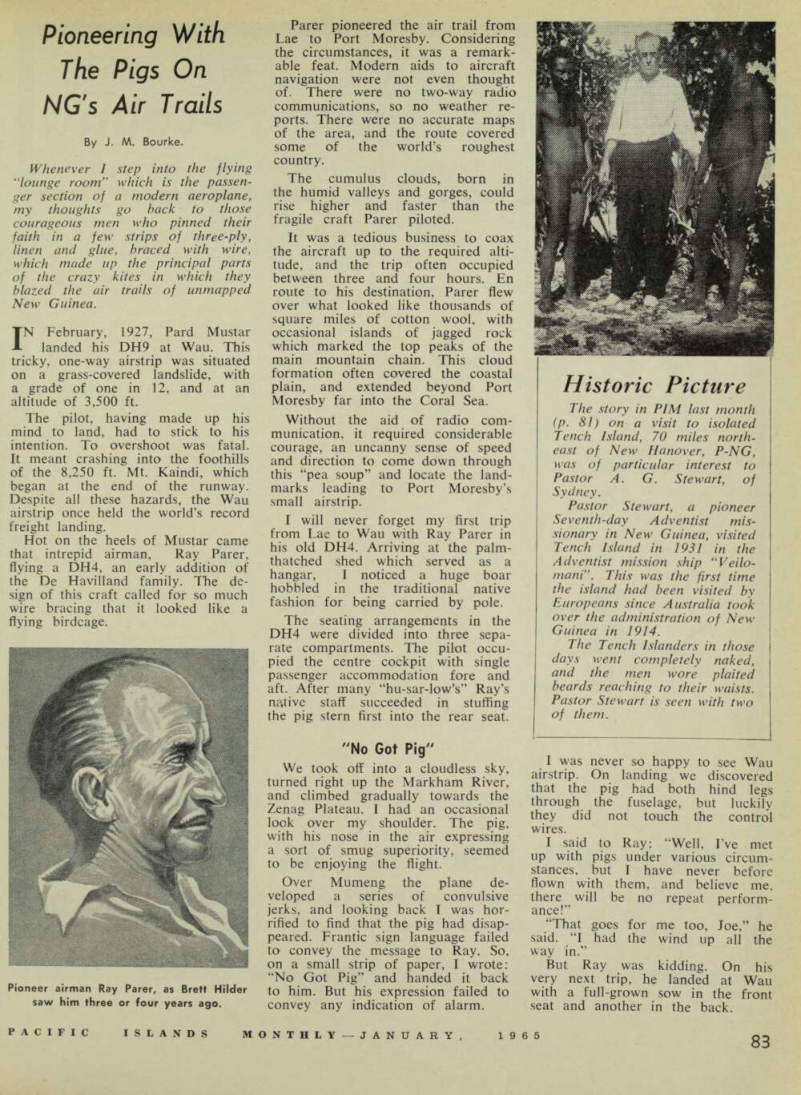
Pioneer airman Ray Parer, as Brett Milder saw him three or four years ago.