Futuna, New Hebrides,
pp. 79-82 · Read in the full issue

Legendary Homeland
Of Tonga's Queen
Story and pictures by Rob Wright.
My visit to Futuna had been arranged by John Leaney, British District Agent at Tanna, and we flew to the island in a Drover of New Hebrides Airways piloted by Paul Burton.
THE island lies about 45 miles east of Tanna and down in the heel of the New Hebrides chain.
Up to this time I had known of only one Futuna—the island of that name in the Wallis Group.
F Futuna in the New Hebrides impressed me in three ways. First, it is the only island with Polynesian inhabitants in a predominantly Melanesian setting; secondly, it is the legendary birth-place of the Queen of Tonga; and thirdly, it must have the smallest airstrip in the South Pacific.
We boarded the plane at Lenakel and headed east across Tanna.
Would I like to look in on Mount Yasua the active volcano on Tanna’s east coast? Paul Burton asWpH mp Kea me - Sure I would; So Paul put one wing-tip in the crater (figuratively speaking) and pivoted on it, giving me an exciting bird’s-eye view of the maw of an active volcano. ~. , . . . .
But if this was exciting, it was
merely a setting-up exercise for Futuna, The island is small, with a flat *°pped “ n jL™S B S ° me J; 9 -° feet habl v thp m CeP f Ue Se ? ; V 1S i pr °’ baBI L u* T ex mct t volcano : The base spreads out into jagged promontories delineated by flashing white lines of surf where the ocean crashes against the rocky shores.
Strive as I did, I could see no landing place in this turmoil of wave and rock, until a narrow strip was pointed out to me.
It looked all of two inches long, ran athwart a spur and had raging f l en^ s - As . we we . nl in for r m ®’ figured my insurance po “S as working overtime. , " eed £ ot . ha £ e worried. I P^ U ♦ Burt f on u could have landed on the top of the cone —if he had really wanted to. . Almost all the inhabitants of Ibau village were there to greet us. The stri P was no novelty to them, for man y of the villagers had sweated to . ma^e A’ cutting it out of rock with hand tools and carting away (over j
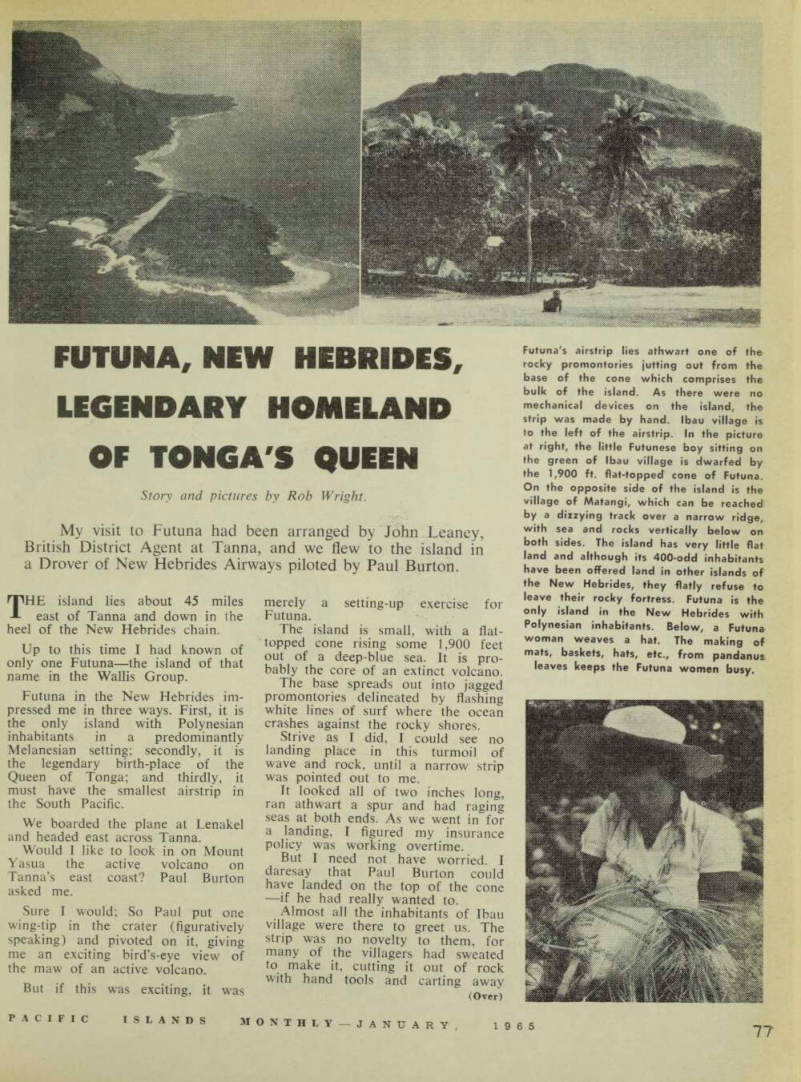
Futuna's airstrip lies athwart one of the rocky promontories jutting out from the base of the cone which comprises the bulk of the island. As there were no mechanical devices on the island, the strip was made by hand. Ibau village is to the left of the airstrip. In the picture at right, the little Futunese boy sitting on the green of Ibau village is dwarfed by the 1,900 ft. flat-topped cone of Futuna.
On the opposite side of the island is the village of Matangi, which can be reached by a dizzying track over a narrow ridge, with sea and rocks vertically below on both sides. The island has very little flat land and although its 400-odd inhabitants have been offered land in other islands of the New Hebrides, they flatly refuse to leave their rocky fortress. Futuna is the only island in the New Hebrides with Polynesian inhabitants. Below, a Futuna woman weaves a hat. The making of mats, baskets, hats, etc., from pandanus leaves keeps the Futuna women busy.
(from page 77) the spoil in baskets plaited from pandanus.
But they liked to see who arrived with each plane, so the women were bedecked in their finery, with mumu type garments scalloped at the hems in current Futuna style. They wore their brown, light-tipped hair combed upwards in typical Melanesian fashion.
The village was well-kept and clean, with a number of European type wood and iron buildings in terspersed with Futunese thatched houses with eaves that reached almost to the ground.
Under open shelters, the women plaited baskets and the men made lobster pots from split pieces of pandanus roots. Both products are well-known throughout the New Hebrides, as is the fact that Futuna men are skilled fishermen.
It was under one of these shelters that we heard from Lisha the story of the Queen of Tonga.
Lisha had his back propped against one of the shelter supports while his blue-flecked eyes looked out over our heads and away into the distance. The light skin and high and wide cheekbones denoted (next page please)
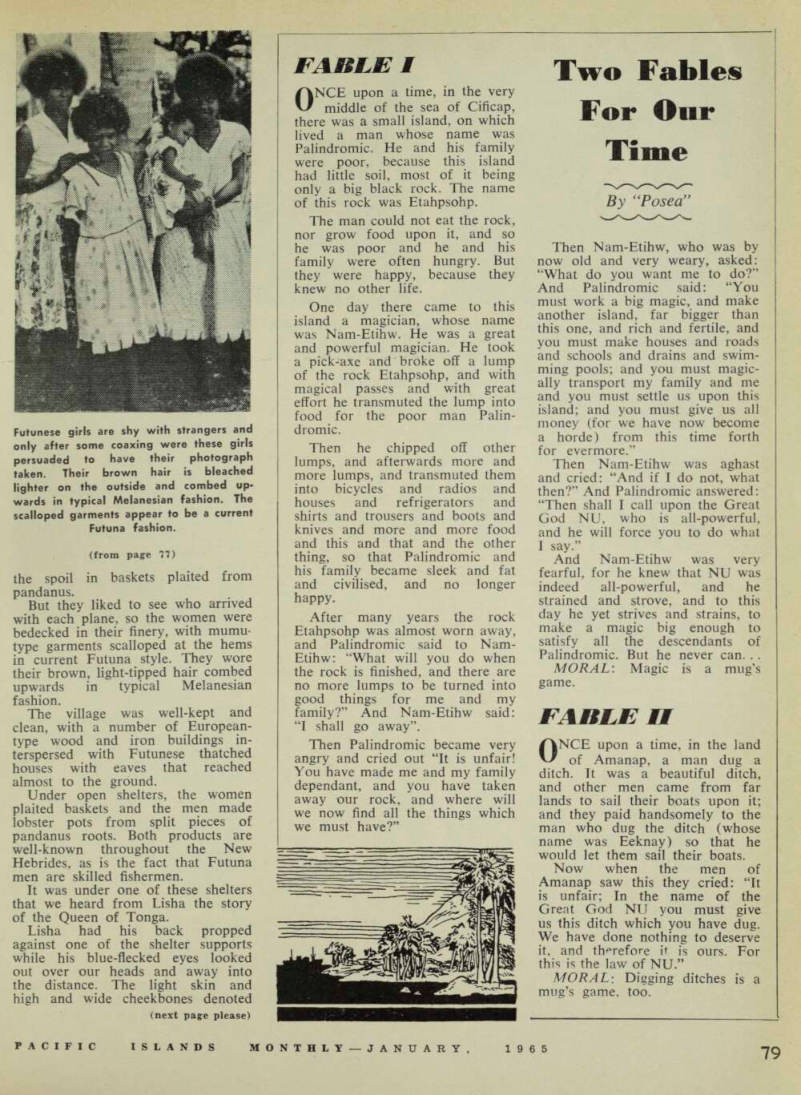
Futunese girls are shy with strangers and only after some coaxing were these girls persuaded to have their photograph taken. Their brown hair is bleached lighter on the outside and combed up wards in typical Melanesian fashion. The scalloped garments appear to be a current Futuna fashion.
his European and Polynesian an cestry. He spoke in Pidgin.
Pidgin is not easy to understand if one is not accustomed to it, so when I found I was losing the gist of the story, I’d glance appealingly at John Leaney who would translate for me.
At times, Lisha would break into song, for this too was a part of the legend.
A great many years ago—Lisha told us—there lived on Futuna a great chief whose name was Boonga.
He and his wife Sina were well respected, as were their four at tractive daughters.
In due course, the three older girls were married and settled down to normal life on Futuna. But not the youngest.
Spurned
Her name was Sina Finariki and she spurned all advances made by the eligible young men of the island.
One morning Boonga went in to awaken his daughter. Her bed had not been slept in. Never before had this happened.
With his wife, he searched the area, but without success. Then they heard the sound of a song, as though it was sung from a great distance.
Rushing to the jagged rocks which overlooked the sea, they saw a canoe silhouetted against the shim mering light of a dawn sky.
They motioned for it to return, and this it did until a few fathoms from the shore. In it was a hand
some stranger by the name of Siverau, and beside him was their missing daughter, Sina Finariki.
She continued to sing the song they had heard—a song which told them that she was bound to leave with Siverau, to journey across the sea to a land where she was to become queen—the Queen of Tonga.
As she sang, Siverau gently pad died the craft out into the ocean swells until it dwindled to a mere speck in the distance, and the voice was so faint that they could not hear. Then it disappeared.
Leapt Into Sea Deeply grieved over her daughter’s departure, Sina. the mother, leapt into the sea and was overcome by waves and sank to the bottom to become a white patch on the reef.
So great was Boonga’s grief when he saw, first his daughter and then his wife disappear, that he was turned into a large block of stone which, to this day, still looks down on to the white patch which was his wife Sina.
As for Sina Finariki, she went on to become Queen of Tonga—in legend anyway. ... As we had only three hours ton the island, I gave away the idea of climbing over the island to the only other village, Matangi.
Instead, I concentrated on trying to find where the Futunese beached their canoes.
Thus far, all I had seen was a coastline of jagged rocks. But I
cove with a tiny beach on which were beached several canoes. In the rock crevices surrounding the ccve were stowed dozens of lobster pots.
When, finally, it was time to go, the populace again trooped down to the strip to watch as we gained speed and shot off the end of the airstrip into the void, with blue water and spume beneath.
A bank, a turn, a waggle of wings, and a zoom down to grass height—and that was the last I saw of Futuna, legendary mother land of the Queen of Tonga.
In the first picture, Lisha, the story-teller of Futuna (left) rests his fingers lightly on Boonga, the stone which was once the father of Sina Finariki, the girl who be came Queen of Tonga. Boonga turned to stone after his daughter had left the island and his wife Sina had jumped into the sea to become a white patch on the reef. Next to Lisha is British District Agent George Leaney, and Paul Burton, pilot of New Hebrides Airways. The picture at right shows houses in Ibau village the main village on Futuna. These have eaves which reach almost to the ground.
There are also a number of wood and iron buildings.
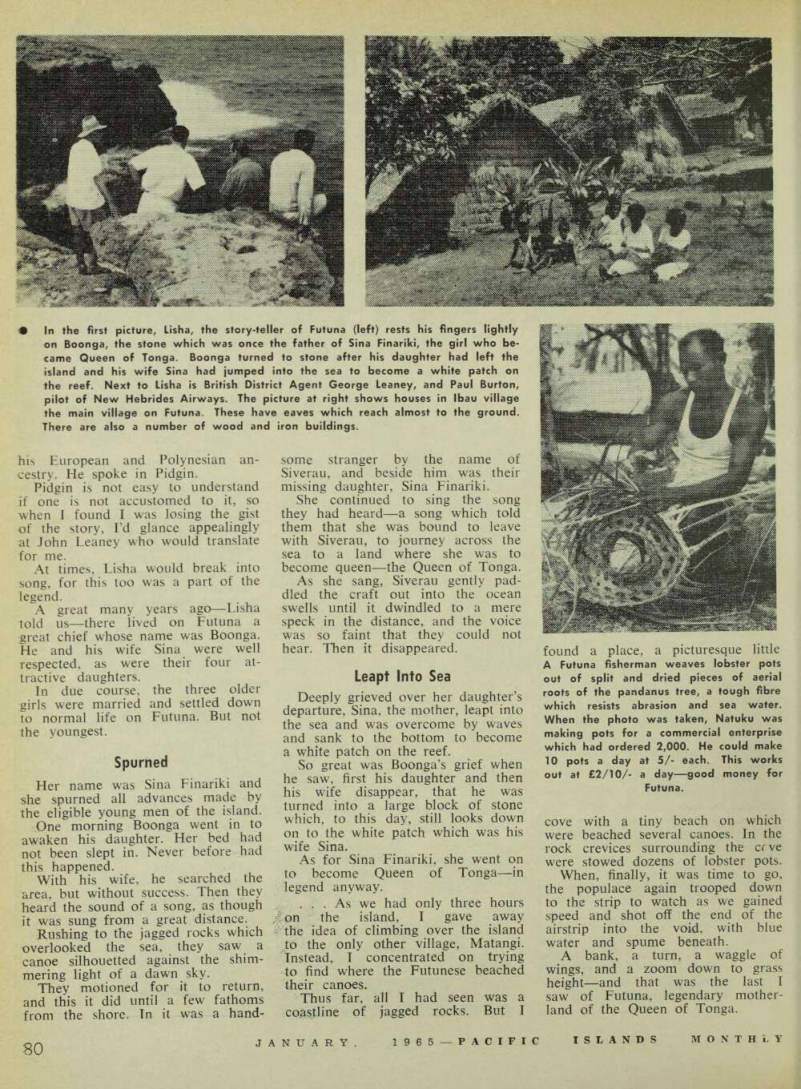
found a place, a picturesque little A Futuna fisherman weaves lobster pots out of split and dried pieces of aerial roots of the pandanus tree, a tough fibre which resists abrasion and sea water.
When the photo was taken, Natuku was making pots for a commercial enterprise which had ordered 2,000. He could make 10 pots a day at 5/- each. This works out at £2/10/- a day—good money for Futuna.