To Grips With Some
pp. 63-65 · Read in the full issue
GEIC Council Gets To Grips With Some Varied Questions
Should Government offices in the Gilbert and Ellice Islands Colony close for the day at two or three o’clock in the afternoon? Should bicycles be bought for touring officers? What is the British Gov ernment’s policy for three recently abandoned islands in the Phoenix Group? And should reef latrines at Tarawa have electric lights in them?
THESE were some of the questions that occupied the minds of members of the GEIC’s Advisory Council when it met in Tarawa in November.
A member who asked if the present daily working hours of the Govern ment could be changed to end at two or three o’clock was told by the Assistant Resident Commissioner, Mr.
R. Angeloni, that the idea was “at present under consideration”.
This prompted Mr. E. H. G.
Blacklock to ask why the offices should close so early in the after noon, to which Mr. Angeloni replied that “officers work more efficiently in the morning, but standards fall in the afternoons”.
The question of bicycles for tour ing officers came up while the Council was in committee consider ing the Colony’s draft Estimates of revenue and expenditure for 1965.
Several unofficial members re marked that money was being set aside unnecessarily to buy bicycles.
Touring officers, they said, spent much of their time on board ship, and only a few hours on land, and as native governments on the large islands were willing to provide these officers with bicycles, there was no necessity to buy bicycles for them.
When an unofficial member, Henry F. Naisili, pointed out that native governments on the small islands did not possess bicycles, he was quickly told by another unofficial member that touring officers on the small islands did not need bicycles because of the very fact the islands were small.
As no one had anything further to add to this discussion, Mr.
Blacklock raised the question of pro viding electric lights “for reef latrines at headquarters”, saying that such a provision was not necessary “in the interests of the people of the Colony”. However, the Assistant Resident Commissioner pointed out that the provision had been made “following a strong request by the Tarawa Community Welfare Com mittee”.
Phoenix Islands When Falani Pasefika asked about Government policy on Sydney, Hull and Baker Islands in the Phoenix Group, the populations of which have been transferred to the Solomons, the Assistant Resident Commissioner said no policy had yet been formulated, but it was “hoped that the copra potential would be exploited, depend ing on economic considerations and shipping”.
Falani Pasefika then asked if the Government could assess the effects
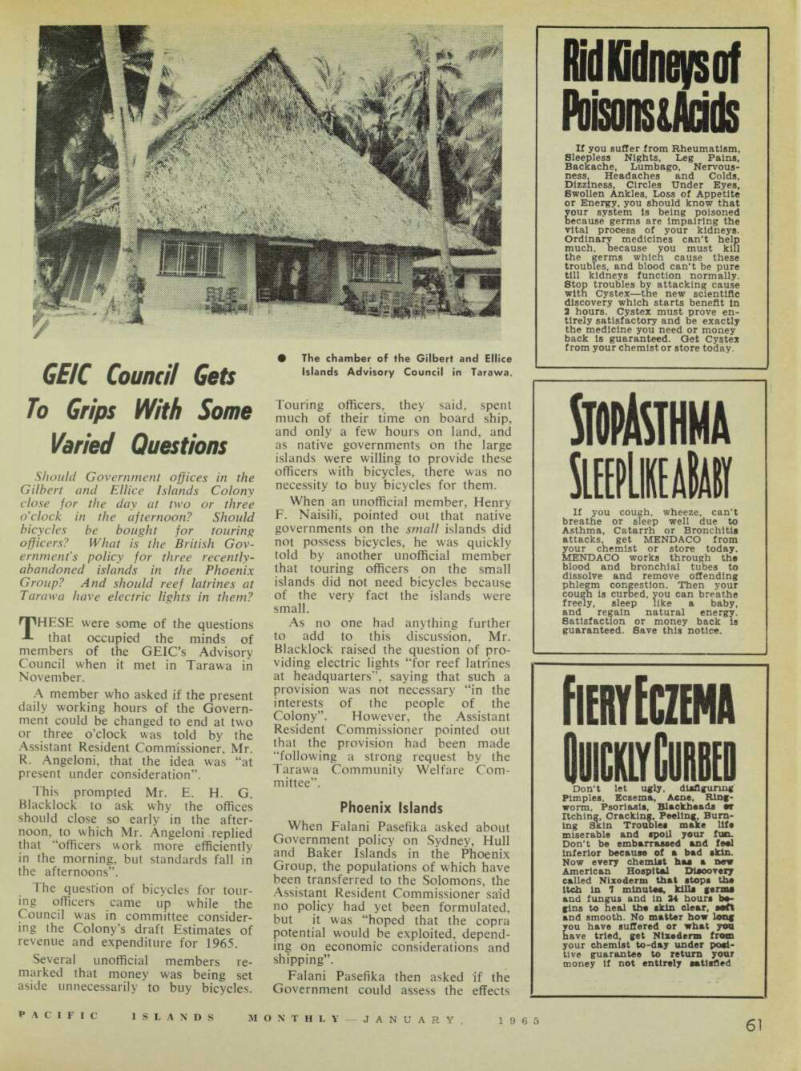
The chamber of the Gilbert and Ellice islands Advisory Council in Tarawa.
of the new liquor legislation which came into force in January, 1964.
In reply, he was told that the offence of drinking without a permit was now rare, whereas in 1963 this offence made up most of the cases reported. Also, the manufacture of home-made liquors was no longer a problem.
However, whereas in 1963 there were 573 liquor offences before the courts, in the 10 months to October 31, 1964, 530 cases had been reported to police, of which about 50 had not been pursued.
In at least 75 per cent, of all serious cases reported, either one or both parties involved had consumed intoxicating liquor immediately be fore the offence.
In a general debate just before the Council adjourned, Tebau Tiba suggested that the Government pro vide more interesting English language programmes from Radio Tarawa to attract listeners abroad.
However, this idea quickly had cold water thrown over it by Reuben K. Uatioa, who said that since the English broadcasts from Radio Tarawa were done voluntarily, he could not agree to further duties being imposed on the people con cerned.
Constitutional Development
Ruka Kaburoro then got on to a subject that has been much discussed in the GEIC recently—constitutional development. He spoke of develop ments in Jamaica from the time of its discovery until it became an independent nation within the British Commonwealth, and he suggested that the British Government might make similar arrangements in the
Geic.
The question of internal com munications then came up, with Mr.
Blacklock saying that since the
inauguration of an air service from Fiji it had become much quicker to travel from Tarawa to London than from Tarawa to Arorae. (Arorae, the southernmost island in the Gilbert Islands, is 300 miles or so from Tarawa). Mr. Blacklock gested that the Government should do something to improve internal communications.
In reply, the Assistant Resident Commissioner scotched any idea of establishing an internal air service.
Aircraft, he said, were expensive to maintain; and he added that Colony
ships could provide a satisfactory service, anyhow.
Finally, Kirabuke Maio asked whether the Government intended to appoint local officers to the higher posts of the Public Service now held by expatriate officers.
The Senior Assistant Secretary, who replied, said there could be no full localisation of the service until there were islanders capable of efficiently performing the tasks per formed by expatriates, and this would not be until students now abroad returned to the Colony.