Way To Becoming French
pp. 54-57 · Read in the full issue
New Hebrides Now Well On The Way To Becoming French
By R. W. Robson
Where is the Condominium of the New Hebrides going from here? My guess is that—unless Australia awakens very soon to the realities of a comfortless situation—the New Hebrides will be lost to British-Australian influence within a very few years.
THE line of islands (New Cale donia and New Hebrides) which stretch along thousands of miles of Australia’s north-eastern coast, only a few hundred miles away, then will be wholly French. That may not be a bad thing; but I don’t think Aus tralia will like it much.
Please, Messieurs, do not mis understand. Anglo-Saxons have had Frenchmen as their nearest neigh bours for thousands of years; and they have inter-traded, and inter married, and fought furiously together—sometimes as foes, some times as allies—and the relationship has done both of them a lot of good.
But the French, like many folk of charm and vision, are not easy to live with—they like their own way.
And, in relation to Islands admini stration, the policies of the French and the British seem to be ever more divergent.
Self-Government The British now are trying to thrust the New Hebrideans into com plete self-government just as fast— even faster —as the New Hebrideans can take it. The French want them to become integral part of La Belle France.
Personally, I am with the French —even although the history of the Roman empire indicates that funda mentally they are wrong.
However, apart from specious thinking, I am sure that Australia, having enjoyed political isolation and her own way for a hundred years, will not be happy in seeing a new Territory of New Caledonia-New Hebrides created right alongside, shaped by the moguls of French finance, and directed by the arrogant bureaucrats of Paris.
That, I am convinced, is what is coming. The New Hebrides, after 60 years of bumbling Condominium rule, is now being permitted by the cynical British and the wholly in
different Australians to slide com pletely into French control.
In the late 19th century, the British and French were squabbling for possession of the lovely, fertile archipelago. Then the rapid rise of Imperial Germany drove them together. The Condominium was set up in 1906, purely as a stop-gap.
They said it wtoidd not last five years. But it has stumbled along ever since.
We used to call it the “Pan demonium” Government, and when first I saw Vila 30 years ago motor cars driven by the French kept to the right, while the rest travelled stubbornly on the left—as was British and proper. The facts that
serious collisions —of all kinds— were avoided, and that all traffic now keeps to the right, give some measure of the officials’ tolerance and the country’s direction.
Until the 1940’5, the Condominium just slept in the sun. French and British Governments were too busy with two World Wars to bother about it. Traders and planters generally loved the place, with its sketchy laws and easy-going officials. Even today—although officialdom, since the end of World War 11, has been acquiring and using teeth —New Hebrides is about the last happy hunting-ground of unrestricted private enterprise.
There is some similarity between Fiji and New Hebrides. In the beginning, Britain went into and stayed in both groups for the sake of prestige; but it was Australian, and not British enterprise which originally entered and developed each country’s natural resources.
There the resemblance ends. The Australians, with governmental help, established a vigorous, profitable economy in Fiji; but in New Hebrides, meeting the French traders head-on, and being completely un supported by the Australian Govern ment, traders have taken a real hid ing—although remnants still are fighting back.
Australia's Bleak Record Australia’s official record in the New Hebrides should be written across Canberra’s front door, as a shame and a disgrace.
Australia’s South Seas trading pioneer, James Burns, saw the economic value of the New Hebrides, recognised its possible political importance, and regarded the activities of the French and the thrusting ambitions of the Germans with a jaundiced eye. Australians at that time were leading the develop ment in the New Hebrides.
When Australia’s Commonwealth came vigorously into being, Burns made a plan.
About 1906-7 he induced the new
Australian Government to accept, as an unconditional gift, about 100,000 acres of good land to which Burns Philp interests had acquired rights in the archipelago. Australia (argued Burns) would never allow the French to grab the New Hebrides while she held so valuable an estate Religion came into it, too. The Australian Presbyterian Church had established a mission in the archipelago, and Burns helped to build it up, as a counter to the French Catholics. He hoped Austraha would protect the Presbyterians when he was dead, and the Presbyterians certainly fought hard at that tim e to get Australia to support all the development work which was going on.
Well, the famous founder of BP’s has been dead a long time; and the thing that he feared most in the NH —namely, a non-British establishment close to the Australian coast— is nearly here.
Here are some of the factors, noted in a brief visit, which in my
opinion are now giving the Condominium the coup de grace : It clearly is the British policy to get rid of all bothersome and unduly expensive colonial units as soon as practicable. New Hebrides is in that category.
Quite understandably, it is French policy to get ready to take over the New Hebrides, and create a much stronger territory out of New Cale donia and New Hebrides, admini stered as one economic unit, No British interests are affected— oniy Australian. And the Australian interests now are too discouraged and weak to do much. The only Australian commercial units still fighting, as far as I can see, are the Burns Philp company, housed in a mass of rusty tin sheds at one end of Vila; that company’s shipping line; Donald Gubbay’s trading group; a handful of isolated coconut planters; the vigorous New Hebrides Airways, directed from Tanna by “the two Pauls”; and a number of the Christian missions, The Australian Government, which
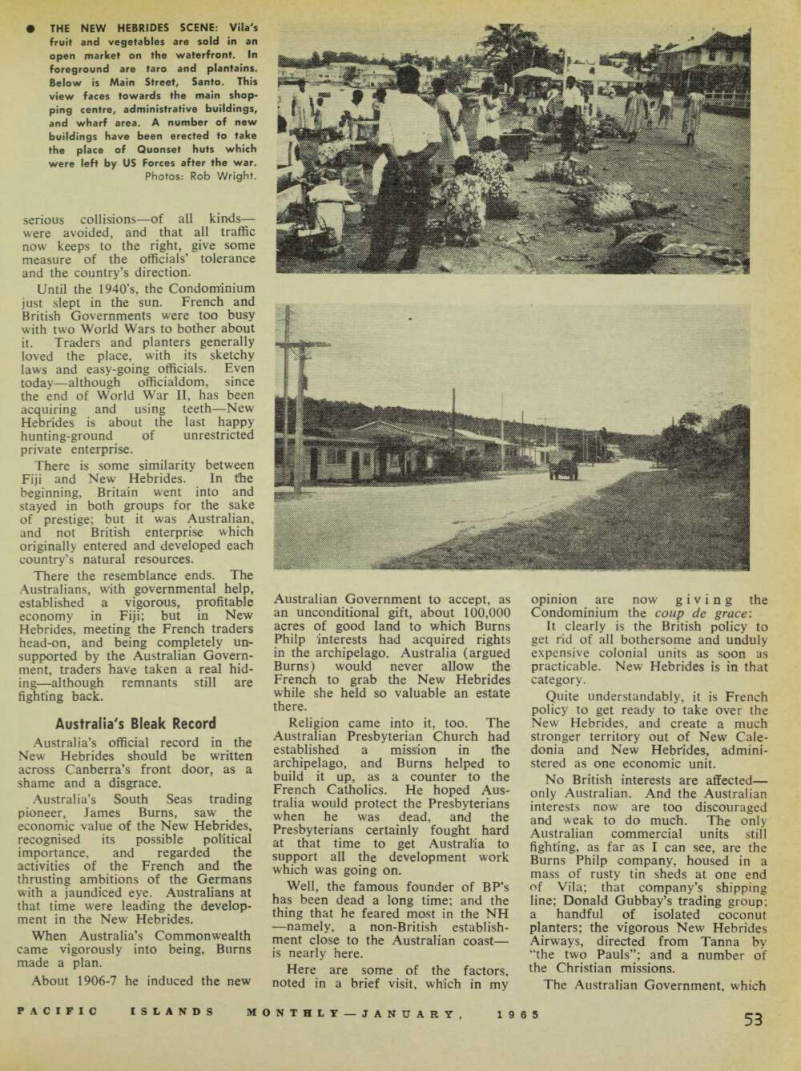
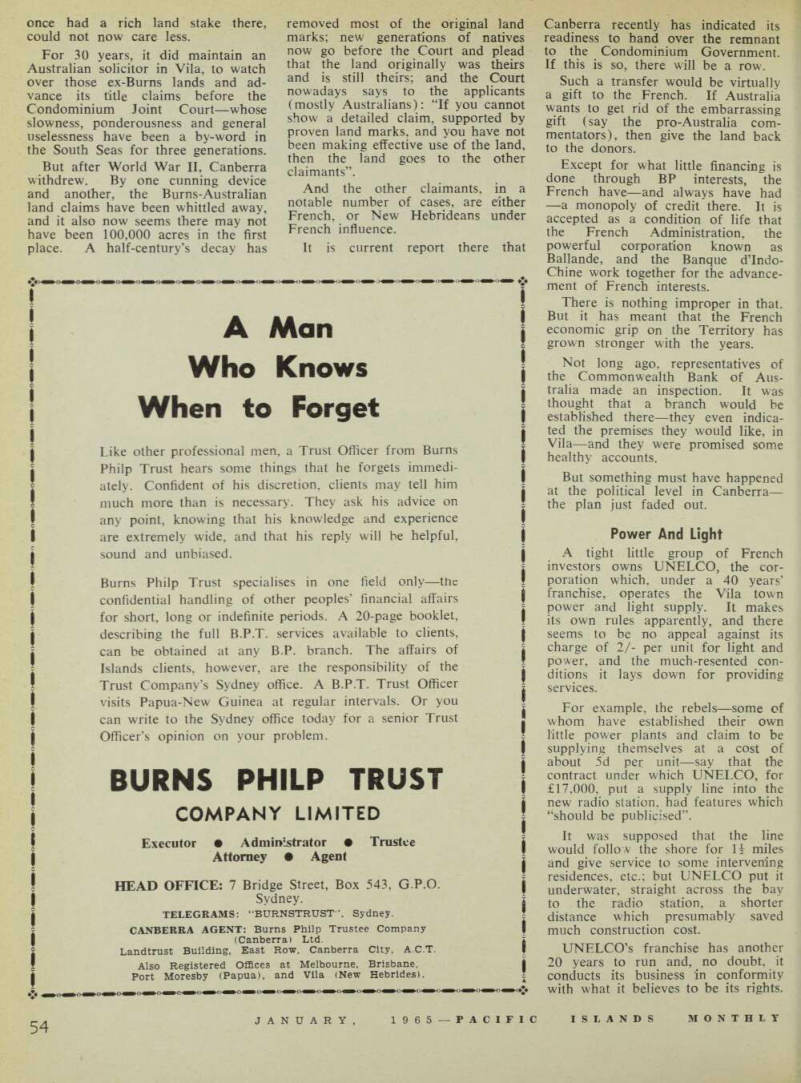
The New Hebrides Scene: Vila's
fruit and vegetables are sold in an open market on the waterfront. In foreground are taro and plantains.
Below is Main Street, Santo. This view faces towards the main shop ping centre, administrative buildings, and wharf area. A number of new buildings have been erected to take the place of Quonset huts which were left by US Forces after the war.
Photos: Rob Wright.
once had a rich land stake there, could not now care less.
For 30 years, it did maintain an Australian solicitor in Vila, to watch over those ex-Burns lands and ad vance its title claims before the Condominium Joint Court—whose slowness, ponderousness and general uselessness have been a by-word in the South Seas for three generations.
But after World War 11, Canberra withdrew. By one cunning device and another, the Burns-Australian land claims have been whittled away, and it also now seems there may not have been 100,000 acres in the first place. A half-century’s decay has
removed most of the original land marks; new generations of natives " ow 8° b f fol ; e the Court and plead tha j the land originally was theirs ls theirs; and the Court nowadays says to the applicants < most| y Australians) : If you cannot show a detailed claim, supported by P roven k” d marks, and you have not been "taking effective use of the land, then the land goes to the other claimants”
A , ‘ . , . , the other claimants > “J a " otabl . e numb f of u ca K s “’ are eitber Frencb ’. ° r New Hebrideans under French influence, It is current report there that
Canberra recently has indicated its readiness to hand over the remnant to the Condominium Government.
If this is so, there will be a row.
Such a transfer would be virtually a gift to the French. If Australia wants to get rid of the embarrassing gift (say the pro-Australia com mentators), then give the land back to the donors.
Except for what little financing is done through BP interests, the French have—and always have had —a monopoly of credit there. It is accepted as a condition of life that the French Administration, the powerful corporation known as Ballande, and the Banque d’lndo- Chine work together for the advance ment of French interests.
There is nothing improper in that.
But it has meant that the French economic grip on the Territory has grown stronger with the years.
Not long ago, representatives of the Commonwealth Bank of Aus tralia made an inspection. It was thought that a branch would be established there—they even indica ted the premises they would like, in Vila—and they were promised some healthy accounts.
But something must have happened at the political level in Canberra— the plan just faded out.
Power And Light A tight little group of French investors owns UNELCO, the cor poration which, under a 40 years’ franchise, operates the Vila town power and light supply. It makes its own rules apparently, and there seems to be no appeal against its charge of 2/- per unit for light and power, and the much-resented con ditions it lays down for providing services.
For example, the rebels—some of whom have established their own little power plants and claim to be supplying themselves at a cost of about 5d pet unit—say that the contract under which UNELCO, for £17,000, put a supply line into the new radio station, had features which “should be publicised”.
It was supposed that the line would follow the shore for H miles and give service to some intervening residences, etc.; but UNELCO put it underwater, straight across the bay to the radio station, a shorter distance which presumably saved much construction cost.
UNELCO’s franchise has another 20 years to run and, no doubt, it conducts its business in conformity with what it believes to be its rights.
But the franchise does confer a monopoly, and no one —except share holders—loves a monopoly.
There is only one modern develop ment, air transport, that so far has gone in favour of Australian in terests. Fiji Airways has made a remarkable success of the airline which goes through the Hebrides to connect Fiji and the Solomons. New Hebrides Airways, under the drive of Messrs. Bob Paul and Paul Burton, is well and usefully established.
Naturally, the French do not like it.
In their view, of course, the archipelago’s local air transport needs should be provided through Hebridair by the New Caledonian company, Transpac, or the big UTA organisa tion, which sends good planes, on a regular schedule, between Noumea, Vila and Santo. (The French see to it, by the way, that these planes do not connect with services from Sydney, so that all passengers must make a contribution to New Cale donia’s economy by staying in Noumea at least overnight.) The sharp little war for airstrips now proceeding between Hebridair and New Hebrides Airways may provide healthy competition; but most observers in the NH profess to see international or political issues in it.
They remark on the fact, for example, that although Mr. Paul’s occupation of the airstrip land at Tanna has been approved by the Joint Court, Mr. Paul is being em barrassed in his airways fight by his failure, so far, to get an official title to the land. There may be nothing sinister in that, of course —because of the slowness of the Joint Court.
Some New industries Commentators, however, do not see international friction in the establishment of the fishing industry at Palekula, near Santo, by a com pany (in which Mr. Donald Gubbay is prominent) with Japanese and British capital. It looks like a valuable industry for the Con dominium.
Very valuable, also, is the new manganese mine on Efate, now strongly established by the French company, CFPO, which owns the phosphate works at Makatea, in French Polynesia, now approaching exhaustion. Current report is that the new French capital for this excellent establishment came here though a Swiss Bank which handles the funds of the Suez Canal company.
It is symptomatic that there seems always a French warship on the coast, showing the Tricolor; but seldom a British or Australian vessel.
There is no income tax there and that, of course, is most agreeable to the French temperament. Against that, there is a really ferocious in crease in most licence fees.
A man who would sell beer to the New Hebrideans—and the piles of empty cans and bottles around Vila’s untidy streets tell their own
tale —must pay, in addition to £lOO for a public bar licence, £lOO for a native licence, £lOO for a restaurant licence, and £5O for a liquor import licence—£3so Stg. altogether.
Hotelkeepers are faced with murderous costs. A total of £150,000 was reputedly paid for the erection of the small but very modern Vate Hotel, plus some £25,000 for equipment. A New Hebridean hotel servant gets £A3S a month. The Rossi Hotel has just been taken over again, from the lessee, by the Rossi family, and is carrying on. The hotels get a fair number of airways travellers in transit; but a tourist traffic is needed if the hotel industry is to flourish.
Chance Missed If British-Australian politicians had had vision and enterprise, the two large, rich archipelagos of the Solomons and New Hebrides long ago would have been under develop ment as one territory, with maybe a quarter-million people growing into a friendly nation alongside the Queensland coast.
The politicians missed their chance; and my forecast is that, in due course, we shall have, instead, a rich Territory of New Hebrides-New Caledonia coming into nationhood under the more imaginative and enterprising French.
Our hope now should be that we shall have there between the French and the Australians, the happy relationship that has existed for so long between the French and the Colonial Office British.
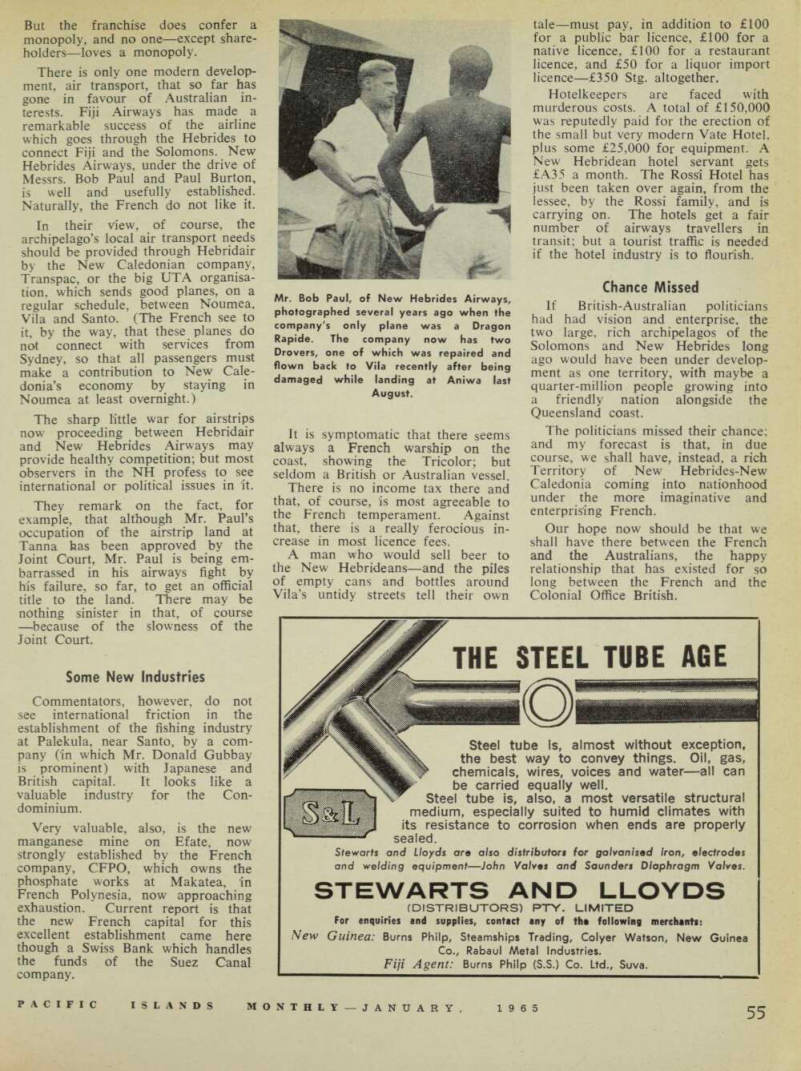
Mr. Bob Paul, of New Hebrides Airways, photographed several years ago when the company's only plane was a Dragon Rapide. The company now has two Drovers, one of which was repaired and flown back to Vila recently after being damaged while landing at Aniwa last August.