Fiji's Annual Spring Cleaning
pp. 32-34 · Read in the full issue
Was Dirtier Than Usual
From a Suva Correspondent The 10-day December sitting of Fiji’s Legislative Coun cil, one of the longest in its history, was an amalgam of tax and attacks, long wrangles on the Government’s plans for raising more money and sustained attacks on individuals, notably the Commissioner of Police, Mr. R. H. T. Beaumont.
IT is the council’s Budget meet ing which, every year, gives the members, particularly on the un official benches, golden opportunities for speech-making and helping in a general spring cleaning for the beginning of a new year.
It is a time for praising and blaming the Government, for plan ning and suggesting, for speeches good and bad, for attacking and defending and for playing politics.
The members did all these things in their 10-day marathon, and the Government replied, cajoled, de fended, attacked and apologised.
Yet it also laid some firm founda tions for the future, when Fiji paddles its own canoe.
Naturally, finance was the main topic, with the sixpenny basic tax the main bone af contention. And the bone was well chewed, but,
despite a vigorously sustained assault by the Indian members on the un official side, and, to a lesser extent, European member Mr. Freddie Archibald, and a couple of the Fijians, the tax became an ac complished fact.
Until there is a change in the In come Tax Ordinance, all the Colony’s residents, permanent ones and birds of passage, earning just over £lOO a year will pay the basic tax of sixpence in the f.
Fiji also now becomes the first country in the world to initiate a novel form of taxation called “They Pay as You Earn”, which will operate side-by-side with “You Pay as You Earn”.
The former, strenuously opposed by the Indian members, is a system whereby a worker, whose wage—after paying the 6d in the £—is below
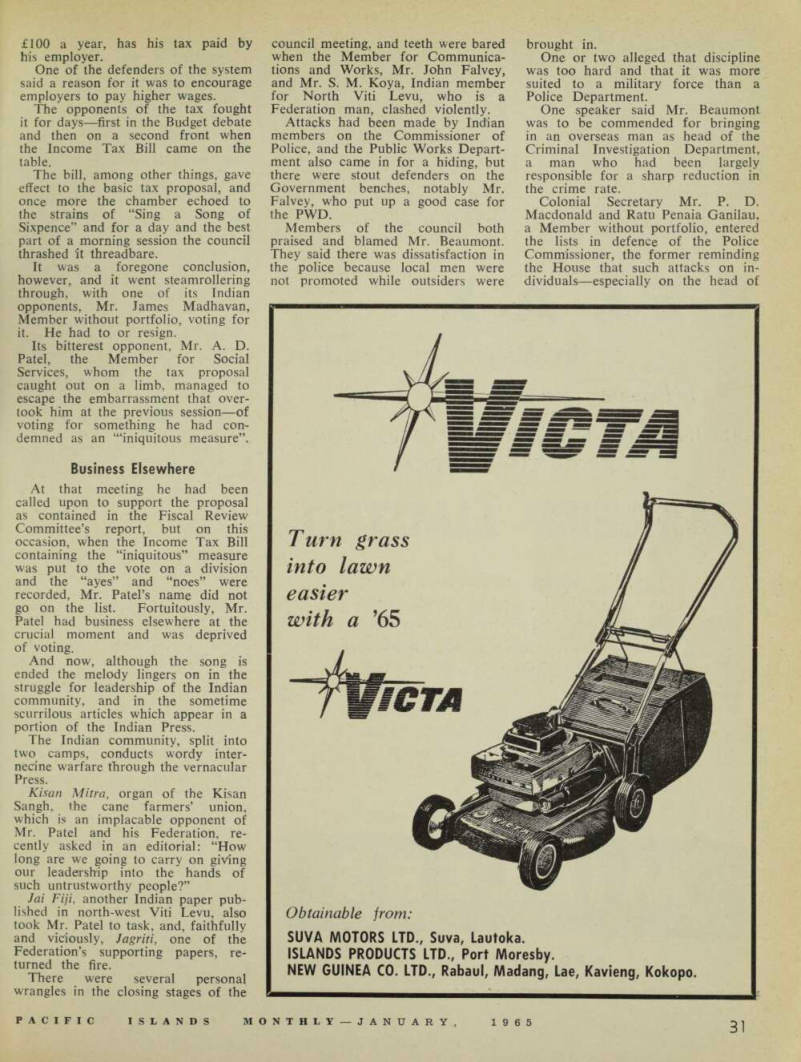
Even in the heat and humidity of Decem ber, Fiji's Legislative Council does not forgo the pageantry it has copied from the British Parlia ment. Here the wigged and robed Speaker of the Council, Mr. H.
Maurice Scott, wel comes the Governor of Fiji, Sir Derek Jakeway, to cere monies accompanying the opening of the Budget Session.
Photo: Rob Wright.
£lOO a year, has his tax paid by his employer.
One of the defenders of the system said a reason for it was to encourage employers to pay higher wages.
The opponents of the tax fought it for days—first in the Budget debate and then on a second front when the Income Tax Bill came on the table.
The bill, among other things, gave effect to the basic tax proposal, and once more the chamber echoed to the strains of “Sing a Song of Sixpence” and for a day and the best part of a morning session the council thrashed it threadbare.
It was a foregone conclusion, however, and it went steamrollering through, with one of its Indian opponents, Mr. James Madhavan, Member without portfolio, voting for it. He had to or resign.
Its bitterest opponent, Mr. A, D.
Patel, the Member for Social Services, whom the tax proposal caught out on a limb, managed to escape the embarrassment that over took him at the previous session—of voting for something he had con demned as an ‘“iniquitous measure”.
Business Elsewhere At that meeting he had been called upon to support the proposal as contained in the Fiscal Review Committee’s report, but on this occasion, when the Income Tax Bill containing the “iniquitous” measure was put to the vote on a division and the “ayes” and “noes” were recorded, Mr. Patel’s name did not go on the list. Fortuitously, Mr.
Patel had business elsewhere at the crucial moment and was deprived of voting.
And now, although the song is ended the melody lingers on in the struggle for leadership of the Indian community, and in the sometime scurrilous articles which appear in a portion of the Indian Press.
The Indian community, split into two camps, conducts wordy inter necine warfare through the vernacular Press.
Kisan Mitra, organ of the Kisan Sangh, the cane farmers’ union, which is an implacable opponent of Mr. Patel and his Federation, re cently asked in an editorial: “How long are we going to carry on giving our leadership into the hands of such untrustworthy people?”
Jai Fiji, another Indian paper pub lished in north-west Viti Levu, also took Mr. Patel to task, and, faithfully and viciously, Jagriti, one of the Federation’s supporting papers, re turned the fire.
There were several personal wrangles in the closing stages of the
council meeting, and teeth were bared when the Member for Communica tions and Works, Mr. John Falvey, and Mr. S. M. Koya, Indian member for North Viti Levu, who is a Federation man, clashed violently.
Attacks had been made by Indian members on the Commissioner of Police, and the Public Works Depart ment also came in for a hiding, but there were stout defenders on the Government benches, notably Mr.
Falvey, who put up a good case for the PWD.
Members of the council both praised and blamed Mr. Beaumont.
They said there was dissatisfaction in the police because local men were not promoted while outsiders were
brought in.
One or two alleged that discipline was too hard and that it was more suited to a military force than a Police Department.
One speaker said Mr. Beaumont was to be commended for bringing in an overseas man as head of the Criminal Investigation Department, a man who had been largely responsible for a sharp reduction in the crime rate.
Colonial Secretary Mr. P. D.
Macdonald and Ratu Penaia Ganilau, a Member without portfolio, entered the lists in defence of the Police Commissioner, the former reminding the House that such attacks on in dividuals—especially on the head of
one of the security forces— would not be tolerated in the British House of Commons.
Mr. Koya enlarged upon com plaints against persons and things— all reminiscent of pre-independence days in other one-time colonies when the main aim was to demolish the image of the empire-builder. He also advocated a commission for the judiciary and control over the police.
Mr. Falvey reproved him for what he called a political move and an attempt to impose political control, alleging that Mr. Koya was proposing —perhaps not intentionally, he added
magnanimously—that “certain things we hold sacred should be the subject of political interference”.
Mr. Koya protested that he was innocent of any such intention and that politics had never come into it.
He attempted to demonstrate the purity of his intentions later when he moved that the Government be requested to make necessary inquiries and advise the Secretary of State as to the desirability of establishing for Fiji a Judicial and Legal Commission on the lines of the Mauritius Judicial and Legal Commission.
During his speech he suggested
Mr. Falvey might like to apologise to him for his accusation that he had advocated political interference.
Mr, Falvey refused and threw a cat among the pigeons when he again attacked Mr. Koya and his motives.
Mr. Koya fumed and accused Mr.
Falvey of impugning his conduct and distorting his opinions. Then the scene faded.
It was not, altogether, Mr. Koya’s best meeting. On one occasion he made an oblique attack on The Fiji Times for what he called racialism, and advocated penal action against it, but later he discovered he had been throwing stones in a glasshouse when Attorney-General Mr. Justin Lewis quoted from a speech made at the September meeting by Mr. Koya when, the Attorney-General sug gested, he had also introduced racialism.
And that wasn’t the only occasion on which Mr. Koya found his words being turned against himself.
He suggested the Government Public Relations Officer should be a member of the Fiji Broadcasting Commission, a suggestion to which the Colonial Secretary replied by quoting a speech made at a previous meeting by Mr. Koya to the effect that the further away the FBC got from Government personnel the better.
All-in-all, the last couple of days of the session were colourful and far from dull.
The next session should be more interesting still, when unofficial members will be jockeying for position at the constitutional con ference table in London, when Fiji’s future will be in the balance.