Pacific Territories
pp. 11-12 · Read in the full issue
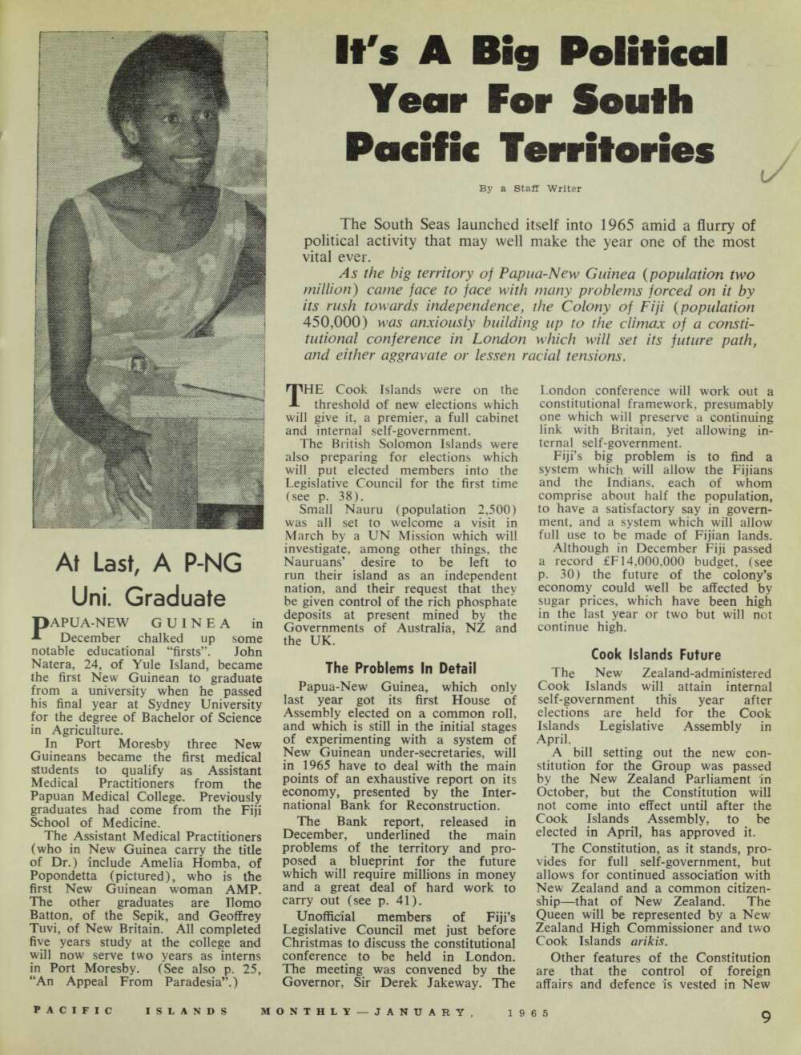
It's A Big Political Year For South Pacific Territories
By a Staff Writer
The South Seas launched itself into 1965 amid a flurry of political activity that may well make the year one of the most vital ever.
As the big territory of Papua-New Guinea (population two million ) came face to face with many problems forced on it by its rush towards independence, the Colony of Fiji (population 450,000) was anxiously building up to the climax of a consti tutional conference in London which will set its future path, and either aggravate or lessen racial tensions.
THE Cook Islands were on the threshold of new elections which will give it, a premier, a full cabinet and internal self-government.
The British Solomon Islands were also preparing for elections which will put elected members into the Legislative Council for the first time (see p. 38).
Small Nauru (population 2,500) was all set to welcome a visit in March by a UN Mission which will investigate, among other things, the Nauruans’ desire to be left to run their island as an independent nation, and their request that they be given control of the rich phosphate deposits at present mined by the Governments of Australia, NZ and the UK.
The Problems In Detail Papua-New Guinea, which only last year got its first House of Assembly elected on a common roll, and which is still in the initial stages of experimenting with a system of New Guinean under-secretaries, will in 1965 have to deal with the main points of an exhaustive report on its economy, presented by the Inter national Bank for Reconstruction.
The Bank report, released in December, underlined the main problems of the territory and pro posed a blueprint for the future which will require millions in money and a great deal of hard work to carry out (see p. 41).
Unofficial members of Fiji’s Legislative Council met just before Christmas to discuss the constitutional conference to be held in London.
The meeting was convened by the Governor, Sir Derek Jakeway. The
London conference will work out a constitutional framework, presumably one which will preserve a continuing link with Britain, yet allowing in ternal self-government.
Fiji’s big problem is to find a system which will allow the Fijians and the Indians, each of whom comprise about half the population, to have a satisfactory say in govern ment, and a system which will allow full use to be made of Fijian lands.
Although in December Fiji passed a record £F 14,000,000 budget, (see p. 30) the future of the colony’s economy could well be affected by sugar prices, which have been high in the last year or two but will not continue high.
Cook Islands Future The New Zealand-administered Cook Islands will attain internal self-government this year after elections are held for the Cook Islands Legislative Assembly in April.
A bill setting out the new con stitution for the Group was passed by the New Zealand Parliament in October, but the Constitution will not come into effect until after the Cook Islands Assembly, to be elected in April, has approved it.
The Constitution, as it stands, pro vides for full self-government, but allows for continued association with New Zealand and a common citizen ship—that of New Zealand. The Queen will be represented by a New Zealand High Commissioner and two Cook Islands arikis.
Other features of the Constitution are that the control of foreign affairs and defence is vested in New
Zealand; that the Cook Islands Cabinet will consist of a Premier and four other Ministers; and that a candidate for election to the As sembly must have resided in the Cook Islands for three years before the election.
The residential qualification for elections will debar Mr. Albert Henry, the leader of the Cook Islands Party, from standing for the April elections, as he only recently returned to Raro tonga from New Zealand (see p. 20).
However, it is possible that he may get into office before the year is out as the Assembly may repeal or amend any part of the Con stitution provided it has the support of two-thirds of its members at the second and third reading stages, and provided there is a lapse of 90 days between those stages.
The ease with which the As sembly could amend the Constitution has given concern to some New Zealanders, notably Sir Leslie Munro, formerly NZ’s arribassador to the United States and president of the UN General Assembly, and now a member of the Government party in the NZ Parliament.
In an article in the Auckland Weekly News (recently, Sir Leslie said that although any change made
to the Constitution by the Cook Islands Assembly would require the confirmation of the NZ Parliament, it could prove difficult for the Parlia ment to withhold this.
“Loyal to the Crown as they now are,” Sir Leslie added, “an un scrupulous demagogue might in future sway the Islanders, who are far from sophisticated politically.
An enemy from the north might seek to subvert the Cook Islands through intrigue and wholesale bribery. The islands, while con ventional war is still waged, are too important for us to confront these possibilities with equanimity.”
BSIP Elections The BSIP elections follow a White Paper published by the Government in October, 1963, and which was reported on by a special select com mittee of the Council last April.
Eight unofficial members out of ten in the Council are to be elected and the remaining two are to be nominated. Seven of the eight will be elected indirectly by an electoral college composed of elected members of local councils and the eighth, to represent Honiara, will be elected directly from a common roll.
There are 11 official members in the BSIP Legislative Council, which was created in 1960, plus the Western Pacific High Commissioner, as president.
Even when the Council first came into existence there was criticism of the fact that it contained no elected members.
The BSIP Government has an nounced that it plans eventually for a common electoral roll.
Bonay Loses Job
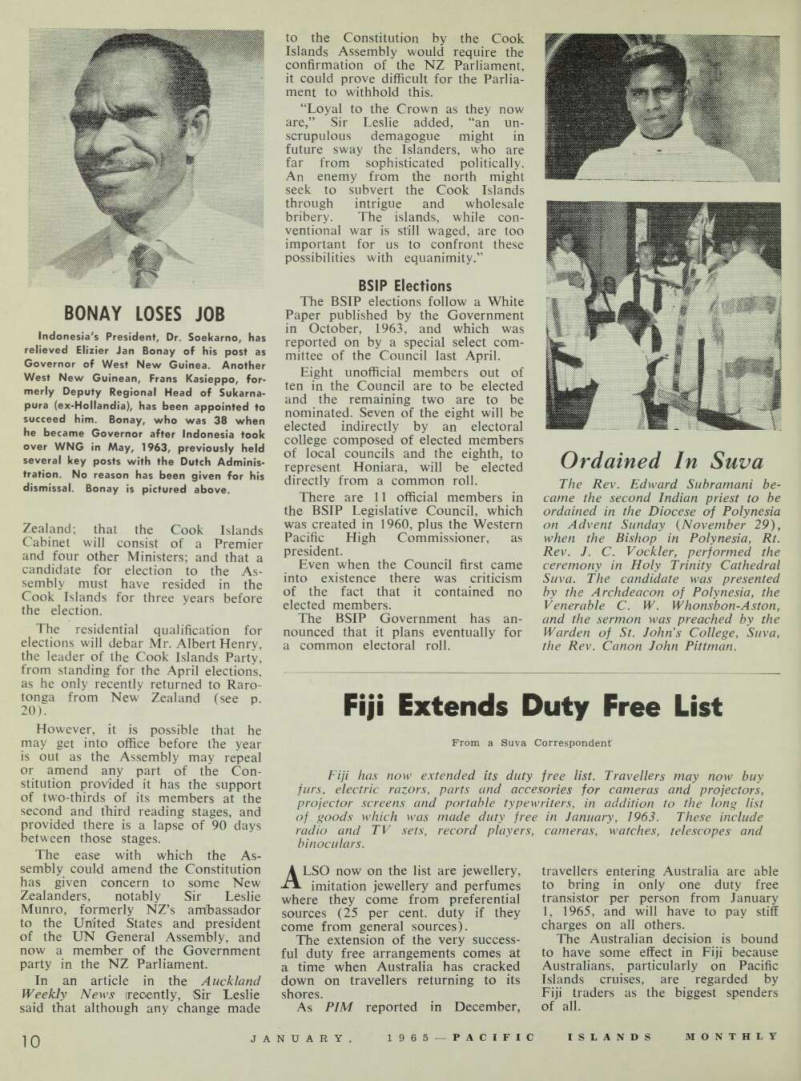
Indonesia's President, Dr. Soekarno, has relieved Elizier Jan Bonay of his post as Governor of West New Guinea. Another West New Guinean, Frans Kasieppo, for merly Deputy Regional Head of Sukarna pura (ex-Hollandia), has been appointed to succeed him. Bonay, who was 38 when he became Governor after Indonesia took over WNG in May, 1963, previously held several key posts with the Dutch Adminis tration. No reason has been given for his dismissal. Bonay is pictured above.
Ordained In Suva
The Rev. Edward Subramani be came the second Indian priest to be ordained in the Diocese of Polynesia on Advent Sunday (November 29), when the Bishop in Polynesia, Rt.
Rev. J. C. Vockler, performed the ceremony in Holy Trinity Cathedral Suva. The candidate was presented by the Archdeacon of Polynesia, the Venerable C. W. Whonsbon-Aston, and the sermon was preached by the Warden of St. John’s College, Suva, the Rev. Canon John Pittman.