Pacific Commerce and Produce
pp. 145-148 · Read in the full issue
It really pioneered and developed the Australian canned passionfruit industry, and it now exports the product to many countries.
Cottees (Fiji) Ltd. are now as sembling a processing plant in Sigatoka, near Nayawa village, on land made available through the Native Land Trust Board. They expect regular supplies of passion fruit from growers in the Valley.
Mr. Cottee has been taking an interest in this new industry—he made passionfruit seed available through the Fiji Department of Agriculture several years ago.
The establishment of the two new canneries is an important develop ment for Fiji.
It is possible that there will be competition for supplies of fruit between the two canneries, but Fiji comment is “the more the merrier— and the better for the new industry”.
It is worth noting, incidentally, that a daughter of the late Mr. Frank Exon and Mrs. Exon, who were well known residents of Suva over 20 years ago, married one of the Cottee brothers who have put the Cottee corporation so prominently on the industrial map.
Rarotonga Fruit Canning
The fruit-canning enterprise in Rarotonga, one of the more notable industries on that island, was established with the encouragement of the New Zealand Administration.
The factory at Avarua processes citrus fruit, tomatoes, pineapple juice, fruit salad and crushed pineapple.
The value of its exports in the year ended March last was £NZ286,000.
It maintains a pineapple-growing industry on the island of Mangaia, from where small ships carry cargoes of the world’s biggest, well-flavoured pineapples to the factory.
The Rarotonga enterprise has its troubles—mainly the result of mis calculation.
Buyers of cargo space from Auckland to Rarotonga complain that the cans sent up empty to the canning works bulk far beyond their true space value. So New Zealand cargo is either shut out, or the canning works have to close down now and again because the cans have not been shipped.
The Rarotonga canners therefore decided to make their own cans alongside the canning plant, and sought to buy half an acre of land there for the can-making equipment.
Thereupon the local native owners jacked up the price of the land from a couple of thousand pounds to £lO,OO0 —a completely impractical figure which brought about a stalemate. Now the canning industry, which should be providing employment and revenue for Raro tonga, is partly hamstrung.
Tuna-Canning
In American Samoa, tuna-canning has been under way at Pago Pago for several years. It is a steady, profitable industry, with Japanese and Korean fishermen providing the tuna and Americans providing the canning know-how.
Two companies have canneries there—Van Camp and Star-Kist.
The American Can Co., of New York, has a factory which supplies cans to both companies.
Van Camp has also established a tuna fishing industry at Koror in the Palau District of the United States Trust Territory, but there the fish are frozen not tinned. The same company may also establish a similar industry on Moen Island in the Truk District. A six-month lease for land on Moen Island was signed in November.
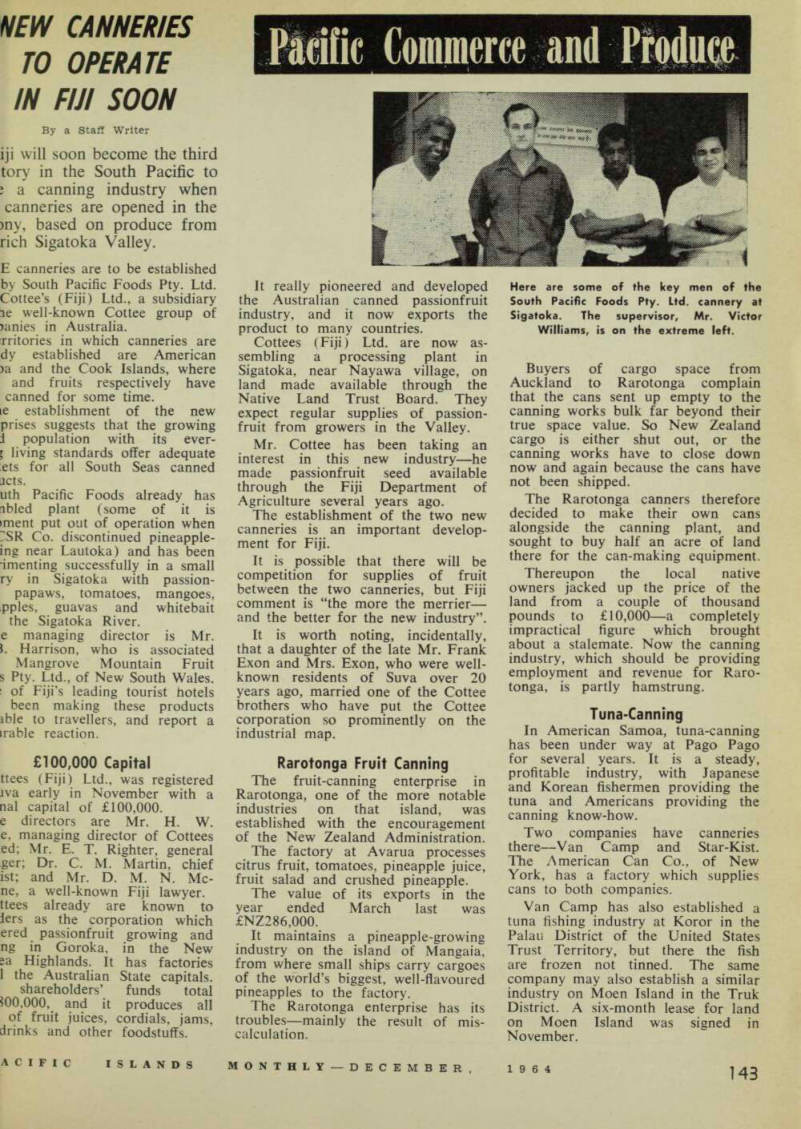
Here are some of the key men of the South Pacific Foods Pty. Ltd. cannery at Sigatoka. The supervisor, Mr. Victor Williams, is on the extreme left.
Speculation
Over NG Hotels
ANEW stage in proceedings to establish the legal ownership of the Cecil (Lae), Goroka and Wau hotels, which are grouped together as the Hotel Cecil Ltd. and Morobe Hotels Ltd., of New Guinea, was taking shape in Sydney and in New Guinea at the end of November.
The outcome may not be known until early 1965.
When the finance organisation created in P-NG a few years ago by Mr. L. F. McEachern, was re arranged a number of local com panies were brought together as Hamac Ltd., directed by Mr. Mc- Eachern. One of the companies was Morobe Hotels Ltd. Hamac en countered financial difficulties, which eventually forced it into liquidation on April 1, 1960.
A complex situation developed.
Eventually, the Supreme Court of P-NG released the group from liquidation, on October 6, 1961, when a concern called the Papua-New Guinea Development Corporation gave to a number of the Hamac creditors a series of notes, A, B and C, acknowledging the debt and pro mising to pay.
Deed Of Trust More trouble developed, however, when a section of the creditors would not accept these notes. The Chief Justice then made it a condition of the release that the dissenting credi tors be paid in full, together with interest at 8 per cent., by September 30, 1962. Their rights were to be protected by a Deed of Trust, and Mr. James Cromie (a leading solicitor) and Mr. B. C. Goodsell (general manager of Burns Philp in the Territory) were appointed trustees.
The debts (a total of £58,000) were not paid as stipulated. The trustees then appointed Mr. A. H.
Carter as Receiver to take charge of the Hamac assets, and especially Morobe Hotels Ltd. and the Hotel Cecil Ltd. Other assets did not appear to interest the Receiver. (The position was described in de-
tail in PIM of October, 1962, page 165.) The general permission given to P-NG natives to drink beer added considerably to the trading profits of the hotels. From October, 1962, up to October, 1964, the trustees were able to discharge the whole debt of £58,000 due to dissenting creditors.
It then was noted that the accrued interest, amounting to £17,000, had not been paid. Also, a new Territory licensing authority now is insisting that the hotels be substantially im proved, in certain respects. It also was noted that the trading liabilities which were suspended in October, 1962, when the Receiver took over, had to be provided for.
One suggestion was that the Re ceiver should carry on until all these further liabilities could be discnarged.
But one report has it that the trustees, at this stage, would prefer to forego the interest payments and end the Receivership and get out of the
picture, as on January 31, 1965; there is to be a formal meeting tween trustees and dissenting credi in January.
But new complications have peared. To whom should Mor Hotels Ltd, be handed over, w the Receivership ends?
Back in 1962, it was reported i Mr. McEachern had acquired an terest in Sangara Holdings Lim (originally a NG mining compai through the sale of a large parcel shares in Morobe Hotels Ltd.
Sangara. A claim has been m that that share deal can be d lenged, on legal or technical groui Early in 1964 someone actively buying Sangara shares. A a time, Sangara shares were remo from the trading lists of the Syd Stock Exchange. It then was closed that the buyer of Sanj shares was Mr. Stanley Eskell, Ml formerly managing director of Sc Pacific Post Ltd., of Port Mores and now the head of a large fina corporation in Sydney.
Recently, Mr. Eskell has been pointed managing director of Sangi and there are indications that h< acting on behalf of Sangara in lation to the affairs of Morobe Ho Ltd.
For example, he now is a dire( of Morobe Hotels Ltd.; and he given some comforting assurances cently to Mrs. Flo Stewart, of I who sold the Hotel Cecil to Mor Hotels Ltd., and who still was o\ £17,000 by that company when passed into the Receiver’s control 1962.
Three Hotels It would appear therefore that and when, the three hotels are pas back to Morobe Hotels Ltd., the c trol of that company will be clair by Sangara.
But an unknown factor in a c( plicated set-up is Mr. McEache There is some connection betw Sangara, which apparently acqui an interest in Morobe Hotels 1 or three years ago, and Sandy Cn Ltd., in which Mr. McEachern came interested a little later on. 1 McEachern became interested also the Cosmopolitan Hotel, Rabaul; s he has been there as manager the last year or two, during currency of the Morobe Hotels \ ceivership. There is a general exp tation that Mr. McEachern now i advance a claim to the Mon Hotels property, through eit Sangara, or Sandy Creek, or both Developments in relation Morobe Hotels Ltd., plus the
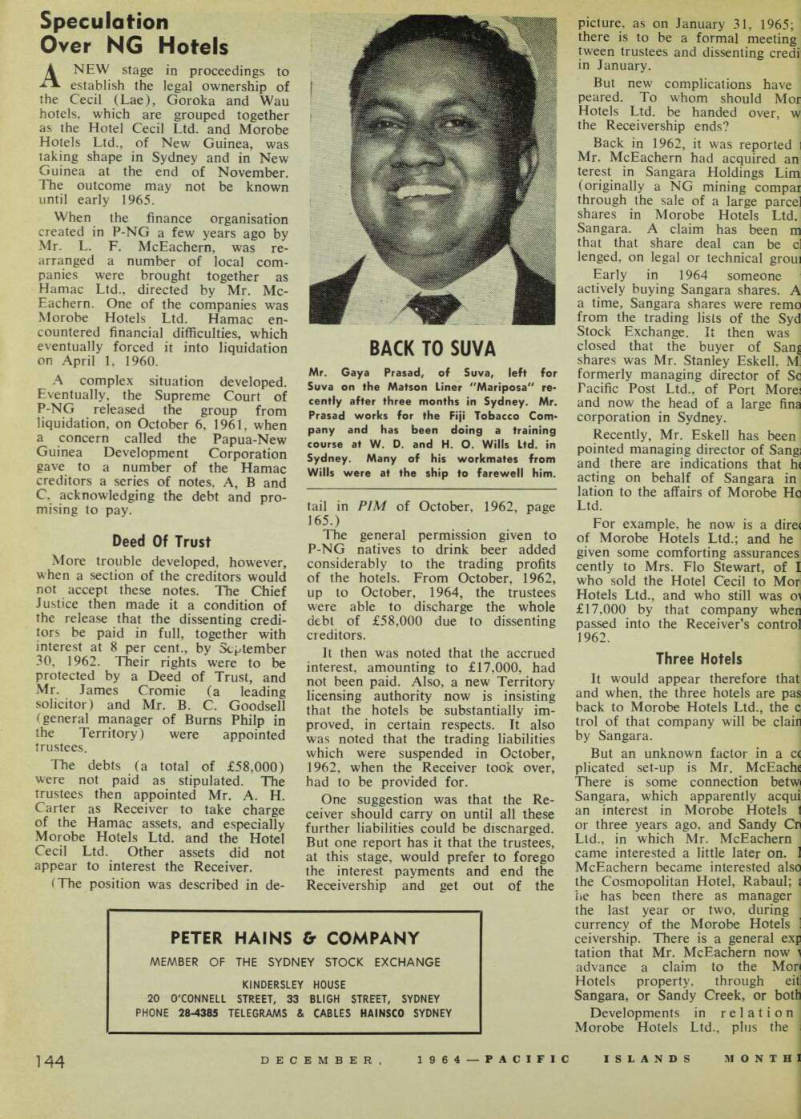
Back To Suva
Mr. Gaya Prasad, of Suva, left for Suva on the Matson Liner "Mariposa" re cently after three months in Sydney. Mr.
Prasad works for the Fiji Tobacco Com pany and has been doing a training course at W. D. and H. O. Wills Ltd. in Sydney. Many of his workmates from Wills were at the ship to farewell him.
)unced decision of Steamships Trad g Co. Ltd. to build a modern, st-class hotel at Lae, suggest that long last the Territory is about be given much better accom odation for travellers.
iopra Prices
emain Steady
•OPRA prices on the London mar -1 ket in November averaged tg.72/2/4 a ton CIF delivered ights UK/Continent for the first If of the month. This compared >re than favourably with the ;rage for October of £Stg.7o/15/-.
At the recent Congress of the In national Association of Seed ushers, held in Wiesbaden, the sociation president, Mr. C. A. C.
Boinville, in his review for the ir commented: ‘Perhaps the outstanding feature the world’s oils and fats situation 1963 was the failure of world iduction to reach the 1962 level, is contrasts sharply with increases a million tons in each of the vious two years and it is in fact years since the level of world Auction in one year failed to eed that of the previous year.
World olive oil production fell in 3 by nearly half a million tons, rine oils were 160,000 tons lower world supplies of rapeseed oil lined by some 30,000 tons.
Production Down Butter production was down by rly 90,000 tons because of marked jctions in the USA and Russia, •eased production of other oils fats was insufficient to offset e very sharp reductions, resulting a world total in 1963 of r 30,000 tons, or marginally less \ Jhe 1962 figure of 33,815,000 Ir. de Boinville also told the gress that: World annual production of oils fat is now running at a level of □st 34 million tons. This pro s an average intake per head of Id population of some 10 kg )rox. 22 lb) per year, n Africa and Asia it is less than that amount and in Western )pe and the United States it is Die. Production would therefore ! to be increased two-fold if yone were to receive as much |ie European or American. !uch an expansion will need a ssal effort, but even so it will be enough in 10 years’ time if remembers that world population
will then have increased by a further 25 per cent.”
The deputy chairman of the Papua and New Guinea Copra Marketing Board, Mr. K. G. Oliver, reported in Port Moresby in late November that the Territory’s copra production for 1964 should top 111,000 tons, compared with 106,700 tons for 1963.
To the end of October, P-NG pro duction was 95,130 tons, compared with 90,370 tons for the same period last year.
Tentative prices for copra delivered to the Board’s storage points re mained unchanged in November at £A6I/10/- for hot air; £6O for FMS and £59 for smoke.
The chairman of the P-NG Board, Mr. lan McDonald, who has been overseas for several months, will re turn to the Territory in early December.
Fund To Be Used
To Buy Sugar Shares
■FIJI’S Legislative Council approved a bill in November to enable sugar cane growers to use money from a Capital Development Fund to buy shares in South Pacific Sugar Mills Ltd., which owns the four sugar mills in the Colony.
The Financial Secretary, Mr. H. P.
Ritchie, said it was the Government view that it was in the national interest that it should be possible to use money from the Fund to purchase these shares.
By 22 votes to 3 with two abstentions, the Council defeated a motion asking Government to obtain a director vote from cane growers and millers on whether it was their wish that the Sugar Price Stabilisa tion Fund should be wound up and the money in it distributed.
The Fund was set up to cushion the industry against any severe fall in price.
An Indian member, Mr. C. A.
Shah, who moved the defeated motion, said he had brought it so that the voice of the cane farmers could be heard. He asked for per mission to withdraw it but his seconder, Mr. A. I. N. Deoki, would not agree.
South Pacific Sugar Mills, which is a subsidiary of the Colonial Sugar Refining Company of Austialia, has offered to the people of Fiji five million 5/- shares in their Fiji com pany.
The offer is at par, with CSR paying the transfer fees. It is con fined to residents of Fiji and Fiji based companies.
The invitation to Fiji people to
share in the ownership of CSR interests in the Fiji sugar industry was recommended by the Trustram Eve Commission, which investigated the affairs of the industry in 1961.
Flour Mill Plans
For NG, Fiji
A DECISION is expected to be made in Port Moresby in early December which will settle an argu ment over the proposed leasing of a half an acre of possible wharf stor age space in the town for the erection of a flour and rice mill.
Gillespie Bros. Pty. Ltd., flour millers, of Pyrmont, Sydney, W. R.
Carpenter, the Rice Growers’ Asso ciation of NSW, and United Bakers, Port Moresby, were tendering as a group for the lease. An improvement covenant of £50,000 calls for the erection of a flour and rice mill within 12 months.
The tender announcement in October touched off protests from some Port Moresby commercial in terests and the Town Advisory Council, which claimed that space on the foreshores should not be used for the mill as this was needed for extension of cargo facilities.
The Land Board will consider the tender in the first week of December.
Meanwhile, flour milling interests in Australia, and even Hong Kong, have been keeping an eye on Suva in the hopes of setting up a flour mill there.
Several approaches have been made to the Fiji Government for protection, but the Government has
considered the concessions sought are more than could reasonably be granted.
At least one application to estab lish a mill in Suva has been with drawn; a NSW company recently applied for protection, and two others are believed to be considering an approach.
First Dividend For
Nine Yeors
THE directors of Emperor Mines Ltd., the Fiji gold-mining com pany, announced in November that they would recommend the payment of a dividend of 3d a share on the issued capital of the company at the annual meeting of shareholders in Melbourne on December 11.
The dividend would absorb £27,837/10/-, and would be the first since 1955.
The company’s net profit for the year ended June 10, 1964, was nearly double that of the previous year.
It was £A38,393, against £20,805 in 1963.
Record Traffic
Figures For TEAL
THE New Zealand airline TEAL made a net profit of £205,382 for the year ended March 31, 1964, compared with £10,958 for the pre vious year.
Passengers rose by 20.67 per cent, to reach an all-route record figure of 123,489; and 35.71 per cent, more air cargo was carried.