Pacific Shipping And Cruising Yachts
pp. 99-107 · Read in the full issue
Cruising Yachts
Australia To Give £lO,OOO For New "Endeavour" Project
The Australian Government has decided to give £lO,OOO towards a project to sail a replica of Captain Cook’s Endeavour from England to Australia in 1970, to mark the 200th an niversary of Cook’s first voyage to the Pacific.
rHE gift was announced in Federal Parliament on November 17, >y the Federal Treasurer, Mr. Harold Jolt. He said the Government had >een asked for a contribution by a lelegation led by Vice-Admiral Sir ohn Collins (RAN, Ret.).
Sir John Collins is chairman of the IMS Endeavour Trust Fund which vas launched in Sydney in March PIM, April, p. 97) to raise money or the Endeavour II voyage. About 250,000 is expected to be needed for he project.
The Endeavour 11 will be com aanded by veteran Australian sailing hip skipper and author, Captain Uan Villiers.
Sir John Collins said in a letter o Sydney newspapers recently that ; was planned to sail the replica of he Endeavour to the Pacific to each Botany Bay on or before the icentenary of Captain Cook’s land
ing at Botany Bay in 1770. After that the ship would be maintained as a national maritime museum in Sydney.
He said the replica would be built in one of the shipyards in the north of England and would be sailed to Australia via the Atlantic, Cape Horn, and some of the Pacific Islands, arriving in New Zealand in December, 1969.
Sir John went on; “The vessel would then sail from New Zealand to Sydney and/or Botany Bay to arrive not later than January, 1970, so as to be available for any bicentennial celebrations which the Commonwealth Government and the Government of New South Wales may arrange.
Seasoning
“This may seem in the rather distant future, but it is necessary now to select the English oak with which the Endeavour replica will be constructed, have it cut and hewn to size and thoroughly seasoned for nearly two years.
“The ship has then to be built, rigged, manned and sailed to Aus tralia so that, if she is to arrive for the bicentenary celebrations, a start must be made forthwith.
“The trustees of the HMS Endeavour Trust, as at present con stituted, are myself as president, A. E. Bax (president, Royal Aus tralian Historical Society), A. H.
Chisholm, R. A. Dickson, Judge H. T. E. Holt (Captain Cook’s Landing Place Trust), A. M. Mac- Sween, Mr. Justice J. H. McClemens (National Trust of Australia), A. J.
Villiers, and W. C. Wentworth, M.P.
“The responsibilities of the trustees are to receive donations and sub sequently make them available to a non-profitmaking company, which will be styled “Captain Cook’s Endeavour Ltd”. This latter body will carry out the business functions of building the replica of the ship, arranging her voyage and sub sequently establishing and maintain ing her as part of a national maritime museum.”
In a later statement. Sir John Collins said: “I think the plan is the best possible way of honouring Cook. It will inspire every Aus tralian.”
Commenting on the Australian Government’s decision to give £lO,OOO towards the cost of the Endeavour replica, Sydney’s Daily Telegraph said the projected voyage was “an imaginative gesture” which would celebrate “a great adventure in an adventurous way” and “should make most people realise Cook’s achievement more vividly than a hundred speeches.” (Over>
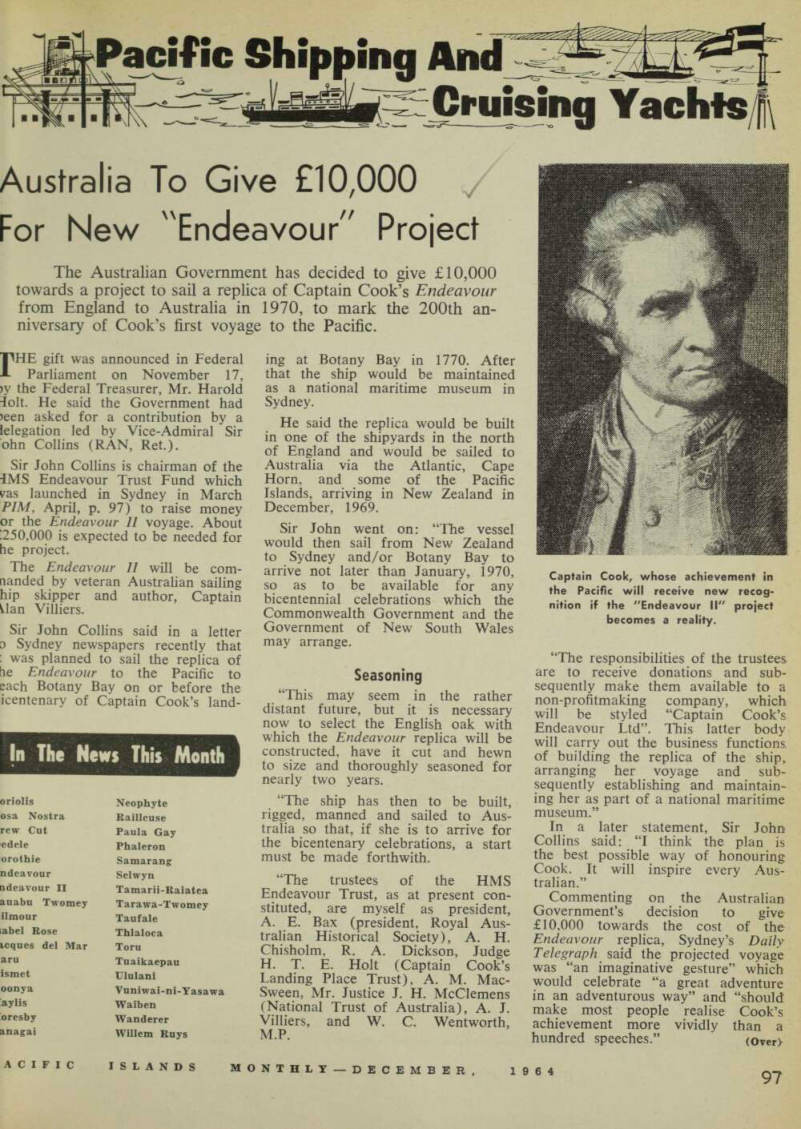
Captain Cook, whose achievement in the Pacific will receive new recog nition if the "Endeavour II" project becomes a reality.
Ship Bought For
New Hebrides
The New Hebrides trading com pany, Societe Maritime Vate, of Vila, has bought the Australian trading vessel Waiben for £55,000 for use in the Islands under the name of Jacques del Mar.
The Waiben, formerly Morialta, was built in Dundee in 1940. She has a gross tonnage of 1,379, net tonnage of 685, and accommodation for up to 50 passengers, and general and refrigerated cargo.
The ship was sold by Banks Bros, and Street, shipping and commercial brokers, on behalf of her owners, John Burke Ltd., of Brisbane.
New Ship For
Melanesian Mission
The 60 ft motor vessel Fauabu Twomey was scheduled to be com missioned about November 20 for the Melanesian Mission in the BSIP.
The new ship will replace one of the same name which was wrecked in Sealark Channel last December.
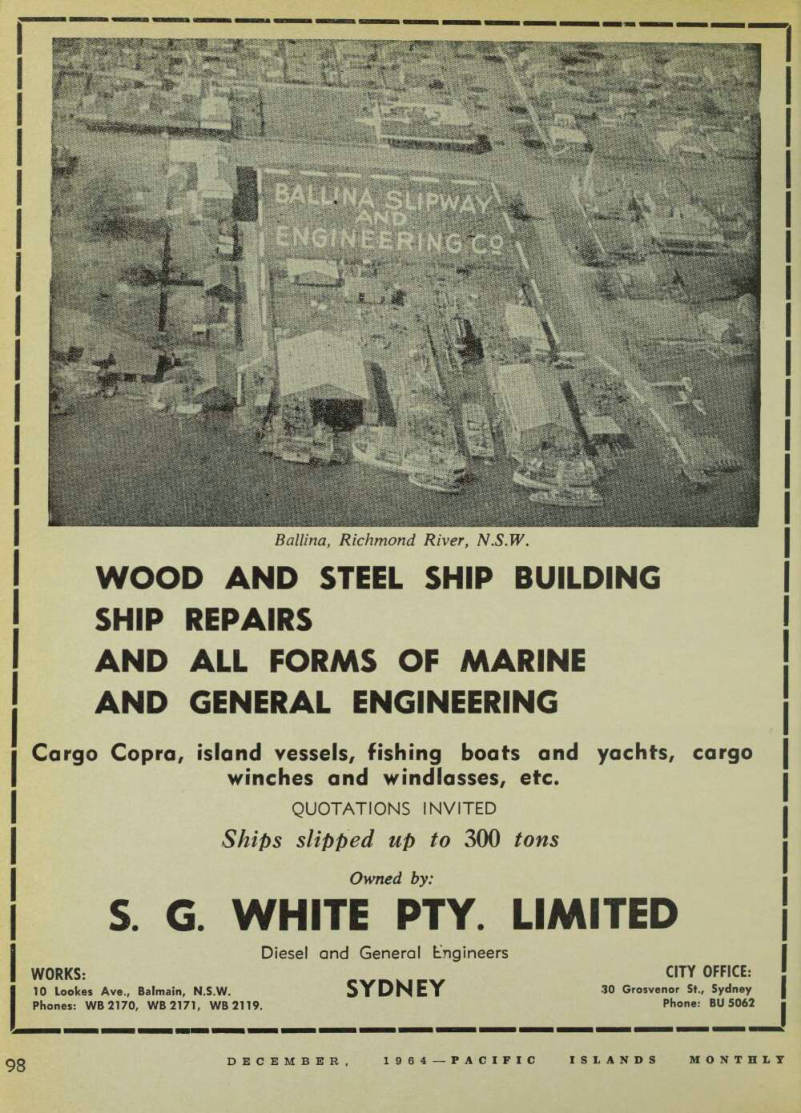
The new vessel was built by the Ballina Slipway and Engineering Co., and was the fifth that company had built for the Melanesian Mission.
She is powered by a 6-cylinder Gardiner diesel engine, and is equipped with a steadying sail.
A native crew was flown to Ballina from the BSIP for the delivery voyage, which is to be made under the command of Captain Langley.
The Fauabu Twomey is a hospital ship and will be stationed at Fauabu in Malaita. She is one of three ships engaged in work among the lepers to have the word “Twomey” in her name. One of the others is operated by the Roman Catholic Mission and the other by the Methodist Mission.
They were all named after the
late Mr. P. J. Twomey, of Christ church, NZ, who was secretary of the Leper Trust Board for many years, and who was well known for his work among the lepers of the Pacific Islands.
New Ships For
Nickel Company
In keeping with its plans to double the output of nickel from its smelters at Noumea, the Societe le Nickel is to order two new ships of 15,000 tons each.
The ships will be used to transport nickel ore from coastal mines in New Caledonia to the smelters at Noumea. The ships will probably also carry coke and coal from Aus tralia for use in the smelters.
At present, three ships of some 5,000 tons carry this cargo.
Grounded Ship
"Steered Badly"
A Marine Board of Papua in vestigation into the grounding of the MV Dorothie on the reef south of Jomard Island about 9 p.m. on July 11 showed that the ship was well found, but that she steered badly, possibly as a result of being trimmed by the head.
The P-NG Administrator, Sir Donald Cleland, released the board’s findings in November.
The board said the grounding was due, as far as could be ascertained, mainly to poor steering as a result of which the vessel did not make good the course which had been set after sighting Jomard Island light.
There was no negligence in the navigation of the ship but there was an error of judgment on the part of the Master, Captain Boulton, in that he failed to allow for the poor steering of the ship during the critical
period after sighting Jomard Island light.
The Dorothie, formerly Karu of the Union Steam Ship Company of New Zealand, was on a voyage from Sydney to Hong Kong, for delivery to new owners. She was laden with a general cargo.
The master and crew abandoned the ship the morning after the grounding. There was no loss of life.
Graciosa Bay To
Be Port Of Entry
The BSIP Collector of Customs, Mr. R. Burrow-Wilkes, issued a reminder in November that Peu, Vanikoro, has been closed as a port of entry for Customs purposes and that Honiara is the port of entry for the Eastern District for the time being. (PIM, Nov., p. 123).
Mr. Burrow-Wilkes added that the Government intended to open Graciosa Bay, Santa Cruz, as a port of entry in the Eastern Solomons early next year.
American Ship
Abandoned In Suva
Marine authorities in Fiji took over a United States ship found abandoned and sinking in Suva Harbour early in November.
The ship, the 89-ton Isabel Rose, is in the possession of the Receiver of Wreck, Mr. J. Burgess. Under the wreck and salvage laws he has power to retain the ship and her cargo until salvage expenses have been paid.
The Isabel Rose is owned by Pan Pacific Lines Ltd., a company registered in Honolulu.
She arrived in Suva about eight weeks earlier from Pago Pago and was to go on to the New Hebrides and Tarawa. She had a full load of
ieral cargo and about 200 drums petroleum products, including ation fuel, which was stowed on :k.
On November 3, harbour thorities noticed that the Isabel se appeared to be settling in the ter. rhe Assistant Harbour Master, plain P. G. Hough, and the United tes Consul, Mr. George Gray, irded the vessel. There was no iy on board and she was taking water fast. >he was taken in tow and brought ngside. The Fire Brigade pumped ter from the ship and her cargo s unloaded. iarlier that day the crew had fered the United States flag and 1 rowed ashore with their be gings. fhe ship’s master is reported to r e left the ship several days earlier ;r complaining that he had two nths’ wages owing to him. )n November 5, Mr. Burgess said t in the opinion of qualified men Isabel Rose, on November 3, had n sinking and had been abandoned her crew. ?here was nobody on board and ship, was, therefore, a ship in ress within territorial waters.
Action had been taken to save the ) and her cargo, and under the ick and salvage laws he had power retain the ship and her cargo il the salvage expenses had been 1 le offered to release the cargo if indemnity was given for the r age costs involved.
He emphasised that the ship and cargo, valued at thousands of pounds, would probably have been under the water if action had not been taken to save the ship.
Mr. Gray said he had asked the Fiji Marine Board to arrange a survey of the ship.
Pilgrimage To
Minerva Reef
Captain Tevita Fifita, one of the heroes of the Minerva Reef epic of a couple of years ago, revisited the reef in late October as skipper of the Tongan yacht Taufale.
The Taufale, which belongs to Mr, Tofa Ramsay, of Nukualofa, was en route to Auckland.
Mr. Ramsay, who was a passenger to Auckland, was also the owner of the yacht Tuaikaepau, which was
wrecked on Minerva Reef on July 7, 1962, while Captain Fifita was in command.
After Fifita and his all-Tongan crew of 16 had waited on the reef for more than 90 days, Fifita and two companions set off to seek help in a make-shift outrigger canoe in which they reached the Fijian island of Kadavu. One of the castaways on the reef, Fatai Efiafi, died before help came.
While Fifita was at Minerva Reef in October, he and his crew picked up a number of personal belongings of the men from the Tuaikaepau.
These included an iron cooking pot used to distil fresh water, tools and a wood cutter used to cut timber from the wreck of a Japanese trawler in which the castaways lived.
Fifita told the Auckland Press that the wreck had moved about 10 ft since 1962. He added that he and his crew had put a new cross on the grave of Fatai Efiafi.
Trading Schooner
Wrecked At Huahine
The trading schooner Tamar ii Raiatea, which ran on a regular schedule between the Leeward Islands of French Polynesia, went aground on a reef at Huahine on the night of November 3 and became a total loss.
The passengers were taken off without difficulty next morning and later the cargo and much of the gear were removed.
Heavy rain had reduced visibility almost to nil at the time of the accident.
Captain Fifita.
Fork On Madang Wharf
0 Start Soon
Work on a new main wharf for ladang is expected to begin in inuary. The wharf will be of steel id concrete and will replace the ■esent wooden structure. It will be jilt in three stages over six years.
The new wharf will overlap the dsting wharf by 990 ft on the estern side and 200 ft on the east.
Two large cargo sheds will be part 1 the first stage of construction.
Cean Research Ship
)R New Caledonia
A newly-constructed ocean re arch ship, Coriolis, left France cently for New Caledonia, where it 11 be based for missions in the rrounding waters.
About 120 ft long, this 460-ton ssel has a crew of 18 and a ientific team of 11, who will—with e aid of modern laboratories on »ard —study the quality of the sea iter, the quantity of vegetable ankton in it, and the various types fish.
Shermen Rescued
10M Cay
The Burns Philp trading ship ?dele rescued a party of fishermen i November 6 who took refuge on amble Cay, about 230 miles west Port Moresby, after their vessel nk earlier in the day.
The fishermen, believed to number were all from Cairns, Queens
land. Their ship was the Trader Horn, owned by Whittaker Bros., of Cairns.
The Trader Horn was fishing for barramundi in Australian waters near Bramble Cay, which is about 20 miles from Daru, when she notified all shipping in the area that she was taking water fast and in great danger of sinking.
The Dedele, which was on a voyage from Port Moresby to Daru, immediately went to the rescue.
But by this time the ship had almost sunk.
Meanwhile, the crew had taken to the lifeboats and had made for Bramble Cay, which is an outcrop of reef barely above water level in Torres Strait.
Four days later, the Royal Aus tralian Navy survey ship HMAS Moresby went to the rescue of the fishing vessel Phaleron which hit a reef after standing by the partly sunken Trader Horn in the hope of salvaging her.
The Phaleron was on her way to Daru when she hit a reef about 100 miles north of Thursday Island.
It was not immediately known whether any of the crew were injured or how badly damaged the ship was.
Jet Boat For G.E.I.C.
Medical Work
Medical officers in the Gilbert Islands will no longer have to travel by canoe to carry out mercy missions, following the arrival at Tarawa re (Over)
"Chicken Of The Sea"
These healthy tuna were caught off the coast of Rarotonga in October. The coasts of Rarotonga—probably because the big island is the peak of a long-sunken volcano—go nearly straight down, and the fishing around the coasts generally is not exciting. But there is plenty of pro tein in the deep seas further out and— as the Japanese have been demonstrating since the war—tuna can be caught in large quantities.
ntly of the jet boat Tarawa vomey, which was bought by the ;w Zealand Lepers’ Trust Board for ;dical service in the Gilberts.
The Tarawa Twomey, which was ilt in Christchurch, had its final al before shipment on Lake yndwr where it was dedicated by i Dean of Christchurch, the Very •V. Alan Pyatt, and accepted on half of the Gilbert and Ellice ands Colony Government by Mr. ichael Bernacchi, a former Resident •mmissioner in the GEIC.
The boat is named after the late *. P. J. Twomey, founder of the pers’ Trust Board.
W Fisheries Laws
R Fiji
Fiji’s Legislative Council passed bill in November designed to l elop the Colony’s fishing potential i to conserve inshore fisheries by ihibiting the use of small mesh s and the taking of undersize fish. \ European member, Mr. C. D.
Iney, criticised the bill as in nate and incapable of enforce nt; while an Indian member, Mr.
M. Koya, contended that the mges would take away the freedom small fishermen in the Colony, ie also expressed opposition to the servation of Fijian customary ing rights because, he said, they Id not be enforced and they pro ed ill-feeling between different es in Fiji.
Replying, the Member for Natural ;ources, Ratu K. K. T. Mara, said had an assurance from the Depart it of Agriculture that the new s could be policed. He added t was Government policy to tect Fijian customary fishing its.
Iislation Likely On
Latable Life Rafts
he Papua-New Guinea Admini tion is considering the intro tion of legislation to require ids in the coasting trade to carry itable life rafts. he projected legislation would /ide that if a vessel was: Proceeding more than 10 miles from land, enough rafts would have to be provided for every person on board, in addition to or in lieu of other types of
life-saving apparatus.
Engaged in voyages not more than 10 miles from the nearest land, rafts would have to be pro vided for at least 25 per cent, of the persons on board, in addition to other approved types of life saving appliances.