yesterday
p. 89 · Read in the full issue
A conference in Canberra in December, 1944, on the indentured labour system in Australia’s Pacific territories did not approve the immediate abolition of the system, although the Territories Minister, Mr. E. J. Ward, said his Govern ment intended to abolish it as soon as practicable. Delegates said that immediate abolition would lead to confusion and economic disaster, and would do the natives a great disservice.
A STORY giving details of what was said at the Canberra conference was the piece de resistance in PIM for December, 1944. Other items in that issue of 20 years ago were: A regular weekly air-mail service was established between Western Samoa and New Zealand. ♦ * ♦ Mr. Alec C. Rentoul, one of the Senior Resident Magistrates of the Papuan Administration, re signed to become Acting Com mandant of Police and British District Agent at Vila, New Hebrides. * ♦ * At a meeting of the Royal Society of New South Wales, Sir Walter McNicoll said that after the war Papua and New Guinea should be under one administra tion. Sir Walter was Administrator of New Guinea between 1934 and the Japanese occupation in 1942. ♦ * * The well-known Islands trading firm of C. Sullivan and Co. was incorporated as C. Sullivan Pty.
Ltd., with Mr. C. Sullivan as man aging director. Mr. Sullivan then had more than 25 years in the Pacific Islands trade. ♦ ♦ ♦ Mrs. C. F. Rich, wife of the Rev. C. F. Rich (both of whom spent their lives in LMS mis sionary service on the south-east coast of Papua) died in Sydney on December 8. Her funeral was attended by many residents of Papua. * * * Admiral Sir Bruce Fraser, C-in-C of the newly-created British Pacific Fleet, arrived in Melbourne. The fleet was expected to be based initially in Sydney and Melbourne, and was to operate under United States command.
The Administrator of Western Samoa, Mr. A. C. Turnbull, laid a foundation stone for a new Anglican church at Apia to com memorate the 50th anniversary of the death of Robert Louis Steven son. The church was built immediately below Stevenson’s grave on Mt. Vaea.
The assassination in Cairo of the British Minister, Lord Moyne, reminded a writer in the Tropicalities section of the con troversy, several years earlier, over who discovered New Guinea’s pygmies.
“In 1935-36,” the writer said, “Lord Moyne, with a cross section of the British aristocracy as his guests ... in his 700 ton luxury yacht Rosaura . . . went up the Ramu River, in the Man dated Territory, and subsequently published stories which indicated that they had been responsible for discovering a tribe of pygmies there.
“As far back as 1896-1901, the old German New Guinea Com pany had expeditions out in that district under a Dr. Lauterbach, a man called Tappenbeck, and others. Some of these parties claim to have reached the Bismarck and Hagen Ranges, and ... if they did really penetrate this country, it is probable that they came into contact with the pygmies. I have a vague idea that I have seen
pictures of these pygmies near Atemble in a magazine published in 1902.
“However, whoever it was who first saw the pygmies, it certainly was not Lord Moyne and party.
And whatever the early ex peditions may have learned of them, the late Father Kirschbaum seems to have been the first Euro pean to study them and their language.” ♦ * * For the first time since the inauguration of the Pacific Terri tories Association, more than 2i years earlier, the executive had some positive progress to report at a quarterly meeting in Sydney.
Referring to a recent Common wealth Government decision to amend the War Damage to Property Regulations to include “indirect” war damage, Mr, E.
A. James, the president, said that the existence of the association had been justified by that one decision.
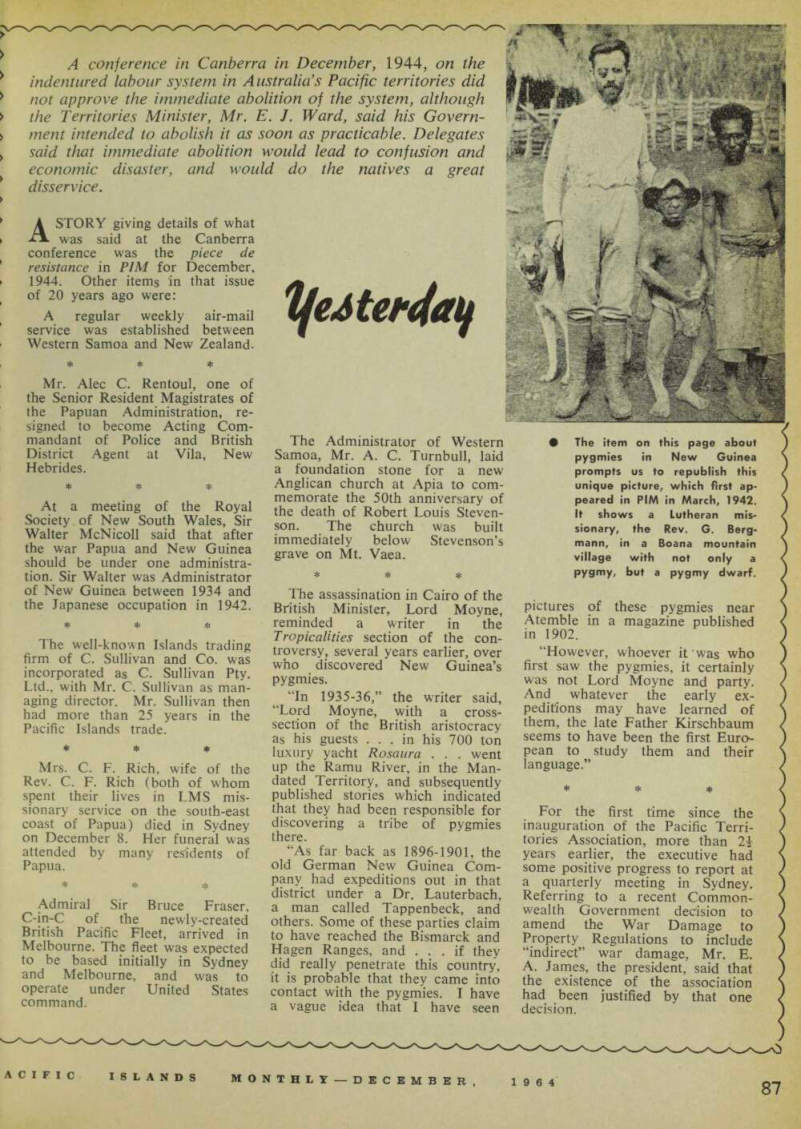
The item on this page about pygmies in New Guinea prompts us to republish this unique picture, which first ap peared in PIM in March, 1942.
It shows a Lutheran mis sionary, the Rev. G. Berg mann, in a Boana mountain village with not only a pygmy, but a pygmy dwarf.